About Me

My photo
I have a burning need to know stuff and I love asking awkward questions.

Friday, December 23, 2005

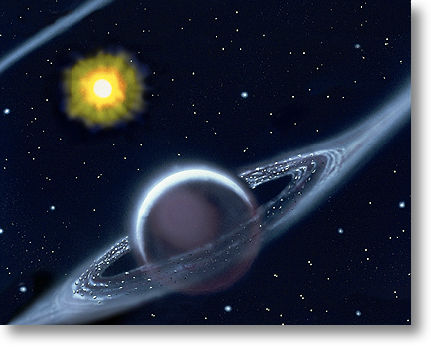
Life's ingredients circle Sun-like star

From New Scientist 22 December 2005

The first evidence that some of the basic organic building blocks of life can exist in an Earth-like orbit around a young Sun-like star has been provided by NASA's Spitzer Space Telescope. Spitzer took infrared spectrograms of 100 very young stars in a nearby stellar nursery, a huge cloud of dust and gas 375 light years away in the constellation Ophiuchus. And one of those stars showed signs of the organic molecules, acetylene and hydrogen cyanide. These gases, when combined with water, can form several different amino acids. These are needed to form proteins, as well as one of the four chemical letters, or bases, in DNA, called adenine.

The organic molecules were detected in a ring of dust and gas circling a young star called IRS 46. Such dust rings, found around all of the young stars that were examined by the Spitzer telescope, are believed to be the raw material for planetary systems. The spectrographic data showed that the gases were so hot that they must be orbiting close to the star, approximately in its "habitable zone", the region where Earth orbits the Sun and where water is just at the borderline between liquid and gaseous states.

The detection supports the widely held theory that many of the molecular building blocks of life were present in the solar system even before planets formed, thus assisting the initial formation of complex organic molecules and the start of life itself. Observations earlier in 2005 by a different team using Spitzer showed that simpler organic molecules, called polycyclic aromatic hydrocarbons, were present in galaxies as much as 10 billion years ago. The star IRS 46 and its emerging planetary system "might look a lot like ours did billions of years ago, before life arose on Earth", said Fred Lahuis of Leiden Observatory in the Netherlands, who led the research team. Acetylene and hydrogen cyanide have been detected before in places closer to home, such as the atmospheres of the giant planets Jupiter and Saturn, and in comets. Observations by the European Infrared Space Observatory have also shown the compounds to exist around massive stars.

From this and other observations it looks like many of the basic building blocks of life occur spontaneously even before planets themselves form. It’s hardly surprising then that life emerged on Earth so quickly after it cooled about 4 Billion years ago. Likewise it’s not unreasonable to suppose that planets orbiting other stars also had these building blocks which allowed life to emerge there too. I wouldn’t be in the least surprised if our Galaxy and the rest of the Universe where teaming with life – all because of natural processes.

Thursday, December 22, 2005

Couples tie knot in 'Gay Capital'

From The BBC:

Three same-sex couples from Brighton have made history by becoming among the first in England and Wales to tie the knot and form civil partnerships. The couples simultaneously signed documents making their partnerships legal at the town hall at 0800 GMT. Brighton and Hove Register Office is holding 17 "gay weddings" on Wednesday and a further 198 are due in December. Two weeks ago a terminally ill man from Brighton was given permission to "wed" his partner a day before he died. The ceremonies are now legal under the Civil Partnerships Act.

The event, held in the marriage room at Brighton and Hove Register Office, was witnessed by more than 300 people, including the couples' guests and local dignitaries. The first three couples to take their vows were the Reverend Debbie Gaston and her partner of 16 years Elaine Gaston; Gino Meriano and Mike Ullett, who have been together for seven years; and Roger Lewis and his partner of 14 years, Keith Willmott-Goodall. Mr Lewis, 57, works for Sussex Police and first met Mr Willmott-Goodall, 64, on Eastbourne seafront 14 years ago. Gino Meriano runs the Pink Weddings Planning Agency with his partner Mr Ullett.

Ms Gaston is a priest at the Metropolitan Community Church, in Hove, and her partner, who changed her surname to Gaston, has two grown-up children from a previous marriage. Speaking before the ceremony, Elaine Gaston said the occasion would cement their relationship. "It says to the world this is what I want to do, this is who I am, and this is who I'm in love with." Debbie Gaston added: "For 16 years we haven't had the opportunity to do something that all our friends and family have been able to do." Following their civil ceremony, which included readings and the exchange of vows and rings, the couple were to have a Christian blessing at the beginning of their reception at a nearby hotel. "God is so central to our lives and our relationship that we couldn't do the whole day without mentioning God and having him in it somewhere," Debbie Gaston said.

It seems that at least some sections of the Christian Church are beginning to accept the inevitable. How long will it be before the sexual orientation of an individual is no longer an issue in the others?

Tuesday, December 20, 2005

Darwin Triumphs in Dover


From The BBC:


A court in the US has ruled against the teaching of the theory of "intelligent design" alongside Darwinian evolution. A group of parents in the Pennsylvania town of Dover had taken the school board to court for demanding biology classes not teach evolution as fact. The authorities wanted to introduce the theory that Earth's life was too complicated to have evolved on its own. Judge John Jones ruled the school board had violated the constitutional ban on teaching religion in public schools. The 11 parents who brought the case argued that teaching intelligent design (ID) was effectively teaching creationism, which is banned.


They complained the theory - which argues life must have been helped to develop by an unseen power - is tantamount to religious education. The school board argued they had sought to improve science education by exposing pupils to alternatives to Charles Darwin's theory of evolution. But Judge Jones said he had determined that ID was not science and "cannot uncouple itself from its creationist, and thus religious, antecedents". In a 139-page written ruling, the judge said: "Our conclusion today is that it is unconstitutional to teach ID as an alternative to evolution in a public school science classroom."


He accused school board members of disguising their true motives for introducing the ID policy. "We find that the secular purposes claimed by the board amount to a pretext for the board's real purpose, which was to promote religion in the public school classroom," he said. He banned any future implementation of the policy in Dover schools. The case, the first of its kind, sets an important precedent in a country where several states have adopted the teaching of ID. Ironically, he adds, it is a somewhat academic ruling in the Dover area since parents there voted last month to replace the school board members who brought in the policy. That move provoked US TV evangelist Pat Robertson to warn the town was invoking the wrath of God. A lawyer for the parents said the ruling was a "real vindication" for those families who challenged the school board.


I guess that the next step is to appeal the decision…..?

Scotland starts Civil Ceremonies

From The BBC:

Seven same-sex couples are taking part in the first civil partnership ceremonies in Scotland. The Civil Partnership Act, which came into effect earlier this month, gives gay and lesbian couples the same legal rights as heterosexual couples. Couples will benefit from a major change in next of kin status and inheritance tax and pension rights. But registrars in the Western Isles Council area are refusing to offer ceremonies on moral grounds. Four of the ceremonies were being held in Edinburgh and one each in Aberdeen, Dumfries and Galloway and Glasgow.

The first couple involved in Edinburgh were John Maguire and partner Laurence Scott-Mackay, who went on to be blessed by Bishop Richard Holloway. Mr Maguire and Mr Scott-Mackay have been together almost 14 years after meeting in a bar in Edinburgh in January 1992. They are both originally from Scotland - Mr Maguire, from Bathgate, West Lothian, while Mr Scott-Mackay is from Dornoch in Sutherland - but currently live in Washington DC in America, where they work for an IT firm. Male homosexuality was still a crime in Scotland, when they were born in the early 1970s and was not decriminalised until 1981.

Mr Maguire said of his big day: "It's absolutely incredible. For the first time in our relationship and for the first time in the history of the lesbian and gay movement, our government and our country is saying 'you're valid, your relationship is worth something. "'It's got to be rewarded, it's got to be encouraged. Here's the benefits, here's the rights, here's the responsibilities - but you're equal'. "There's definitely a sense of history about it, there's no mistaking that. "It's an incredibly awesome experience. It's mind-blowing and breathtaking.”

But the Roman Catholic Church in Scotland - and others - have said that "gay weddings" undermine the importance and unique status of marriage which they believe is best for individuals, society and children. Every council is obliged to register civil partnerships, although accompanying ceremonies are discretionary. The Registrar General has guaranteed that every couple will be entitled to registration and a ceremony anywhere in Scotland.

Comhairle nan Eilean Siar (Western Isles Council) in the staunchly religious Outer Hebrides has agreed to support registrars who will not offer ceremonies although it will meet its legal obligations to register civil partnerships. Western Isles MSP Alasdair Morrison said: "What the local authority is quite responsibly doing is what it's obliged to do under statute. That is allowing people to register their partnerships but what it's not doing is providing the all-singing, all-dancing ceremony. They're not obliged to do that under any act or any piece of legislation, so why should they do that?"

Green MSP Patrick Harvie has submitted a motion in parliament urging all MSPs to condemn the council's position. More than 140 couples in Scotland have already indicated that they want to register civil unions and many more are expected to follow. The registrar general has confirmed that same sex couples who have already tied the knot abroad in a country where the law is recognised, such as Scandavian countries, are automatically registered in Scotland.

Monday, December 19, 2005

Books @ my Bedside (1)

The Pearly Gates of Cyberspace: A History of Space from Dante to the Internet by Margaret Wertheim

In this day and age, cyberspace may seem an unlikely gateway for the soul. But, as science commentator Margaret Wertheim argues in this volume, cyberspace has become more and more a repository for immense spiritual yearning. Wertheim explores the underpinnings of this mapping of spiritual desire onto digitized space and suggests that the modem today has become a metaphysical escape-hatch from a materialism that many people find increasingly unsatisfying. In a journey through the history of space, Wertheim traces the combined story of physical space and spiritual space from the Middle Ages to the present, and shows how reality has come to be defined as the exclusive domain of the physical world. It is against this profoundly materialistic world that Wertheim persuades us of the appeal and ultimate failure of cyberspace to satisfy spiritual needs.

I’ve just about finished this after picking it up several months ago in a second hand book shop (or actually bookbarn). I thought it was interesting to look at the history of an idea – Space – that isn’t usually discussed by many people. In this book Ms Wertheim looked at (largely) European history through the lens of its relationship to its vision of space and how the ideas that followed affected science, art and religion. On somewhat shakier ground when she moved the discussion into various aspects of Cyberspace (not helped by the fact that the book is ‘old’ in technological terms – having been published in 1999) and after some pretty wild statements, both for and against the power of the Internet, she nevertheless made some interesting points about the future on the Net. Though it didn’t “rock my world” it certainly made me look at things in an interesting way. If you can find a copy I recommend you pick it up.
First Gay Weddings in Belfast

From The BBC:

The first set of civil partnership ceremonies for gay couples in the UK is due to be held in Northern Ireland. Two lesbian couples and a gay couple are due to exchange vows at Belfast City Hall, which already has 20 provisional bookings for the services. The new Civil Partnership Act provides same-sex couples with similar legal rights to married couples. The first ceremonies in Scotland will take place on Tuesday, and in England and Wales on Wednesday.

Two women, Shannon Sickles and Grainne Close, will be the first couple to exchange vows in a ceremony at Belfast City Hall at 1000 GMT. Both protesters and supporters are expected to be outside. The Reverend David McIlveen, of the Free Presbyterian Church - who will be among the protesters - said he was "very much opposed" to the "marriage in all but name" of gay couples. The bible described marriage as "a relationship between male and female for the bringing up of children", he told BBC News. "It is revealed as being an honourable relationship whereas the bible speaks of same sex relationships as being an abomination. You cannot reconcile the two."

But Maria Quirey from Northern Ireland's Lesbian Advocacy Service said the ceremonies would be welcomed by many. "I would remind people that we're talking about a minority, but quite a substantial minority and the British government have given the official figure now as 6% of the population," she said. "So in the north of Ireland, we're talking about 100,000 people - men and women." At least 1,200 ceremonies are confirmed as being scheduled across the UK already, according to figures from councils.

Campaigners say the law ends inequalities for same-sex couples. Since it came into force, couples have been able to legally register an intention to form a civil partnership with local councils. It means same-sex couples can have their relationships recognised in law for the first time. It also provides registered gay and lesbian couples with a number of legal rights and entitlements already held by heterosexual couples in civil marriages. But unlike marriages, the signing of the legal partnership papers does not need to happen in public. Last month, Lisburn City Council in Northern Ireland overturned its policy regarding gay and lesbian unions. The council had banned the use of its wedding room for same-sex civil partnership registrations, prompting gay activists to threaten legal action. After consulting lawyers, a council committee decided the ban should be lifted.

And so it begins……

Sunday, December 18, 2005

Somewhat lacking in Design.

By Scott Atran

The founders of evolutionary theory imagined adaptations — like the bullet shapes of fish and sea mammals, the wings of birds and bats, and the human being's opposable thumb and reasoning capacity — as well-crafted designs. Charles Darwin marvelled at how adaptations were functionally "perfected for any given habitat" and Alfred Wallace saw in them "very much the appearance of design by an intelligent designer on which the well being and very existence of the organism depends." Nevertheless, such designs are actually far from optimal in any engineering sense. This is because there never can be a natural selection of tools and materials from scratch.

In land animals, for example, the mouth does double duty as an opening to take in food and air. As creatures evolved from water onto land, the opening to the respiratory system was jerry-rigged to share the pre-existing digestive tract's anterior structure, including the mouth and pharynx (throat). In terrestrial vertebrates, the pharynx became a short passage linking the mouth to the oesophagus and the windpipe. Any mistiming of the swallowing mechanism, which blocks off the air passage in routing food to the oesophagus, causes choking. For humans, the problem is even worse because the mouth and throat do triple duty, serving also the function of speech. Both in swallowing food and in articulating speech sounds, respiration is temporarily inhibited as the larynx rises to close (in swallowing) or constrict (in speaking) the opening to the air passage (glottis). Humans are more liable than other animals to choke, as they attempt to simultaneously coordinate eating, breathing and speaking.

But the most imperfect design affecting the child bearer's health and life, results from evolution's jamming together the outlets of all of three major expulsive functions into the same narrow basin: the expulsion of the large-headed human foetus through this narrow region at childbirth occurs at considerable cost. The "design flaw" of human childbirth has had cascading effects: human offspring profit from having big brains, but only at substantial cost-to-fitness of relatively high fatality rates for child and mother, long periods of postnatal care and reduction in fertility rates.

Creationists, and proponents of "intelligent design," often point to human adaptations as evidence of God's plan, or "intelligent design," and good disposition towards His creatures. A closer look reveals that God may never been wholly pleased with His most preferred creations in granting them the parts they have. Why did He invert the retina and give humans (but not the octopus) a blind spot? Why, in making us upright, did He render us so liable to back problems?

The so called ‘intelligent’ designs of creatures on Earth seems somewhat less intelligent the more they are studied and looks more like what it actually is – evolution doing the best it can adapting what it has been given as the result of countless generations of adaptation and mutation.

Saturday, December 17, 2005

Love or Something like it….

From The BBC:

Some couples may disagree, but romantic love lasts little more than a year, Italian scientists believe. The University of Pavia found a brain chemical was likely to be responsible for the first flush of love. Researchers said raised levels of a protein was linked to feelings of euphoria and dependence experienced at the start of a relationship.

But after studying people in long and short relationships and single people, they found the levels receded in time. The team analysed alterations in proteins known as neurotrophins in the bloodstreams of men and women aged 18 to 31, the Psychoneuroendocrinology journal reported.

They looked at 58 people who had recently started a relationship and compared the protein levels in the same number of people in long-term relationships and single people. In those who had just started a relationship, levels of a protein called nerve growth factors (NGF), which causes tell-tale signs such as sweaty palms and the butterflies, were significantly higher. Of the 39 people who were still in the same new relationship after a year, the levels of NGF had been reduced to normal levels. Report co-author Piergluigi Politi said the findings did not mean people were no longer in love, just that it was not such an "acute love".

"The love became more stable. Romantic love seemed to have ended." And he added the report suggested the change in love was down to NGF. "Our current knowledge of the neurobiology of romantic love remains scanty. "But it seems from this study biochemical mechanisms could be involved in the mood changes that occur from the early stage of love to when the relationship becomes more established."

I’d heard something similar to this before – that ‘love’ lasts about two years… Which is long enough to meet someone, have sex, produce a baby and be around as a couple long enough to pretty much ensure its survival. All very understandable in evolutionary terms. This ‘acute love’ sounds a lot like lust to me. That fevered time of just having met someone attractive and having lots of sex at every opportunity – thus almost guaranteeing (pre-contraceptive age) the production of babies and, thereby, the continuation of the species.

It’s interesting to see that they might have actually found part of that mechanism. I wonder if you can buy NGF in aerosol form…………………….?

Thursday, December 15, 2005

A country @ War with Science.

From The Guardian:

Reflect on this. Only one out of four Americans believes life on earth today has evolved through natural selection. Three-quarters of Americans, in other words, still do not accept what Darwin established 150 years ago. Just under half of all Americans believe the natural world was created in its present form by God in six days as described in Genesis. They believe, incredibly, that the earth is only a few thousand years old.

But these people are not content to disagree with Darwin and the scientists. They are up for a fresh fight with them. School boards and education authorities in several parts of America have mounted a series of anti-evolution challenges. These have often come under the guise of putting "intelligent design" - the conceit that the complexity of the natural world can only be explained by the intercession of a supreme being - on a par with evolutionary theory. This claim, advanced on spurious grounds of fairness to different theories, is utterly without any scientific validity, yet a Pennsylvania court will rule on the matter early in the New Year.

Since 9/11 you often hear the argument that the liberal western world must study and learn more about Islam in order to better comprehend the fundamentalist Muslim mind. Maybe so. But you do not often hear people advocating similar inquisitiveness about the fundamentalist Christian mind. Perhaps that too ought to change, especially if we want to understand an America in which religious feeling is growing, not shrinking, and in which the outriders are becoming more audacious intellectually and politically by the day.

We live in a world dominated by the United States. The US claims and asserts military and economic -and moral - primacy in that world. And yet, not least in the estimation of many of its people, the US is not like the rest of the world. In their eyes, it is a special place whose specialness is part, and even proof, of a divine purpose. It is but a small step from there to say that divine claims should take precedence over science, and rhetoric over reason.

Is America a nation in the vanguard of the modern world? Or is it also a nation in revolt against the modern world? One thing is clear: America will not resolve this dilemma until it is more honest and courageous with itself about science and religion than many Americans are today.

I find it rather strange (and not a little frightening) that a country such as the USA, a country built on science and technology, could find itself slipping – apparently inexorably – towards becoming a Theocracy. I worry for the rest of the world when that day dawns.

Tuesday, December 13, 2005

The God Debate.

I’ve become quite disillusioned with the debates regarding religious issues on the various Blogs I visit (including my own to be honest). From subjects ranging from Evolution to Morality the Theists & the Atheists sit in their respective trenches lobbing barbed comments at each other until they break off in mutual accusation and confusion. Like the trench warfare on WW1 neither side makes any ground that isn’t swiftly denied by the other. Such a war of attrition waged in this way will last forever and will be equally fruitless.

But why do I think it’s that way? I actually feel that we’re not in fact discussing what we believe we’re discussing. When we debate Evolution or where Morality comes from we’re not really discussing just those subjects. What we are in fact discussing is the existence (or otherwise) of God. That’s basically what the debates on these subjects boil down to. What uniform you wear and what trench you live in will determine your stance on these topics so why don’t we actually debate the real issue and get that out of the way before we move on to the other stuff?

Of course it’s not that simple and I’m coming to the conclusion that not only is the debate on the existence of God probably impossible I think it’s also pointless. Why I hear you ask? Well, ask yourselves these questions:

Is there any idea, fact, observation or anything else that can convince a Theist that God does not exist?

Is there any idea, fact, observation or anything else that can convince an Atheist that God does exist?

If the answer to either of these questions is ‘No’ then any proposed debate is going to be a vast waste of time and energy. However, I hear you say, there are ex-theists out there who have lost their faith just as there are ex-atheists who have found it. What made them change their minds/belief systems? That’s a very good (and often very personal) question.

I think that only after the God Debate has been settled can we move on from the endless round of pointless debating about the age of the Earth/Universe, Evolution Vs Creationism and much else. Of course this begs the question: Can the God issue BE settled? Somehow I think not.

What are your views?

Sunday, December 11, 2005

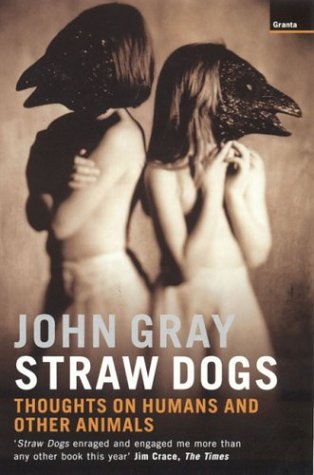
Books that Rocked my World (2): Straw Dogs: Thoughts on Humans and Other Animals by John Gray

John Gray's Straw Dogs attempts to present a world view in which humans are not central and which argues against the humanist belief in progress. The heart of the book is summed up in the idea that modern humanists have still not come to terms with Darwin, still not come to terms with the idea that humans are like other animals. Christians and modern humanists in the Platonic-Cartesian tradition typically think of humans enjoying a special relationship to God, or a special status in nature in a way that other animals do not. Even the great debunkers--philosophers such as Nietzsche, Wittgenstein and Heidegger--end up making human beings the centre of things or the end point of some world-historical process. By contrast, in a Taoist, Shinto, Hindu or animist culture Darwin's discovery would have been easily accommodated since these faiths see humans and other animals as kin.

In short, for Gray, humanism is nothing more than "a secular religion thrown together from decaying scraps of Christian myth". Gray champions James Lovelock's view of the Earth as a self-regulating system whose behaviour resembles, in some ways, that of an organism. The Gaia hypothesis is the backdrop to Gray's apparently relentless pessimism about the fate of humankind. What it teaches us is that this self-regulating system has no need of humanity, does not exist for the sake of humanity, and will regulate itself in ignorance of humanity's fate.

I cannot recommend this book too highly. I actually picked it up because of its striking cover but then became intrigued by the idea – that humans are not a central feature in the world, that we’re just another animal. This book literally knocked me off my feet and made me see things in a whole new light. Needless to see I have since bought everything John Gray has written.
Myths about Secular Humanism (1)

From 10 Myths About Secular Humanism by Matt Cherry & Molleen Matsumura

Secular humanists have no morals.

If you believe the myth that you cannot have morality without religion and God, then you are forced to one of two conclusions. Either you can say humanists have no morals, or you can concede that they have a moral code but insist they must have gotten it from religion. We'll deal with these positions in turn. Let's start by explaining humanist ethics.

Secular humanists believe morality and meaning come from humanity and the natural world, not from God or the supernatural. It is our human values that give us rights, responsibilities, and dignity. We believe that morality should aim to bring out the best in people, so that all people can have the best in life. And morality must be based on our knowledge of human nature and the real world.

Humanist and religious morality share many basic principles because in fact both are underpinned by the fundamental human moral sense summarized in the Golden Rule: treat others with the same consideration as you would have them treat you. Humanists recognize that the common moral decencies - for example, people should not lie, steal, or kill; and they should be honest, generous, and cooperative.

However, there are differences between humanist and religious moralities. Humanists realize that individuals alone cannot solve all our problems, but instead of turning to the supernatural, we believe that problems are solved by people working together, relying on understanding and creativity. That is why humanists are committed to promoting human values, human understanding, and human development. Humanists also emphasize the importance of self-determination - the right of individuals to control their own lives, so long as they do not harm others. Secular humanists, therefore, often promote causes where traditional religion obstructs the right to self-determination, for example, freedom of choice regarding sexual relationships, reproduction, and voluntary euthanasia.

Secular humanists disagree that, without God, life can have no meaning or purpose. We believe that people create their own meaning and purpose in life. The value and significance of life comes from how we live life, not from some supposed transcendent realm. Humanists believe the meaning of life is to live a life of meaning. The moral differences between secular humanism and religion do not justify the allegation that secular humanist have no morals. This claim is not an argument, just an insult. It merely represents the human tendency to see one's opponents as amoral.

I’m posting this because I was getting increasingly annoyed at comments on this and other Blogs linking morality with, and only with, a belief in God. I hope (though do not expect) that the situation is now a little clearer.

Friday, December 09, 2005

The Evolution of Belief.

From The Times:

SPIRITUALITY and a belief in God may be a result of evolutionary pressure, Lord Winston said yesterday. The Labour peer stepped out of line with mainstream scientific thinking to suggest that religiosity may have a genetic basis. He argued that, in life or death situations, belief can be the key to survival and for this reason has become programmed into human genes. “I take the view, which is quite controversial among scientists, that religious values are worthwhile,” Lord Winston said.

“There may be a selective reason why we have become religious. Evolutionary pressure may have meant it was an advantage to us. My premise is that man was a deeply threatened species from the savannah. I think that having a feeling there’s something above you may have been a powerful help to survival.” The belief in some form of spirituality led, in time, to the development of organised religions such as Christianity, Judaism and Islam, he said.

He dismissed, however, the idea that the identification of a gene that predisposes people to believe in God would get science any closer to answering the question of whether there is a God. It would, though, reduce the gulf that exists between scientific thought and theology because they would cease to be seen as diametrically opposed. “My contention is we cannot explain the universe,” he said. “Religion and science are different views of looking at uncertainty. I don’t think they are opposed.”

The existence of a religiosity gene could have been an important factor in man’s struggle for survival but would by no means have been an over-riding consideration. “It would be a side issue in evolution,” he said. “If it wasn’t, we would all be wholly religious or wholly unreligious.”

Interesting idea I thought. Is there a ‘God’ gene which promotes spirituality/religiosity? Does that explain why so many people believe in some kind of divine being? I also can’t help wondering that, if such a gene exists, whether it would be possible to invent a vaccine that, in effect, turns the gene off. Wouldn’t that be interesting? Finally, if such a gene does exist then what does it say (if anything) about the actually existence of a Creator – is the gene essentially God?

Thursday, December 08, 2005

For the Want of a Sixpence…


My Mother told me this story today and I thought it was so cool and (possibly) explained an important factor in why I am what I am that I couldn’t help sharing it with you – not that I’m usually known for getting all personal here. Anyway:


The story concerns my maternal Grandmother. During WW2 my Grandfather was in the Army fighting somewhere in North Africa and Europe. Gran, left at home to bring up their 7 daughters, was fully dependent on the portion of his Army pay sent to her on a weekly basis. But, as they tend to do from time to time, things went wrong (after all there was a war on) and a payment was delayed. Frantic and at her whit’s end she asked a visiting Catholic priest for a loan of a sixpence to tied her over until her husbands payment arrived. The priest, rather surprisingly, declined to lend her any money. Luckily the delayed Army pay arrived the next day and Gran managed to feed her 7 children.


But from that day, until over 30 years later, Gran never stepped inside another church. Because of the priests lack of basic Christian charity my Mother was not brought up in the Catholic faith and because of that neither I, nor my siblings, had any contact with the Church. Because of that single incident none of my sister’s children have been baptised. It’s amazing to think that because of a sixpence three generations of my family have become either indifferent or antagonistic towards religion.


I couldn’t help wondering about what might have happened if the priest had actually had some Christian charity and lent my Gran the money. She would’ve continued going to Church and would probably have brought up my Mother as a practicing Catholic which would probably have meant that her children (including me) would have been practicing Catholics too…. Which is all a little TOO scary to think about…. And all because of the want of a sixpence 15+ years before I was even born.


Spooky the hand of ‘fate’ isn’t it?

Spare the Rod & Save the Child.


From the BBC:


Children who are smacked are more likely than those who are not to become aggressive and anxious, no matter what the cultural norm, a study says.


A global research team studied 336 families across six countries - some of which accepted smacking as legitimate discipline and some which did not. It found smacking resulted in more behavioural problems in all countries. But in countries where smacking was the norm, the problems were less acute, the Child Development journal reported. There are mixed opinions over whether smacking leads to behavioural problems and whether the society the child is being brought up in has an impact.


All the children who were disciplined showed higher levels of aggression, anxiety and other emotional problems than their contemporaries. But researchers did find that in countries where physical discipline was more common and culturally accepted, the behavioural problems were not as bad as when it was carried out where it was more taboo.


Lead researcher Jennifer Lansford said the findings prompted the question of whether physical discipline was "acceptable, regardless of whether it occurs commonly within a cultural group". But she added: "One implication of our findings is the need for caution in making recommendations about parenting practices across different cultural groups."


Paul Farmer, chairman of the Mental Health Alliance, which represents professionals and charities, said environmental factors such as physical discipline were likely to have an impact on behavioural problems no matter what the cultural norm. But he added: "It is not just anxiety and aggression that can be caused by trauma. Other emotional problems, such as depression, can result." Mary Marsh, director of child protection charity NSPCC, urged parents not to smack their children. "A child's safety and respect for their human rights should be at the core of caring for children." And she said parents needed support in finding out about positive parenting and alternatives to hitting.


So, should parents be allowed to hit their children? Is it ethical to ever strike a child? What is physical punishment actually teaching children? How can we tell them that violence doesn’t solve problems if we use violence against them as a teaching method? What kind of society do we produce from successive ‘beaten’ generations?

Monday, December 05, 2005

'Gay weddings' become law in UK


From the BBC.


Hundreds of gay couples are preparing to form civil partnerships in the coming weeks as the law changes after decades of campaigning. At least 1,200 ceremonies are confirmed as being scheduled already, according to figures from councils.


Registrars are preparing for the first ceremonies, with couples permitted to register from Monday morning. Campaigners says the law ends inequalities for same-sex couples. The first ceremonies under the Civil Partnerships Act can take place in Northern Ireland on 19 December, followed by Scotland the next day and England and Wales on 21 December. Under the law, couples who want to form a partnership must register their intentions with local councils. Unlike marriages, the signing of the legal partnership papers does not need to happen in public.


Meg Munn, minister for equality, said the government expected 4,500 couples to get "partnered" in the first year. "This is an important piece of legislation that gives legal recognition to relationships which until now were invisible in the eyes of the law," Ms Munn told the BBC. "It accords people in same-sex relationships the same sort of rights and responsibilities that are available to married couples. "We know there are people who have been together maybe 40 years and have been waiting for the chance to do this kind of thing, because of the important differences it makes to their lives. "They have the same concerns as married couples - tenancy, ownership, pensions and inheritance."


Alan Wardle, of gay campaign group Stonewall, said the importance of the change should not be underestimated. "Our view is that civil partnerships are transformative for the lives of individual couples and their rights, but also for society more generally. "Society now legally recognises gay relationships for the first time. "It's a big day but 21 December, when the first partnerships take place, will be even bigger because that will see gay and lesbian people removing discrimination." But a spokesman for the one of the UK's major Christian groups told the BBC they believed same-sex couples should not get the same rights as married couples. "If you transport something unique, like marriage, into a different context, there's always a cost. And the cost here is in terms of reduction of marriage and the undermining of it," Don Horrocks of the Evangelical Alliance said.


Looks like another step forward on the road to a fully equal society. Long may it continue. I hope that one day people will actually struggle to understand the idea of discrimination – and fail to do so.

Sunday, December 04, 2005

Catholic Church no longer swears by truth of the Bible

From The Times:

THE hierarchy of the Roman Catholic Church has published a teaching document instructing the faithful that some parts of the Bible are not actually true.

The Catholic bishops of England, Wales and Scotland are warning their five million worshippers, as well as any others drawn to the study of scripture, that they should not expect “total accuracy” from the Bible. “We should not expect to find in Scripture full scientific accuracy or complete historical precision,” they say in The Gift of Scripture. The document is timely, coming as it does amid the rise of the religious Right, in particular in the US. Some Christians want a literal interpretation of the story of creation, as told in Genesis, taught alongside Darwin’s theory of evolution in schools, believing “intelligent design” to be an equally plausible theory of how the world began.

But the first 11 chapters of Genesis, in which two different and at times conflicting stories of creation are told, are among those that this country’s Catholic bishops insist cannot be “historical”. At most, they say, they may contain “historical traces”.

In the document, the bishops acknowledge their debt to biblical scholars. They say the Bible must be approached in the knowledge that it is “God’s word expressed in human language” and that proper acknowledgement should be given both to the word of God and its human dimensions. They say the Church must offer the gospel in ways “appropriate to changing times, intelligible and attractive to our contemporaries”.

The Bible is true in passages relating to human salvation, they say, but continue: “We should not expect total accuracy from the Bible in other, secular matters.” They go on to condemn fundamentalism for its “intransigent intolerance” and to warn of “significant dangers” involved in a fundamentalist approach. “Such an approach is dangerous, for example, when people of one nation or group see in the Bible a mandate for their own superiority, and even consider themselves permitted by the Bible to use violence against others.”

As examples of passages not to be taken literally, the bishops cite the early chapters of Genesis, comparing them with early creation legends from other cultures, especially from the ancient East. The bishops say it is clear that the primary purpose of these chapters was to provide religious teaching and that they could not be described as historical writing. Similarly, they refute the apocalyptic prophecies of Revelation, the last book of the Christian Bible, in which the writer describes the work of the risen Jesus, the death of the Beast and the wedding feast of Christ the Lamb. The bishops say: “Such symbolic language must be respected for what it is, and is not to be interpreted literally. We should not expect to discover in this book details about the end of the world, about how many will be saved and about when the end will come.”

Well, what an impressive step forward for the Catholic Church – and a slap in the face for the Fundamentalists. Maybe we can stop having the 'Literalist' Argument now?

Saturday, December 03, 2005

Being Sceptical.

From The Burden of Scepticism by Carl Sagan.

The French scientist Henri Poincar remarked on why credulity is rampant: "We also know how cruel the truth often is, and we wonder whether delusion is not more consoling." But I don't think that's the only reason credulity is rampant. Scepticism challenges established institutions. If we teach everybody, let's say high school students, the habit of being sceptical, perhaps they will not restrict their scepticism to aspirin commercials.

Scepticism is dangerous. That's exactly its function, in my view. It is the business of scepticism to be dangerous. And that's why there is a great reluctance to teach it in the schools. That's why you don't find a general fluency in scepticism in the media. On the other hand, how will we negotiate a very perilous future if we don't have the elementary intellectual tools to ask searching questions of those nominally in charge, especially in a democracy?

[But] you can get into a habit of thought in which you enjoy making fun of all those other people who don't see things as dearly as you do. This is a potential danger which we have to guard carefully against it. It seems to me what is called for is an exquisite balance between two conflicting needs: the most sceptical scrutiny of all hypotheses that are served up to us and at the same time a great openness to new ideas. Obviously those two modes of thought are in some tension. But if you are able to exercise only one of these modes, whichever one it is, you're in deep trouble.

If you are only sceptical, then no new ideas make it through to you. You never learn anything new. You become a crotchety old person convinced that nonsense is ruling the world. (There is, of course, much data to support you.) But every now and then, maybe once in a hundred cases, a new idea turns out to be on the mark, valid and wonderful. If you are too much in the habit of being sceptical about everything, you are going to miss or resent it, and either way you will be standing in the way of understanding and progress.

On the other hand, if you are open to the point of gullibility and have not an ounce of sceptical sense in you, then you cannot distinguish the useful as from the worthless ones. If all ideas have equal validity then you are lost, because then, it seems to me, no ideas have any validity at all. Some ideas are better than others. The machinery for distinguishing them is an essential tool in dealing with the world and especially in dealing with the future. And it is precisely the mix of these two modes of thought that is central to the success of science.

So the ‘trick’ seems to be sceptical but not too sceptical whilst being open-minded but not gullible. But most importantly of all is the necessity to ask questions. LOTS of questions.

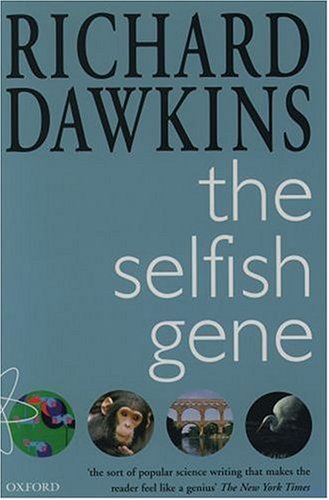
Books that Rocked My World (1): The Selfish Gene by Richard Dawkins


Inheriting the mantle of revolutionary biologist from Darwin, Watson, and Crick, Richard Dawkins forced an enormous change in the way we see ourselves and the world with the publication of The Selfish Gene. Suppose, instead of thinking about organisms using genes to reproduce themselves, as we had since Mendel's work was rediscovered, we turn it around and imagine that "our" genes build and maintain us in order to make more genes. That simple reversal seems to answer many puzzlers which had stumped scientists for years, and we haven't thought of evolution in the same way since. Why are there miles and miles of "unused" DNA within each of our bodies? Why should a bee give up its own chance to reproduce to help raise her sisters and brothers? With a prophet's clarity, Dawkins told us the answers from the perspective of molecules competing for limited space and resources to produce more of their own kind. Drawing fascinating examples from every field of biology, he paved the way for a serious re-evaluation of evolution. He also introduced the concept of self-reproducing ideas, or memes, which (seemingly) use humans exclusively for their propagation. If we are puppets, he says, at least we can try to understand our strings.


I read this many, many years ago and I can still remember being overwhelmed by the power and simplicity of his explanation of evolutionary processes. I can enthusiastically recommend this to anyone who has any interest in who we are and where we come from. Though it didn’t exactly convert me to Darwinian Evolution – it most certainly confirmed in my mind that Darwin was right and that evolution was the best explanation for the diversity of life on Earth. If, at that age, their still existed any possibility of me accepting a supernatural explanation for what we see around us – it vanished after reading The Selfish Gene.

Thursday, December 01, 2005

Can Biology do better than Faith?

From the New Scientist

Why does an intense and pervasive resistance to evolution continue 150 years after the publication of On The Origin of Species, and in the teeth of the overwhelming accumulated evidence favouring it? The answer is simply that the Darwinian revolution, even more than the Copernican revolution, challenges the prehistoric and still powerful self-image of humanity. Evolution by natural selection, to be as concise as possible, has changed everything.

In the more than slightly schizophrenic circumstances of the present era, global culture is divided into three opposing images of the human condition. The dominant one, exemplified by the creation myths of the Abrahamic monotheistic religions - Judaism, Christianity and Islam - sees humanity as a creation of God. He brought us into being and He guides us still as father, judge and friend. We interpret His will from sacred scriptures and the wisdom of ecclesiastical authorities.

The second world view is that of political behaviourism. Still beloved by the now rapidly fading Marxist-Leninist states, it says that the brain is largely a blank state devoid of any inborn inscription beyond reflexes and primitive bodily urges. As a consequence, the mind originates almost wholly as a product of learning, and it is the product of a culture that itself evolves by historical contingency. Because there is no biologically based "human nature", people can be moulded to the best possible political and economic system, namely communism. In practical politics, this belief has been repeatedly tested and, after economic collapses and tens of millions of deaths in a dozen dysfunctional states, is generally deemed a failure.

Both of these world views, God-centred religion and atheistic communism, are opposed by a third and in some ways more radical world view, scientific humanism. Still held by only a tiny minority of the world's population, it considers humanity to be a biological species that evolved over millions of years in a biological world, acquiring unprecedented intelligence yet still guided by complex inherited emotions and biased channels of learning. Human nature exists, and it was self-assembled. Having arisen by evolution during the far simpler conditions in which humanity lived during more than 99 per cent of its existence, it forms the behavioural part of what, in The Descent of Man, Darwin called "the indelible stamp of [our] lowly origin".

The inexorable growth of biology continues to widen, not to close, the tectonic gap between science and faith based religion. Rapprochement may be neither possible nor desirable. There is something deep in religious belief that divides people and amplifies societal conflict. The toxic mix of religion and tribalism has become so dangerous as to justify taking seriously the alternative view, that humanism based on science is the effective antidote, the light and the way at last placed before us.

Religions continue both to render their special services and to exact their heavy costs. Can scientific humanism do as well or better, at a lower cost? Surely that ranks as one of the great unanswered questions of philosophy.

So. Can scientific humanism replace faith based religion? Is it a better, safer and more productive way of looking at the world? Or can Humanisn be seen as a 'flash in the pan' soon to be relegated to a footnote in the religious history of the world?