Losing the Long War
by Tom Porteous for TomPaine.com
Tuesday, May 30, 2006
Last week's summit meeting in Washington between George Bush and Tony Blair took place against the background of the escalating failures of their coercive policies in the Long War against Islamist radicalism. In Afghanistan, more than four years after the United States and its allies intervened to oust the Taliban and install a pro-Western regime, NATO forces face more than just another spring offensive by Taliban "remnants." May 2006 has witnessed little short of a countrywide rebellion. Significant masses of Afghan political and military forces are mounting a serious challenge to the status quo.
In Iraq, the formation in May of a new government under Nuri al-Maliki may or may not halt, or slow down, the steady collapse into sectarianism that has unfolded since the U.S. invasion of 2003. But the insurgency continues and opposition to the intervention grows even among those Iraqis who once welcomed it. In Muslim communities world-wide, the U.S. military intervention fuels anti-Western sentiment among extremists and moderates alike. Furthermore, the failure of the United States to control the situation in Iraq has dispelled the illusion of American military dominance in the world.
In Palestine, experts and politicians—few of them apologists for Islamism or admirers of Hamas—have argued to no avail against the U.S. policy of cutting off aid to the Palestinian Authority following the Islamists' election. Such a policy, they point out, leads to further chaos in Gaza and the West Bank, strengthens the hand of extremists and sets back even further the prospects of Arab-Israeli peace. Meanwhile Western complicity in Israeli's continuing occupation of Palestinian territory remains a rallying cry for Islamists and anti-Western sentiment throughout the Muslim world.
In Iran, the hard-line Islamists have rolled back political reform and are thumbing their noses at the United States and Europe, rushing ahead with a nuclear enrichment program in defiance of U.S. and Israeli threats, safe in the knowledge that the political and military position of the United States in the region is now so precarious as to render the option of U.S. military action against Iran catastrophic for Western interests.
In Egypt, long regarded as a pillar of pro-Western stability in the Middle East and the most populous Arab state, the judiciary is now standing against the corruption and political stagnation of the Mubarak regime. There are signs that further repression of the burgeoning Egyptian movement for political reform is leading to a serious political crisis. There is little doubt that the main winners of any genuine political opening will be the Islamist Muslim Brotherhood. Even in distant Somalia, the pernicious impact of the Long War is being felt as U.S. backed warlords struggle to suppress Somali Islamist militias whose political and military influence has been steadily filling the power vacuum left by the collapse of the Somali state in 1991, and the failure of the international community to rescue it from feuding warlords and violent intervention by Ethiopia. The ideological appeal of Somalia's Islamists now appears stronger than the clan loyalties that have sustained the murderous squabbling of the warlords for the past decade.
If you add up all these (and other) complex events, they point to the comprehensive failure of the West's strategy to tackle radical Islamism. If the Long War really is an existential struggle between the "free world" and "Islamo-fascism" then these should be dark days indeed for the West. The fact is, however, that we are not living through any crisis remotely comparable to the Cold War or WW II (as goes the rhetoric of the Long War). The "threat" from Islamism remains limited to random acts of political terrorism, horrifying for the victims and entirely reprehensible, but of no major strategic threat to the West. The balance of economic, military and political power remains overwhelmingly on the side of the United States and its allies. All Muslim states except Iran are subservient to America's interests. For the vast majority of Westerners, the Long War impinges hardly at all on their daily lives.
The same cannot be said of the impact on Middle Easterners. The occupation of Iraq, the unqualified support for Israel's coercive and expansionist policies, the continuing support for authoritarian regimes, the brutal counter-insurgency and counter-terrorism techniques, and the deeply worrying doctrine of pre-emptive coercion (detention, torture, economic sanctions and war) have very real and catastrophic consequences for millions of Middle Easterners and serve to strengthen the political influence of precisely those extremist and anti-Western forces the West is seeking to suppress. Is the West now dropping the rhetoric of confrontation and returning to more realistic and sensible policies towards the Muslim world? Bush, Blair and their ideological supporters are yesterday's men, discredited at home and abroad by the negative consequences of their policies in the Middle East. In two years time they will be out of office. U.S. and European policymakers have looked into the abyss of a potential military strike against Iran and appear to have flinched. Long postponed, direct negotiations between the United States and Iran are now a possibility.
There is much that could still occur to maintain the current state of confrontation between Islam and the West. Extremists on both sides have an interest in upping the tension through polarising acts of homicide. Iraq, Afghanistan and Palestine remain arenas of acute crisis and violence. There are few signs that any new Western leaders waiting in the wings in the United States or Europe have the ideas, the courage or the will to address the roots of these difficult crises. In their conflict with radical Islam, the West and Israel will not be able to win peace and stability through war and military occupation, but must seek it through genuine political accommodation and compromise based on a modicum of justice and fairness.
About Me

- CyberKitten
- I have a burning need to know stuff and I love asking awkward questions.
Wednesday, June 14, 2006

Tuesday, June 13, 2006
An Introduction to Atheism
From: The Atheism Web
What is atheism?
Atheism is characterized by an absence of belief in the existence of gods. This absence of belief generally comes about either through deliberate choice, or from an inherent inability to believe religious teachings which seem literally incredible. It is not a lack of belief born out of simple ignorance of religious teachings.
Some atheists go beyond a mere absence of belief in gods: they actively believe that particular gods, or all gods, do not exist. Just lacking belief in Gods is often referred to as the "weak atheist" position; whereas believing that gods do not (or cannot) exist is known as "strong atheism". Regarding people who have never been exposed to the concept of 'god': Whether they are 'atheists' or not is a matter of debate. Since you're unlikely to meet anyone who has never encountered religion, it's not a very important debate... It is important, however, to note the difference between the strong and weak atheist positions. "Weak atheism" is simple scepticism; disbelief in the existence of God. "Strong atheism" is an explicitly held belief that God does not exist. Please do not fall into the trap of assuming that all atheists are "strong atheists". There is a qualitative difference in the "strong" and "weak" positions; it's not just a matter of degree. Some atheists believe in the non-existence of all Gods; others limit their atheism to specific Gods, such as the Christian God, rather than making flat-out denials.
"But isn't disbelieving in God the same thing as believing he doesn't exist?" Definitely not. Disbelief in a proposition means that one does not believe it to be true. Not believing that something is true is not equivalent to believing that it is false; one may simply have no idea whether it is true or not. Which brings us to agnosticism.
What is agnosticism then?
The term 'agnosticism' was coined by Professor T.H. Huxley at a meeting of the Metaphysical Society in 1876. He defined an agnostic as someone who disclaimed both ("strong") atheism and theism, and who believed that the question of whether a higher power existed was unsolved and insoluble. Another way of putting it is that an agnostic is someone who believes that we do not know for sure whether God exists. Some agnostics believe that we can never know. In recent years, however, the term agnostic has also been used to describe those who simply believe that the evidence for or against God is inconclusive, and therefore are undecided about the issue. To reduce the amount of confusion over the use of term agnosticism, it is recommended that usage based on a belief that we cannot know whether God exists be qualified as "strict agnosticism" and usage based on the belief that we merely do not know yet be qualified as "empirical agnosticism". Words are slippery things, and language is inexact. Beware of assuming that you can work out someone's philosophical point of view simply from the fact that she calls herself an atheist or an agnostic. For example, many people use agnosticism to mean what is referred to here as "weak atheism", and use the word "atheism" only when referring to "strong atheism". Beware also that because the word "atheist" has so many shades of meaning, it is very difficult to generalize about atheists. About all you can say for sure is that atheists don't believe in God. For example, it certainly isn't the case that all atheists believe that science is the best way to find out about the universe.
From: The Atheism Web
What is atheism?
Atheism is characterized by an absence of belief in the existence of gods. This absence of belief generally comes about either through deliberate choice, or from an inherent inability to believe religious teachings which seem literally incredible. It is not a lack of belief born out of simple ignorance of religious teachings.
Some atheists go beyond a mere absence of belief in gods: they actively believe that particular gods, or all gods, do not exist. Just lacking belief in Gods is often referred to as the "weak atheist" position; whereas believing that gods do not (or cannot) exist is known as "strong atheism". Regarding people who have never been exposed to the concept of 'god': Whether they are 'atheists' or not is a matter of debate. Since you're unlikely to meet anyone who has never encountered religion, it's not a very important debate... It is important, however, to note the difference between the strong and weak atheist positions. "Weak atheism" is simple scepticism; disbelief in the existence of God. "Strong atheism" is an explicitly held belief that God does not exist. Please do not fall into the trap of assuming that all atheists are "strong atheists". There is a qualitative difference in the "strong" and "weak" positions; it's not just a matter of degree. Some atheists believe in the non-existence of all Gods; others limit their atheism to specific Gods, such as the Christian God, rather than making flat-out denials.
"But isn't disbelieving in God the same thing as believing he doesn't exist?" Definitely not. Disbelief in a proposition means that one does not believe it to be true. Not believing that something is true is not equivalent to believing that it is false; one may simply have no idea whether it is true or not. Which brings us to agnosticism.
What is agnosticism then?
The term 'agnosticism' was coined by Professor T.H. Huxley at a meeting of the Metaphysical Society in 1876. He defined an agnostic as someone who disclaimed both ("strong") atheism and theism, and who believed that the question of whether a higher power existed was unsolved and insoluble. Another way of putting it is that an agnostic is someone who believes that we do not know for sure whether God exists. Some agnostics believe that we can never know. In recent years, however, the term agnostic has also been used to describe those who simply believe that the evidence for or against God is inconclusive, and therefore are undecided about the issue. To reduce the amount of confusion over the use of term agnosticism, it is recommended that usage based on a belief that we cannot know whether God exists be qualified as "strict agnosticism" and usage based on the belief that we merely do not know yet be qualified as "empirical agnosticism". Words are slippery things, and language is inexact. Beware of assuming that you can work out someone's philosophical point of view simply from the fact that she calls herself an atheist or an agnostic. For example, many people use agnosticism to mean what is referred to here as "weak atheism", and use the word "atheism" only when referring to "strong atheism". Beware also that because the word "atheist" has so many shades of meaning, it is very difficult to generalize about atheists. About all you can say for sure is that atheists don't believe in God. For example, it certainly isn't the case that all atheists believe that science is the best way to find out about the universe.

Monday, June 12, 2006
Accept it: we're married, lesbian couple tell judge
Jamie Doward, home affairs correspondent for The Observer
Sunday May 28, 2006
A lesbian couple will this week make British legal history when they mount a High Court challenge to have their civil partnership recognised as a marriage. The case has dismayed Christian groups, which fear it could undermine marriage as an institution. University professors Sue Wilkinson and Celia Kitzinger married in Canada and want their relationship to have the same status in the UK. They hope their test case, which starts on Friday and is expected to last four days, will lead to others in same-sex relationships being able to wed in the UK. 'It's outrageous the government won't recognise our marriage,' Kitzinger said. 'Our lawyers are seeking a declaration of the validity of our marriage with reference to the European Convention on Human Rights and the Human Rights Act 1998.' Wilkinson said: 'If a different-sex couple went to Canada and got married and returned to England it would be automatically recognised ... This case is about equality.'
The pair, who have been together for 16 years, married in August 2003 while Wilkinson was working in British Columbia, one of the first places in the world to recognise same-sex marriages. Peter Tatchell of gay rights group OutRage, which is backing the case along with human rights group Liberty, said it was an attempt to end 'sexual apartheid'. 'Civil partnerships are second best,' Tatchell said. 'Nothing less than marriage equality is acceptable.' But Don Horrocks, head of public affairs at the Evangelical Alliance, said allowing same-sex couples to marry would set a dangerous precedent. 'Where does it stop?' Horrocks asked. 'Soon there will be people wanting to marry their horse or perhaps three or four people all want to get married. If the word marriage is going to be infinitely plastic it loses all meaning.' Many Christian groups see the case as vindicating the arguments they made when opposing the introduction of civil partnerships. 'We said this would happen all along,' Horrocks said. 'We know that when the homosexual lobby get one thing they move on to the next stage. It was always going to be the case that once they had got civil partnerships somebody who had been married in Canada would mount a test case in Britain.'
In April a High Court judge gave an interim ruling allowing the case to proceed: 'I consider that there is sufficient material available for an argument based on principle ... that the requirement of the Civil Partnership Act that a marriage between same-sex partners abroad must, on registration, be treated as a civil partnership and not a marriage, is on the face of it discriminatory on the grounds of sexual orientation.' The test case is one of several challenges around the world to have same-sex relationships recognised as marriages. There are similar challenges in Ireland, Israel, New Zealand and Hong Kong. Since civil partnerships were introduced in the UK, gay and lesbian couples have had the same legal rights as heterosexual couples. Some observers have therefore asked why those supporting the case feel that recognising a civil partnership as a marriage is so important. 'In some sense, those who say it's just a word are absolutely right,' Wilkinson said. 'So, in that case, why is the government fighting so hard against us?'
Jamie Doward, home affairs correspondent for The Observer
Sunday May 28, 2006
A lesbian couple will this week make British legal history when they mount a High Court challenge to have their civil partnership recognised as a marriage. The case has dismayed Christian groups, which fear it could undermine marriage as an institution. University professors Sue Wilkinson and Celia Kitzinger married in Canada and want their relationship to have the same status in the UK. They hope their test case, which starts on Friday and is expected to last four days, will lead to others in same-sex relationships being able to wed in the UK. 'It's outrageous the government won't recognise our marriage,' Kitzinger said. 'Our lawyers are seeking a declaration of the validity of our marriage with reference to the European Convention on Human Rights and the Human Rights Act 1998.' Wilkinson said: 'If a different-sex couple went to Canada and got married and returned to England it would be automatically recognised ... This case is about equality.'
The pair, who have been together for 16 years, married in August 2003 while Wilkinson was working in British Columbia, one of the first places in the world to recognise same-sex marriages. Peter Tatchell of gay rights group OutRage, which is backing the case along with human rights group Liberty, said it was an attempt to end 'sexual apartheid'. 'Civil partnerships are second best,' Tatchell said. 'Nothing less than marriage equality is acceptable.' But Don Horrocks, head of public affairs at the Evangelical Alliance, said allowing same-sex couples to marry would set a dangerous precedent. 'Where does it stop?' Horrocks asked. 'Soon there will be people wanting to marry their horse or perhaps three or four people all want to get married. If the word marriage is going to be infinitely plastic it loses all meaning.' Many Christian groups see the case as vindicating the arguments they made when opposing the introduction of civil partnerships. 'We said this would happen all along,' Horrocks said. 'We know that when the homosexual lobby get one thing they move on to the next stage. It was always going to be the case that once they had got civil partnerships somebody who had been married in Canada would mount a test case in Britain.'
In April a High Court judge gave an interim ruling allowing the case to proceed: 'I consider that there is sufficient material available for an argument based on principle ... that the requirement of the Civil Partnership Act that a marriage between same-sex partners abroad must, on registration, be treated as a civil partnership and not a marriage, is on the face of it discriminatory on the grounds of sexual orientation.' The test case is one of several challenges around the world to have same-sex relationships recognised as marriages. There are similar challenges in Ireland, Israel, New Zealand and Hong Kong. Since civil partnerships were introduced in the UK, gay and lesbian couples have had the same legal rights as heterosexual couples. Some observers have therefore asked why those supporting the case feel that recognising a civil partnership as a marriage is so important. 'In some sense, those who say it's just a word are absolutely right,' Wilkinson said. 'So, in that case, why is the government fighting so hard against us?'
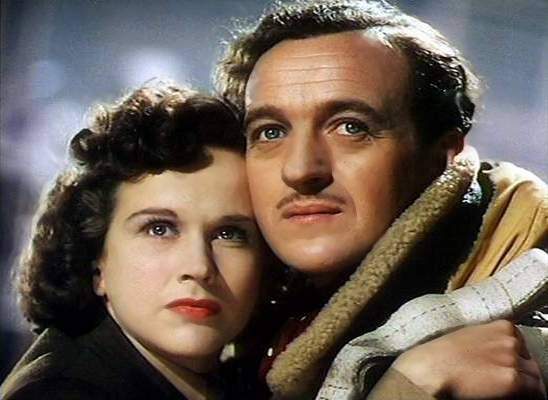 My Favourite Movies: A Matter of Life and Death.
I’ve had this film on video for many years and have just replaced it with a DVD copy. Made in 1946 it starred David Niven & Kim Hunter (pictured above) as lovers who met in rather unusual circumstances.
Niven plays Squadron Leader Peter D Carter who, on his way back from a bombing mission over Germany (yup – not quite another war movie, but one with a war background), finds that he has to bail out of his stricken bomber – without a parachute. After ‘meeting’ the American radio operator – played by Hunter – and starting to fall in love with her, he jumps to his certain death. Or not. For his heavenly conductor – played by the superb Marius Goring – misses him in the fog. Niven survives the jump and falls deeper in love with Hunter causing a problem for the Authorities in heaven. So starts the trail of Peter Carter who fights for his life and his love against Heaven itself.
This is a wonderful movie on many levels. The story is sublime, the acting magnificent, the cinematography outstanding. I can hardly fault it in any way. I particularly liked the character of Conductor 71 (played by Goring) and Doctor Reeves (played by Robert Livesy). A classic in every sense directed by Michael Powell and Emeric Pressburger who also directed The Red Shoes (which I also own) & Black Narcissus (which I shall own shortly). If you haven’t seen this you’ve missed a real treat.
Sunday, June 11, 2006
Haditha Signals Beginning of End of Iraq War
by Richard Gwyn for the Toronto Star
Friday, June 2, 2006
Comparisons are being made between the alleged massacre — it's still being investigated — in the Iraqi town of Haditha of some 24 civilians by U.S. Marines with the killing of Vietnamese civilians by U.S. troops in the village of Mai Lai in 1968 in the middle of the Vietnam War. Those comparisons are invalid: What reportedly happened in Haditha is far worse. Only in certain respects was Mai Lai worse. The deaths there totalled an incredible 400, rather than two dozen. Not a single shot was fired by any of the Vietnamese villagers at the U.S. soldiers who had descended on them from helicopters, while the Marine convoy of Humvees was hit by a car bomb as it approached Haditha. One Marine was killed and two others were wounded.
Yet two defining differences between the two terrible events mark Haditha as the worst atrocity by far. What allegedly was done at Haditha was not done by raw draftees, or conscripts, but by elite professionals — that is, by highly trained and highly disciplined troops. That the Marines would be edgy and angry at the death of a comrade is understandable. They didn't, though, then go on a rampage. Instead, their alleged killings were spaced out and deliberate. First they apparently stopped a car with four students in it, ordered them out and shot all. Then, they entered three houses and killed almost everyone in it, of whatever sex and age. The second critical difference between the two outrages is that the alleged crime in Haditha happened after Mai Lai took place.
This means that all the publicity about that earlier crime, and all the shame so many Americans then felt about it and expressed so clearly and loudly, and all the systems and controls instituted by the military to make sure it could never happened again, made not the slightest bit of difference. Indeed, it appears that one new practice instituted by the U.S. military since the Mai Lai massacre amounts to a technique for covering up crimes like it. This relates to the way the cover story about the alleged Haditha massacre began to fall apart. The killings happened last November. Once it was realized that some of those shot down could not have been insurgents — the dead included women and children, one as young as 2 years old — approval was given for cash payments to be given to survivors as compensation. Some survivors, though, complained that they hadn't received any payments — in effect, "hush money" — as recompense for dead relatives.
Marine officers began to notice discrepancies in the numbers of the dead that they had been given and the numbers of those alleged to have been insurgents, as a consequence of which their relatives were ineligible for any compensation. As with Mai Lai, the Marine chain of command was incredibly slow to gather the courage it took to accept that a massacre had almost certainly taken place and, therefore, to investigate aggressively. The actual turning point was the first media story on what had happened, in Time magazine last March. Between Haditha, about which the White House has now gone into full damage control mode, and Mai Lai, there is one significant similarity. What Mai Lai did was to turn American citizens against the Vietnam War by making them realize what the war was doing to their own troops. This was that it was demoralizing and debasing otherwise decent young Americans, out of fear, out of hatred, out of sheer despair at being trapped in an unwinnable war — because it involved, inevitably, killing many innocent citizens as well as actual insurgents or guerrillas. The alleged Haditha massacre, once its full details are made public, will undoubtedly push American public opinion toward the same tipping point.
Abu Graib. Guantanamo. Haditha. And most probably many others which now will come to light. We are witnessing the beginning of the end of the Iraq war.
by Richard Gwyn for the Toronto Star
Friday, June 2, 2006
Comparisons are being made between the alleged massacre — it's still being investigated — in the Iraqi town of Haditha of some 24 civilians by U.S. Marines with the killing of Vietnamese civilians by U.S. troops in the village of Mai Lai in 1968 in the middle of the Vietnam War. Those comparisons are invalid: What reportedly happened in Haditha is far worse. Only in certain respects was Mai Lai worse. The deaths there totalled an incredible 400, rather than two dozen. Not a single shot was fired by any of the Vietnamese villagers at the U.S. soldiers who had descended on them from helicopters, while the Marine convoy of Humvees was hit by a car bomb as it approached Haditha. One Marine was killed and two others were wounded.
Yet two defining differences between the two terrible events mark Haditha as the worst atrocity by far. What allegedly was done at Haditha was not done by raw draftees, or conscripts, but by elite professionals — that is, by highly trained and highly disciplined troops. That the Marines would be edgy and angry at the death of a comrade is understandable. They didn't, though, then go on a rampage. Instead, their alleged killings were spaced out and deliberate. First they apparently stopped a car with four students in it, ordered them out and shot all. Then, they entered three houses and killed almost everyone in it, of whatever sex and age. The second critical difference between the two outrages is that the alleged crime in Haditha happened after Mai Lai took place.
This means that all the publicity about that earlier crime, and all the shame so many Americans then felt about it and expressed so clearly and loudly, and all the systems and controls instituted by the military to make sure it could never happened again, made not the slightest bit of difference. Indeed, it appears that one new practice instituted by the U.S. military since the Mai Lai massacre amounts to a technique for covering up crimes like it. This relates to the way the cover story about the alleged Haditha massacre began to fall apart. The killings happened last November. Once it was realized that some of those shot down could not have been insurgents — the dead included women and children, one as young as 2 years old — approval was given for cash payments to be given to survivors as compensation. Some survivors, though, complained that they hadn't received any payments — in effect, "hush money" — as recompense for dead relatives.
Marine officers began to notice discrepancies in the numbers of the dead that they had been given and the numbers of those alleged to have been insurgents, as a consequence of which their relatives were ineligible for any compensation. As with Mai Lai, the Marine chain of command was incredibly slow to gather the courage it took to accept that a massacre had almost certainly taken place and, therefore, to investigate aggressively. The actual turning point was the first media story on what had happened, in Time magazine last March. Between Haditha, about which the White House has now gone into full damage control mode, and Mai Lai, there is one significant similarity. What Mai Lai did was to turn American citizens against the Vietnam War by making them realize what the war was doing to their own troops. This was that it was demoralizing and debasing otherwise decent young Americans, out of fear, out of hatred, out of sheer despair at being trapped in an unwinnable war — because it involved, inevitably, killing many innocent citizens as well as actual insurgents or guerrillas. The alleged Haditha massacre, once its full details are made public, will undoubtedly push American public opinion toward the same tipping point.
Abu Graib. Guantanamo. Haditha. And most probably many others which now will come to light. We are witnessing the beginning of the end of the Iraq war.

Saturday, June 10, 2006
Why do Skeptics doubt the existence of God? – Part II
From: Why I Am a Skeptic about Religious Claims
By Paul Kurtz
The historic religions maintain that God has revealed himself in history and that he has manifested his presence to selected humans. These revelations are not corroborated by independent, objective observers. They are disclosed, rather, to privileged prophets or mystics, whose claims have not been adequately verified: there is insufficient circumstantial evidence to confirm their authenticity. To attribute inexplicable events to miracles performed by God, as declared in the so-called sacred literature, is often a substitute for finding their true causes scientifically. Scientific inquiry is generally able to explain alleged "miracles" by discovering natural causes.
The Bible, Qur'an, and other classical documents are full of contradictions and factual errors. They were written by human beings in ancient civilizations, expressing the scientific and moral speculations of their day. They do not convey the eternal word of God, but rather the yearnings of ancient tribes based on oral legends and received doctrines; as such, they are hardly relevant to all cultures and times. The Old and New Testaments are not accurate accounts of historical events. The reliability of the Old Testament is highly questionable in the events and personages it depicts; Moses, Abraham, Joseph, etc. are largely uncorroborated by historical evidence. As for the New Testament, scholarship has shown that none of its authors knew Jesus directly. The four Gospels were not written by eyewitnesses but are products of oral tradition and hearsay. There is but flimsy and contradictory evidence for the virgin birth, the healings of Jesus, and the Resurrection. Similarly, contrary to Muslim claims that that religion's scriptures passed virtually unmediated from Allah, there have in fact been several versions of the Qur'an; it is no less a product of oral traditions than the Bible. Likewise, the provenance of the Hadith, allegedly passed down by Muhammad's companions, has not been independently confirmed by reliable historical research.
Some claim to believe in God because they say that God has entered into their personal lives and has imbued them with new meaning. This is a psychological or phenomenological account of a person's inner experience. It is hardly adequate evidence for the existence of a divine being independent of human beings' internal soliloquies. Appeals to mystical experiences or private subjective states hardly suffice as evidential support that some external being or force caused such altered states of consciousness; skeptical inquirers have a legitimate basis for doubt, unless or until such claims of interior experience can somehow be independently corroborated. Experiences of God or gods, or angels or demons, talking to one may disturb or entrance those persons who undergo such experiences, but the question is whether these internal subjective states have external veracity. This especially applies to those individuals who claim some sort of special revelation from on high, such as the hearing of commandments.
[To be continued in Part III].
From: Why I Am a Skeptic about Religious Claims
By Paul Kurtz
The historic religions maintain that God has revealed himself in history and that he has manifested his presence to selected humans. These revelations are not corroborated by independent, objective observers. They are disclosed, rather, to privileged prophets or mystics, whose claims have not been adequately verified: there is insufficient circumstantial evidence to confirm their authenticity. To attribute inexplicable events to miracles performed by God, as declared in the so-called sacred literature, is often a substitute for finding their true causes scientifically. Scientific inquiry is generally able to explain alleged "miracles" by discovering natural causes.
The Bible, Qur'an, and other classical documents are full of contradictions and factual errors. They were written by human beings in ancient civilizations, expressing the scientific and moral speculations of their day. They do not convey the eternal word of God, but rather the yearnings of ancient tribes based on oral legends and received doctrines; as such, they are hardly relevant to all cultures and times. The Old and New Testaments are not accurate accounts of historical events. The reliability of the Old Testament is highly questionable in the events and personages it depicts; Moses, Abraham, Joseph, etc. are largely uncorroborated by historical evidence. As for the New Testament, scholarship has shown that none of its authors knew Jesus directly. The four Gospels were not written by eyewitnesses but are products of oral tradition and hearsay. There is but flimsy and contradictory evidence for the virgin birth, the healings of Jesus, and the Resurrection. Similarly, contrary to Muslim claims that that religion's scriptures passed virtually unmediated from Allah, there have in fact been several versions of the Qur'an; it is no less a product of oral traditions than the Bible. Likewise, the provenance of the Hadith, allegedly passed down by Muhammad's companions, has not been independently confirmed by reliable historical research.
Some claim to believe in God because they say that God has entered into their personal lives and has imbued them with new meaning. This is a psychological or phenomenological account of a person's inner experience. It is hardly adequate evidence for the existence of a divine being independent of human beings' internal soliloquies. Appeals to mystical experiences or private subjective states hardly suffice as evidential support that some external being or force caused such altered states of consciousness; skeptical inquirers have a legitimate basis for doubt, unless or until such claims of interior experience can somehow be independently corroborated. Experiences of God or gods, or angels or demons, talking to one may disturb or entrance those persons who undergo such experiences, but the question is whether these internal subjective states have external veracity. This especially applies to those individuals who claim some sort of special revelation from on high, such as the hearing of commandments.
[To be continued in Part III].
 My favourite Places: Stonehenge
Stonehenge is a Neolithic and Bronze Age megalithic monument located near Amesbury in the English county of Wiltshire, about 8 miles (13 km) northwest of Salisbury. It is composed of earthworks surrounding a circular setting of large standing stones and is one of the most famous prehistoric sites in the world. Archaeologists think the standing stones were erected between 2500 BC and 2000 BC although the surrounding circular earth bank and ditch, which constitute the earliest phase of the monument, have been dated to about 3100 BC. The site and its surroundings were added to the UNESCO's list of World Heritage Sites in 1986 in a co-listing with Avebury henge monument, and it is also a legally protected Scheduled Ancient Monument. Stonehenge itself is owned and managed by English Heritage whilst the surrounding downland is owned by the National Trust.
[The above from Wikipedia].
I’ve visited Stonehenge 2-3 times so far and I must admit that I was initially disapointed, probably because I expected something a bit bigger. [grin] But on subsequent visits I became very impressed by the technical achievement and by the sheer majesty of the place. It’s truly awesome and the more we find out about it the more impressive it becomes. The last time I was there they had electronic ‘guides’ for hire which inform you about the history of the site which certainly adds greatly to the experience. A wonder of the age and well worth a visit if you’re in the area.
Friday, June 09, 2006
There We Go Again, Restricting Rights
by Nicola Castle-Bauer for the Seattle Post-Intelligencer (Washington)
February 27, 2006
It seems to me that the United States has a knack for repeating history, especially when it comes to restricting rights from the citizens who rightfully deserve them. On Dec. 7, 1941, Japan attacked Pearl Harbor. President Franklin Roosevelt signed Executive Order 9066, which allowed the Army to intern more than 120,000 Japanese and Japanese Americans indefinitely without a trial, and without knowing what they were charged with. Sound familiar?
After World War II officially ended, we began the Cold War with Russia. In 1954, Congress enacted the Communist Control Act. "Red Menace" hysteria quickly devoured the country, causing the government to enact restrictions on free expression and free association, to create emergency detention plans for suspected "communists," to back legislative investigations designed to punish by exposure and to keep public and private blacklists of those who had been "exposed." Now that World War II is over and we've "saved" the country from the Japanese, the Germans and the Italians, and now that the Cold War is over and we've "saved" the country from the communists, shouldn't we be safe? Unfortunately, the answer is no. As probably every person in the world knows by now, the Twin Towers were destroyed by two hijacked planes flown by serial bombers on the morning of Sept. 11, 2001, killing 2,300-plus people, including rescue workers and counting those killed when another plane flew into the Pentagon.
So now we are on high alert for a suspect just as broad as the men, women and children of Japanese ancestry (not one of whom was proved to be a spy), or all the accused communists. We are looking for the terrorists, in what our government is now calling the "war on terrorism," and that is where Guantanamo Bay comes into the picture. In our "war on terrorism," we feel obligated to detain more than 600 "enemy combatants" indefinitely without a trial, and without knowing what they are charged with. The "enemy combatants" are masterfully detained. Since the "enemy combatants" are being held on soil rented to the United States, the Constitution should apply, particularly the Fifth and Sixth amendments, which provide citizens and those being held on U.S. soil with due process of law. Unfortunately, it apparently does not. The Geneva Conventions, giving rights to prisoners of war does not apply, either, because the "enemy combatants" do not meet POW criteria (example, they are not associated with a certain country).
We can be thankful that the Supreme Court has decided to step in. In two very crucial decisions in 2004 on the range of the president's wartime powers, The Supreme Court debunked the claim by the Bush administration that it could hold "enemy combatants" on American soil without giving them a proper trial. Because Guantanamo Bay is under U.S. control, and thus appropriately within the jurisdiction of U.S. courts, whether U.S. citizens or not, the detainees will retain their rights to at least a legal hearing. "The president's constitutional powers, even when supported by Congress in wartime, do not include the authority to close the doors to an independent review of the legality of locking people up," said Fred Barbash of The Washington Post, summarizing the decisions made by the judges during the June 18 detainee hearings.
Now it is two years later, and not much has been done to put the estimated 500 to 600 detainees on trial for the charges, or lack thereof, that they are accused of. I hope we will clean up our act soon. The Golden Rule about treating others the way you wish to be treated has been passed down through generations for a reason; it works.
by Nicola Castle-Bauer for the Seattle Post-Intelligencer (Washington)
February 27, 2006
It seems to me that the United States has a knack for repeating history, especially when it comes to restricting rights from the citizens who rightfully deserve them. On Dec. 7, 1941, Japan attacked Pearl Harbor. President Franklin Roosevelt signed Executive Order 9066, which allowed the Army to intern more than 120,000 Japanese and Japanese Americans indefinitely without a trial, and without knowing what they were charged with. Sound familiar?
After World War II officially ended, we began the Cold War with Russia. In 1954, Congress enacted the Communist Control Act. "Red Menace" hysteria quickly devoured the country, causing the government to enact restrictions on free expression and free association, to create emergency detention plans for suspected "communists," to back legislative investigations designed to punish by exposure and to keep public and private blacklists of those who had been "exposed." Now that World War II is over and we've "saved" the country from the Japanese, the Germans and the Italians, and now that the Cold War is over and we've "saved" the country from the communists, shouldn't we be safe? Unfortunately, the answer is no. As probably every person in the world knows by now, the Twin Towers were destroyed by two hijacked planes flown by serial bombers on the morning of Sept. 11, 2001, killing 2,300-plus people, including rescue workers and counting those killed when another plane flew into the Pentagon.
So now we are on high alert for a suspect just as broad as the men, women and children of Japanese ancestry (not one of whom was proved to be a spy), or all the accused communists. We are looking for the terrorists, in what our government is now calling the "war on terrorism," and that is where Guantanamo Bay comes into the picture. In our "war on terrorism," we feel obligated to detain more than 600 "enemy combatants" indefinitely without a trial, and without knowing what they are charged with. The "enemy combatants" are masterfully detained. Since the "enemy combatants" are being held on soil rented to the United States, the Constitution should apply, particularly the Fifth and Sixth amendments, which provide citizens and those being held on U.S. soil with due process of law. Unfortunately, it apparently does not. The Geneva Conventions, giving rights to prisoners of war does not apply, either, because the "enemy combatants" do not meet POW criteria (example, they are not associated with a certain country).
We can be thankful that the Supreme Court has decided to step in. In two very crucial decisions in 2004 on the range of the president's wartime powers, The Supreme Court debunked the claim by the Bush administration that it could hold "enemy combatants" on American soil without giving them a proper trial. Because Guantanamo Bay is under U.S. control, and thus appropriately within the jurisdiction of U.S. courts, whether U.S. citizens or not, the detainees will retain their rights to at least a legal hearing. "The president's constitutional powers, even when supported by Congress in wartime, do not include the authority to close the doors to an independent review of the legality of locking people up," said Fred Barbash of The Washington Post, summarizing the decisions made by the judges during the June 18 detainee hearings.
Now it is two years later, and not much has been done to put the estimated 500 to 600 detainees on trial for the charges, or lack thereof, that they are accused of. I hope we will clean up our act soon. The Golden Rule about treating others the way you wish to be treated has been passed down through generations for a reason; it works.

Thursday, June 08, 2006
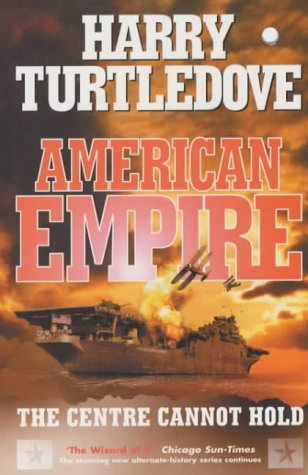 Just Finished Reading - American Empire: The Centre Cannot Hold by Harry Turtledove.
As I’ve already said, I do like the SF sub-genre of Alternate History. Although certainly not the best example of this sub-genre, Harry Turtledoves many books are certainly entertaining – almost hypnotically so. This particular volume was the 5th (or 6th depending if you count the prequel How Few Remain) in the series charting the lives of about 20 characters shaped by and shaping an alternate world where the Confederate States won the American Civil War.
The Centre Cannot Hold runs from the early 1920’s to 1934 through the Great Depression, the Occupation of Canada and the bombing of Los Angeles by the Japanese Air force. The victorious USA grows ever prosperous under the guidance of its 12 year Socialist administration (falling into Depression after 1929) whilst the CSA stumbles towards fascism, finally electing a hard right-wing President in 1934 dedicated to rebuilding and revenge.
Not exactly the best writing in the world but the narrative keeps moving forward and you do find yourself getting ‘involved’ in these peoples lives as they grow up, grow old and produce children of their own. Turtledove does have a few annoying habits – the worst of which is incessant repetition of events or characteristics – but once you get past that you can enjoy the ride. I have three more volumes to go in this saga and there’s another one just out in hardback. Looks like I won’t be running out of storyline just yet.
Tuesday, June 06, 2006
'New Monasticism' on the increase
From Ekklesia - 21/03/06
The number of 'monastic' Christian communities is on the increase, suggests new research. With the power, influence and privilege of Christendom crumbling, George Lings, Director of Church Army’s research unit The Sheffield Centre has claimed that the number of emerging monastic Christian communities is growing. His comments come in the latest edition of the magazine 'Encounters on the Edge' where he also speculates that the church may be entering a new 'dark age', with many Christians feeling there is an increasingly hostile environment around them.
His suggestions come ahead of a book to be published at the end of June by Ekklesia's director Jonathan Bartley, which looks at the phenomena of 'Post-Christendom' which will suggest that not all Christians lament the passing of Christendom. It will also critically assess the responses of those Christians who feel that they are being increasingly marginalized and excluded, sometimes even persecuted.
The 'new monasticism' has been identified as one type of fresh expression of church in the best-selling “Mission-shaped Church” report, is challenging the church to re-examine those areas of congregational life where there is a “weak sense of community, narrow attitude of enquiry, anaemic worship style and disconnection from issues of life.” Lings thinks it could even be of greater significance than most other fresh expressions because it invites us into a deeper spiritual life. Lings observes that most Anglican liturgies do little to nurture the calling of pioneers and evangelists and is not surprised by a stronger drive amongst the scores of fresh expressions of church being established which feed the calling and identity of hundreds of people who have discovered new and distinct ways of being church.
The Northumbria Community (a case study Lings examines in depth in the booklet) is “unusual and noteworthy in that both mission and community are deep in its DNA, and profoundly well-balanced. The danger for many fresh expressions is the reverse. Their temptations are to activism and to seek results in order to justify their existence before the watching church.”
From Ekklesia - 21/03/06
The number of 'monastic' Christian communities is on the increase, suggests new research. With the power, influence and privilege of Christendom crumbling, George Lings, Director of Church Army’s research unit The Sheffield Centre has claimed that the number of emerging monastic Christian communities is growing. His comments come in the latest edition of the magazine 'Encounters on the Edge' where he also speculates that the church may be entering a new 'dark age', with many Christians feeling there is an increasingly hostile environment around them.
His suggestions come ahead of a book to be published at the end of June by Ekklesia's director Jonathan Bartley, which looks at the phenomena of 'Post-Christendom' which will suggest that not all Christians lament the passing of Christendom. It will also critically assess the responses of those Christians who feel that they are being increasingly marginalized and excluded, sometimes even persecuted.
The 'new monasticism' has been identified as one type of fresh expression of church in the best-selling “Mission-shaped Church” report, is challenging the church to re-examine those areas of congregational life where there is a “weak sense of community, narrow attitude of enquiry, anaemic worship style and disconnection from issues of life.” Lings thinks it could even be of greater significance than most other fresh expressions because it invites us into a deeper spiritual life. Lings observes that most Anglican liturgies do little to nurture the calling of pioneers and evangelists and is not surprised by a stronger drive amongst the scores of fresh expressions of church being established which feed the calling and identity of hundreds of people who have discovered new and distinct ways of being church.
The Northumbria Community (a case study Lings examines in depth in the booklet) is “unusual and noteworthy in that both mission and community are deep in its DNA, and profoundly well-balanced. The danger for many fresh expressions is the reverse. Their temptations are to activism and to seek results in order to justify their existence before the watching church.”
Monday, June 05, 2006
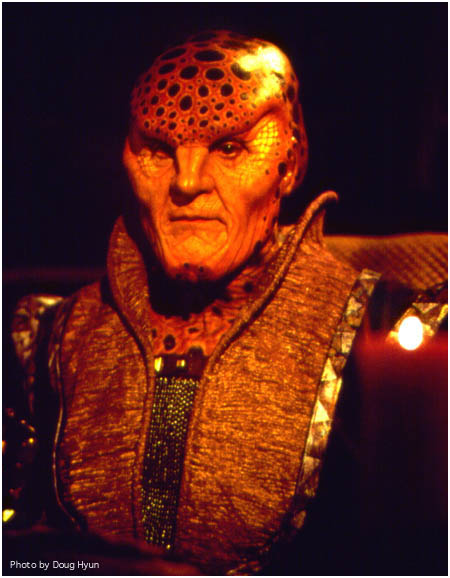 “No dictator, no invader, can hold an imprisoned population by force of arms forever. There is no greater power in the universe than the need for freedom. Against that power, governments and tyrants and armies cannot stand.”
Spoken by G’Kar in the SF Series Babylon 5 written by J. Michael Straczynski
 Hamster survives giant shredder
From BBC News.
Friday, 2 June 2006
A hamster has survived almost unscathed after spending several minutes passing through an industrial shredder. The rodent is thought to have got into a skip of rubbish that was taken to Recyclo recycling plant in Flintshire. It survived a giant shredder used to destroy waste such as washing machines and was found in a sorting area with no injuries other than a sore foot. The hamster, named Mike, has been adopted by Liam Bull, 10, whose father Craig works at Recyclo. Liam said: "I can't believe he's still alive after what happened, but he's doing fine now." The hamster's ordeal, which lasted around four minutes, began when it arrived at the plant in Sandycroft, probably aboard one of the many skips of waste which arrive there daily. As well as surviving the giant shredder, Mike passed through a rotating drum and vibrating grids before he was discovered by staff.
The plant's general manager, Tony Williams, said: "We deal with 300 to 400 tonnes of dry waste a day from all over Cheshire, Flintshire and Wrexham. "Some of the material is shredded and then goes through a series of conveyor belts and grids that enable smaller pieces of waste to fall through. "It seems that the hamster was small enough to pass through the blades of the shredder, but big enough to pass along the trammel without falling through an aperture. "We don't get very much animal activity here, but we're delighted Mike survived and is now being cared for."
Sunday, June 04, 2006
Pentagon Report Said to Find Killing of Iraqi Civilians Deliberate
by Drew Brown for Knight Ridder
Thursday, May 18, 2006
WASHINGTON - A Pentagon report on an incident in which U.S. Marines shot and killed more than a dozen Iraqi civilians last November will show that those killings were deliberate and worse than initially reported, a Pennsylvania congressman said Wednesday. "There was no firefight. There was no IED (improvised explosive device) that killed those innocent people," Rep. John Murtha, D-Pa., said during a news conference on Iraq. "Our troops overreacted because of the pressure on them. And they killed innocent civilians in cold blood. That is what the report is going to tell."
Murtha's comments were the first on-the-record remarks by a U.S. official characterizing the findings of military investigators looking into the Nov. 19 incident. Murtha, the ranking Democrat on the Defense Appropriations subcommittee and an opponent of Bush administration policy in Iraq, said he hadn't read the report but had learned about its findings from military commanders and other sources. Military public affairs officers said the investigation isn't completed and declined to provide further information. "There is an ongoing investigation," said Lt. Col. Sean Gibson, a Marine spokesman at Central Command headquarters in Tampa, Fla. "Any comment at this time would be inappropriate." Both Gibson and Pentagon spokeswoman Cheryl Irwin said that the military has yet to decide what, if any action, might be taken against Marines involved in the incident.
"It would be premature to judge any individual or unit until the investigation is complete," Irwin said. Said Gibson, "No charges have been made as we have to go through the entire investigatory process and determine whether or not that is a course of action." Three Marine commanders whose troops were involved in the incident were relieved of duty in April, but the Marines didn't link their dismissals to the incident, saying only that Gen. Richard Natonski, commander of 1st Marine Division, had lost confidence in the officers' ability to command. Gibson reiterated that point Wednesday. "It's important to remember that the officers were relieved by the commanding general of 1st Marine Division as a result of events that took place throughout their tour of duty in Iraq," he said.
The dismissed officers were Lt. Col. Jeffrey R. Chessani, commander of 3rd Battalion, 1st Marine Regiment, and two of his company commanders, Capt. James S. Kimber and Capt. Lucas M. McConnell. Gibson said all three have been assigned to staff jobs with the 1st Division. U.S. military authorities in Iraq initially reported that one Marine and 15 Iraqi civilians traveling in a bus were killed by a roadside bomb in the western Iraq insurgent stronghold of Haditha. They said eight insurgents were killed in an ensuing firefight. But Lt. Gen. Peter W. Chiarelli, the ground commander of coalition forces in Iraq, ordered an investigation on Feb. 14 after a reporter with Time magazine told military authorities of allegations that the Marines had killed innocent civilians.
After CNN broke the news of the initial investigation in March, military officials told Knight Ridder that the civilians were killed not in the initial blast but were apparently caught in the crossfire of a subsequent gun battle as 12 to 15 Marines fought insurgents from house to house over the next five hours. At that time, military officials told Knight Ridder that four of the civilians killed were women and five were children. Subsequent reporting from Haditha by Time and Knight Ridder revealed a still different account of events, with survivors describing Marines breaking down the door of a house and indiscriminately shooting the building's occupants. Twenty-three people were killed in the incident, relatives of the dead told Knight Ridder.
The uncle of one survivor, a 13-year-old girl, told Knight Ridder that the girl had watched the Marines open fire on her family and that she had held her 5-year-old brother in her arms as he died. The girl shook visibly as her uncle relayed her account, too traumatized to recount what happened herself. "I understand the investigation shows that in fact there was no firefight, there was no explosion that killed the civilians on a bus," Murtha said. "There was no bus. There was no shrapnel. There was only bullet holes inside the house where the Marines had gone in. So it's a very serious incident, unfortunately. It shows the tremendous pressure these guys are under every day when they're out in combat and the stress and consequences." Murtha, who retired as a colonel after 37 years in the Marine Corps, said nothing indicates that the Iraqis killed in the incident were at fault. "One man was killed with an IED," Murtha said, referring to a Marine killed by the roadside bomb. "And after that, they actually went into the houses and killed women and children."
by Drew Brown for Knight Ridder
Thursday, May 18, 2006
WASHINGTON - A Pentagon report on an incident in which U.S. Marines shot and killed more than a dozen Iraqi civilians last November will show that those killings were deliberate and worse than initially reported, a Pennsylvania congressman said Wednesday. "There was no firefight. There was no IED (improvised explosive device) that killed those innocent people," Rep. John Murtha, D-Pa., said during a news conference on Iraq. "Our troops overreacted because of the pressure on them. And they killed innocent civilians in cold blood. That is what the report is going to tell."
Murtha's comments were the first on-the-record remarks by a U.S. official characterizing the findings of military investigators looking into the Nov. 19 incident. Murtha, the ranking Democrat on the Defense Appropriations subcommittee and an opponent of Bush administration policy in Iraq, said he hadn't read the report but had learned about its findings from military commanders and other sources. Military public affairs officers said the investigation isn't completed and declined to provide further information. "There is an ongoing investigation," said Lt. Col. Sean Gibson, a Marine spokesman at Central Command headquarters in Tampa, Fla. "Any comment at this time would be inappropriate." Both Gibson and Pentagon spokeswoman Cheryl Irwin said that the military has yet to decide what, if any action, might be taken against Marines involved in the incident.
"It would be premature to judge any individual or unit until the investigation is complete," Irwin said. Said Gibson, "No charges have been made as we have to go through the entire investigatory process and determine whether or not that is a course of action." Three Marine commanders whose troops were involved in the incident were relieved of duty in April, but the Marines didn't link their dismissals to the incident, saying only that Gen. Richard Natonski, commander of 1st Marine Division, had lost confidence in the officers' ability to command. Gibson reiterated that point Wednesday. "It's important to remember that the officers were relieved by the commanding general of 1st Marine Division as a result of events that took place throughout their tour of duty in Iraq," he said.
The dismissed officers were Lt. Col. Jeffrey R. Chessani, commander of 3rd Battalion, 1st Marine Regiment, and two of his company commanders, Capt. James S. Kimber and Capt. Lucas M. McConnell. Gibson said all three have been assigned to staff jobs with the 1st Division. U.S. military authorities in Iraq initially reported that one Marine and 15 Iraqi civilians traveling in a bus were killed by a roadside bomb in the western Iraq insurgent stronghold of Haditha. They said eight insurgents were killed in an ensuing firefight. But Lt. Gen. Peter W. Chiarelli, the ground commander of coalition forces in Iraq, ordered an investigation on Feb. 14 after a reporter with Time magazine told military authorities of allegations that the Marines had killed innocent civilians.
After CNN broke the news of the initial investigation in March, military officials told Knight Ridder that the civilians were killed not in the initial blast but were apparently caught in the crossfire of a subsequent gun battle as 12 to 15 Marines fought insurgents from house to house over the next five hours. At that time, military officials told Knight Ridder that four of the civilians killed were women and five were children. Subsequent reporting from Haditha by Time and Knight Ridder revealed a still different account of events, with survivors describing Marines breaking down the door of a house and indiscriminately shooting the building's occupants. Twenty-three people were killed in the incident, relatives of the dead told Knight Ridder.
The uncle of one survivor, a 13-year-old girl, told Knight Ridder that the girl had watched the Marines open fire on her family and that she had held her 5-year-old brother in her arms as he died. The girl shook visibly as her uncle relayed her account, too traumatized to recount what happened herself. "I understand the investigation shows that in fact there was no firefight, there was no explosion that killed the civilians on a bus," Murtha said. "There was no bus. There was no shrapnel. There was only bullet holes inside the house where the Marines had gone in. So it's a very serious incident, unfortunately. It shows the tremendous pressure these guys are under every day when they're out in combat and the stress and consequences." Murtha, who retired as a colonel after 37 years in the Marine Corps, said nothing indicates that the Iraqis killed in the incident were at fault. "One man was killed with an IED," Murtha said, referring to a Marine killed by the roadside bomb. "And after that, they actually went into the houses and killed women and children."
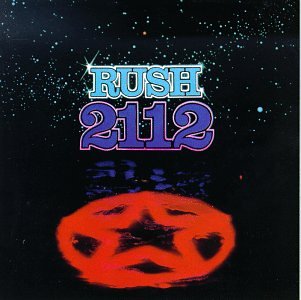 My Favourite Music: 2112 by Rush
My favourites do seem to be stuck in the 1970’s don’t they? Though first released in 1976 I probably didn’t hear this album until almost 10 years later. I was introduced to Rush by a friend in College who leant me Fly by Night to listen to on my newly acquired Sony Walkman. The rest, as they say, is history. I guess I was attracted to 2112 in particular by the long 20 minute first track which had a serious SF theme to it. I also really liked the second track A Passage to Bangkok. But what I like most about Rush is their almost orchestral feel despite being very much a 'progressive' rock band.
As far as I know the Rush sound is pretty unique and so far I own about 5-6 of their CD’s. I’m planning to own them all – it’ll stop me buying books for a while if nothing else. If you haven’t heard Rush before I can certainly recommend them and 2112 is as good a place as any to start a possible addiction.
Saturday, June 03, 2006
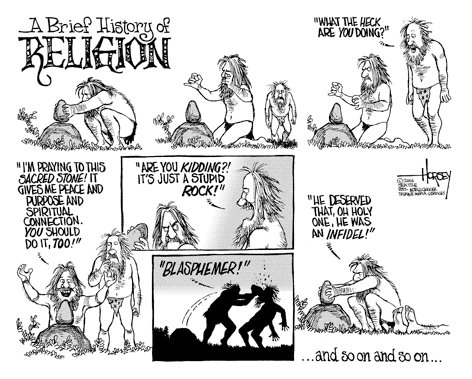
Praying for the Demise of Religion
by Rev. Kenneth W. Chalker for the Cleveland Plain Dealer
Monday, December 12, 2005
I have heard the line many times: "Rev, I want you to know right upfront that I'm spiritual - but not religious." This distinction is a 21st century American mantra: spiritual - but not religious. It could be on a T-shirt or a bumper sticker. Truth be told, in the wake of the recent United Methodist Judicial Council ruling mandating the reinstatement of a United Methodist pastor who had refused church membership to an openly gay man, I would be one of the folks wearing the T-shirt. I have been a parish pastor in the United Methodist Church for 31 years. This calling continues to be a marvelous, enriching and energizing spiritual experience. Among other things, it has made me deeply spiritual and leads me to pray daily for the demise of religion.
While sharing in the lives of people, I have had numerous encounters with the Holy, Infinite One. I have witnessed resurrections, liberations, high moments of justice and mercy, and life-changing acts of forgiveness. I have seen healings that restored broken hearts, fractured minds and shattered spirits. I have seen people who were sinking in turbulent waters suddenly walk on those waves as a result of renewed faith. I've seen waters part, revealing reliable paths to places of promise. I have seen bramble bushes of confusion and pain set ablaze with a Holy presence revealing messages of clarity and hope. I have heard angels sing of holy births even as death appears to close the eyes of cherished friends. Because of wonderfully hopeful things such as these, I believe what all world faith traditions reveal. Namely, that God is Spirit and thus never captured in a picture, idea, book or creed. Rather, the Holy One is always mysterious, awe-inspiring, hope-raising and fear-relieving. Encounters with the Spirit are at once and always an amazing grace. Religion, however, is what Satan devises as a way of confusing faithful people. Holy wars, suicide bombings and other religiously motivated killings prove the point.
Those of us who exercise our spirituality by attempting to follow in the footsteps of Jesus are very much aware that when Jesus was around religious people it made him nauseated. I believe that is why Jesus always enjoyed eating with sinners. It was the only way he could keep his lunch. In these religious times, church organizations are forsaking their initial spiritual impetus and going over to the dark side. Employing labored, amplified heavy breathing, they have become religious institutions. Like most institutions, religious ones are very much interested in preserving their various ways of doing things. That is, in large part, why there are judicial councils. Their job is not to keep the faith. Their job is to keep the rules and make folks think that "the rules" and "the faith" are the same thing. Most often, they are not. While the decision of the United Methodist Judicial Council purports to protect a pastor's right to ascertain a person's readiness to affirm the vows of membership in the church, it does nothing of the sort. The decision does what religion so often does: It sanctifies acts of hidden prejudice and self-righteousness.
Wonder of wonders, there are many, many clergy and laypersons who serve in and give life to many, many churches, synagogues, mosques, temples and prayer rooms. They are those who each day open the doors of such places in marvelous ways. They welcome folks in. They step out into the streets to help others. They transform communities and daily work to make things better. They relieve suffering and amplify - as well as enable rejoicing. Such faithful people reveal that the Spirit is alive and active in our midst. They also know that judicial council terms come to an end and prejudices will one day pass away. In the meantime (and sometimes the times are very mean), institutional religion continues to be a mind-numbing reality. In all cultures, it preserves the status quo in ice. That is why religious folks often seem to be the "frozen chosen" rather than ones warmed by the fire of the Spirit with tolerance, acceptance and love, and set ablaze with a passion for justice.
Putting people out is a coldly religious thing to do. In the end, the rooms from which people have been excluded become empty. The temperature is turned way down to save expenses. Not much is going on in those rooms, but at least they are neat and orderly. Current judicial councils, like all of them over time, very much like it that way. Among other things, the thermostats in their rooms never have to be reset and the chairs need never be moved for their small, bi-annual meetings.
by Rev. Kenneth W. Chalker for the Cleveland Plain Dealer
Monday, December 12, 2005
I have heard the line many times: "Rev, I want you to know right upfront that I'm spiritual - but not religious." This distinction is a 21st century American mantra: spiritual - but not religious. It could be on a T-shirt or a bumper sticker. Truth be told, in the wake of the recent United Methodist Judicial Council ruling mandating the reinstatement of a United Methodist pastor who had refused church membership to an openly gay man, I would be one of the folks wearing the T-shirt. I have been a parish pastor in the United Methodist Church for 31 years. This calling continues to be a marvelous, enriching and energizing spiritual experience. Among other things, it has made me deeply spiritual and leads me to pray daily for the demise of religion.
While sharing in the lives of people, I have had numerous encounters with the Holy, Infinite One. I have witnessed resurrections, liberations, high moments of justice and mercy, and life-changing acts of forgiveness. I have seen healings that restored broken hearts, fractured minds and shattered spirits. I have seen people who were sinking in turbulent waters suddenly walk on those waves as a result of renewed faith. I've seen waters part, revealing reliable paths to places of promise. I have seen bramble bushes of confusion and pain set ablaze with a Holy presence revealing messages of clarity and hope. I have heard angels sing of holy births even as death appears to close the eyes of cherished friends. Because of wonderfully hopeful things such as these, I believe what all world faith traditions reveal. Namely, that God is Spirit and thus never captured in a picture, idea, book or creed. Rather, the Holy One is always mysterious, awe-inspiring, hope-raising and fear-relieving. Encounters with the Spirit are at once and always an amazing grace. Religion, however, is what Satan devises as a way of confusing faithful people. Holy wars, suicide bombings and other religiously motivated killings prove the point.
Those of us who exercise our spirituality by attempting to follow in the footsteps of Jesus are very much aware that when Jesus was around religious people it made him nauseated. I believe that is why Jesus always enjoyed eating with sinners. It was the only way he could keep his lunch. In these religious times, church organizations are forsaking their initial spiritual impetus and going over to the dark side. Employing labored, amplified heavy breathing, they have become religious institutions. Like most institutions, religious ones are very much interested in preserving their various ways of doing things. That is, in large part, why there are judicial councils. Their job is not to keep the faith. Their job is to keep the rules and make folks think that "the rules" and "the faith" are the same thing. Most often, they are not. While the decision of the United Methodist Judicial Council purports to protect a pastor's right to ascertain a person's readiness to affirm the vows of membership in the church, it does nothing of the sort. The decision does what religion so often does: It sanctifies acts of hidden prejudice and self-righteousness.
Wonder of wonders, there are many, many clergy and laypersons who serve in and give life to many, many churches, synagogues, mosques, temples and prayer rooms. They are those who each day open the doors of such places in marvelous ways. They welcome folks in. They step out into the streets to help others. They transform communities and daily work to make things better. They relieve suffering and amplify - as well as enable rejoicing. Such faithful people reveal that the Spirit is alive and active in our midst. They also know that judicial council terms come to an end and prejudices will one day pass away. In the meantime (and sometimes the times are very mean), institutional religion continues to be a mind-numbing reality. In all cultures, it preserves the status quo in ice. That is why religious folks often seem to be the "frozen chosen" rather than ones warmed by the fire of the Spirit with tolerance, acceptance and love, and set ablaze with a passion for justice.
Putting people out is a coldly religious thing to do. In the end, the rooms from which people have been excluded become empty. The temperature is turned way down to save expenses. Not much is going on in those rooms, but at least they are neat and orderly. Current judicial councils, like all of them over time, very much like it that way. Among other things, the thermostats in their rooms never have to be reset and the chairs need never be moved for their small, bi-annual meetings.
 Wouldn’t it be cool to be able to fly?
Prompted, at least partially, by my recent viewing of X-Men 3: The Last stand I’ve been thinking about how cool it would be to be able to fly. Having the ability to just leap into the air whenever you felt like it and fly off somewhere. Wouldn’t that be so liberating?
I sometimes catch myself watching birds flying around and can’t help but wonder if they actually enjoy their abilities. I suppose it’s a bit like asking if people enjoy walking or if fish enjoy swimming. It’s just something that they do without much thought. But sometimes I do get the feeling that birds actually do enjoy flying. You can see them sometimes seemingly ‘playing’ with the wind, almost testing their limits. You see them at other times doing acrobatics with others of their kind and that’s just got to be fun.
OK. I’m sure that flying probably has its downside too and would undoubtedly present no end of practical problems if humans could do it – but we can dream, can’t we?
Friday, June 02, 2006
Subscribe to:
Posts (Atom)