About Me

My photo
I have a burning need to know stuff and I love asking awkward questions.
Showing posts with label Philosophy. Show all posts

Thursday, June 11, 2026


Just Finished Reading: How to Use Your Enemies by Baltasar Gracian (FP: 1647) [54pp] 

This was SO much fun! Extracted from the larger Penguin Classics work ‘The Pocket Oracle and Art of Prudence’ it read very much like Maciavelli’s ‘The Prince’ except that this book was aimed at the average person rather than the higher levels of society.  

Broadly speaking this was a list of acts and activities that could both protect the reader from the actions of others as well as advice on how to profit and progress in a world that is far from safe or secure. A few examples will show what I mean: 

Cautious silence is the refuge of good sense

A person without knowledge is a world in darkness

No one is born complete; perfect yourself and your activities day by day until you become a truly consummate being

Don’t so belong to others that you don’t belong to yourself

Always be suspicious of unbroken good fortune; far safer is fortune that’s mixed, and for it to be bittersweet even whilst you are enjoying it

...and that’s just a random handful of quotable moments from the first NINE pages! This is one of those classic advice manuals that are timeless (as is human nature and the human experience) and can be dipped into or read and re-read at regular intervals through a life and will reward your attention every time you do so. I’ll definitely be picking up the longer work (not at full price though as I think it's somewhat OVER-priced!) as soon as I can source a copy. 

I’m not sure if I’m surprised or not that Gracian was a Jesuit priest and presumably knew a thing or two about the uses and abuses of power as well as how people could, indeed needed to, protect themselves against both. From what I can tell from his writing he was one SMART cookie. Definitely recommended, but I’d plump for the full work rather than this booklet extract.  

Translated from the Spanish by Jeremy Robbins  

Monday, May 18, 2026


Just Finished Reading: Immortality – The Quest to Live Forever and How It Drives Civilisation by Stephen Cave (FP: 2012) [307pp] 

Here the author makes a rather sweeping proposition – that THE drive to civilisation since its very beginnings has been the unending search for ways to live forever. That’s quite the idea, so I was intrigued to see if he could pull it off.  

Essentially, he split the idea of immortality into four separate threads which each giving rise to different expansions of technology, ideas or beliefs each of which helped shape the world we inhabit. The first, logically, is actual physical immortality with the body and mind you were born with – mostly. This is the process where health is the primary outcome depending on medicine, vaccinations, food security and so on. Clearly such things might enhance longevity somewhat but not enough to live beyond our normal span. This means going further with progressively intrusive medical procedures, technological enhancements etc.. Going further still we have ideas such as transferring the human brain into indestructible robot bodies or ‘uploading’ minds into machines. Each step extends life a little, or a lot, further into the future. 

Then we have bodily reincarnation after death with the hope (dream?) of being brought back by future technical means or within a spiritual belief system. The next link in the chain encompasses various beliefs in ‘souls’ that are the essential you which, after bodily death, migrate into another reality or in some way re-engage with the material world for another round of life. Finally, we have the idea of living in the memories and culture of future generations as an historical figure through stories, icons and monuments left behind. 

Although the author does make some case for his thesis I don’t think he quite brings it off. I’d certainly go so far as saying that the idea of living forever – by whatever means – could be seen as ‘A’ driver behind various scientific endeavours and religious or philosophical belief systems I certainly wouldn’t go so far as to say it is ‘THE’ driver. On top of that I had a problem throughout by how the author defined immortality itself – taking it to the extreme with it meaning essentially outliving the Universe itself trillions of years hence with its predicted heat death. Personally, if someone could live for 10 THOUSAND years never mind 10 TRILLION years, I’d say that they’re as good as immortal at that point. 

But is immortality – ignoring the religious side of things – even possible? I think it's possible (or at least conceivable) that science can extend life a great deal. Even with present technology an average life expectancy of 100 years is achievable. Even something like 125-150 healthy years is probably not beyond us. Going much further will probably demand some radical breakthroughs beyond cloned organs and so on. With complete cloned bodies (or their replacing by – for want of a better term – androids) and an ‘uploaded’ consciousness we should be able to live a great deal longer. The only question would be – is that REALLY you? Is a copy of you – which is what we’re talking about here – really YOU isn’t just a philosophical question. It may look like you and might even feel like you from the inside but it's still a simulacrum. Somehow, I’m not sure if we can even get that far even in the reasonably far future – but who knows? This was an interesting dive into some rather fringe ideas (hopes?) with a scattering of religious belief and philosophy throughout. Reasonable. 

Monday, May 11, 2026


Just Finished Reading: A Cup of Sake Beneath the Cherry Trees by Yoshida Kenko [51pp] 

On plucking this out of the Penguin Classics boxset I thought: Oh... ANOTHER poetry booklet. What FUN! But I was, thankfully, wrong. This wasn’t poetry at all. It was instead the musing of a 14th century Japanese monk on Life, the Universe and Everything. It was, actually, rather interesting if a bit strange from time to time. 

One of the things that does surprise me reading this sort of thing was how often very different philosophies from very different cultures tend to come to broadly similar conclusions on the human condition that we all have to deal with. I suppose that it’s the fact that, despite culture or sometimes vast chasms of time we are all still human beings doing what humans do. That side of things changes very little in the grand scheme of things. 

Being of the time and place involved, the author does have a very hierarchical view of things. Those in the highest places, especially the Emperor himself, are exalted and deserve to be in those places because they are (obviously) superior beings. At the same time the poor and destitute are in THEIR place because of fundamental failings in character or through their behaviour in previous incarnations.  

Probably the strangest thing the author said was that everyone should aim to be dead before reaching 40 years of age. Personally, my post-40's where some of my very best years! There was much about how distracting women are (true) and how men have their heads turned all too easily (also true). Much also about friends and the pleasure of good conversation (couldn’t agree more), and, of course, the delight of sitting alone reading a good book! 

As you might expect there are several criticisms throughout the text on the pursuit of wealth, power and fame. What is the use of such things, the author maintains, when they stop you appreciating the beauty of a snowy landscape and forget to remark on it to an acquaintance.  

This was a booklet full of interesting cultural insights, gentle wisdom and a few funny stories. As an introduction both to Japanese culture and Buddhist philosophy it's pretty fair. Recommended. 

Translated from the Japanese by Meredith McKinney

Saturday, February 28, 2026


Happy Birthday: Michel Eyquem, Seigneur de Montaigne (28 February 1533 – 13 September 1592), commonly known as just Michel de Montaigne, was one of the most significant philosophers of the French Renaissance. He is known for popularising the essay as a literary genre. His work is noted for its merging of casual anecdotes and autobiography with intellectual insight. Montaigne had a direct influence on numerous writers of Western literature; his Essais contain some of the most influential essays ever written.

During his lifetime, Montaigne was admired more as a statesman than as an author. The tendency in his essays to digress into anecdotes and personal ruminations was seen as detrimental to proper style, rather than as an innovation; moreover, his declaration that "I am myself the matter of my book" was viewed by his contemporaries as self-indulgent. In time, however, Montaigne came to be recognised as embodying the spirit of critical thought and open inquiry that began to emerge around that time. He is best known for his sceptical remark, "Que sçay-je ?" ("What do I know?", in Middle French; "Que sais-je ?" in modern French).

Montaigne's humanism is expressed in his Essais (published in 1580), a large collection of short, subjective essays on various topics; these essays were inspired by his studies in the classics, especially the works of Plutarch and Lucretius. Montaigne's stated goal was to describe humans, and especially himself, with complete frankness.

Inspired by considering the lives and ideals of leading figures of his age, Montaigne finds the most basic feature of human nature to be its great variety and volatility. He describes his own poor memory; his ability to solve problems and mediate conflicts without getting deeply involved emotionally; his disdain for the human pursuit of enduring fame; and his attempts to detach himself from worldly things to prepare for his approaching death. He also writes about his disgust with the religious conflicts of the time. He believed that humans are unable to attain true certainty. The longest of his essays, Apology for Raymond Sebond, marks his adoption of Pyrrhonism and contains the famous motto, "What do I know?"

Montaigne considered marriage necessary for raising children, but he disliked feelings of passionate love, because he saw them as detrimental to freedom. In education, he favored concrete examples and experience over abstract knowledge that is intended to be accepted uncritically. His essay "On the Education of Children" is dedicated to Diana of Foix.

The Essais exerted a significant influence on both French and English literature, shaping thought as well as style. Francis Bacon's Essays, published more than a decade later (first in 1597), are usually assumed to reflect direct influence by Montaigne's collection, and Montaigne is cited by Bacon alongside other classical sources in later essays.

Saturday, December 20, 2025


Happy Birthday: Alain de Botton FRSL (born 20 December 1969) is a Swiss-born British author and public speaker. His books discuss various contemporary subjects and themes, emphasizing philosophy's relevance to everyday life. He published Essays in Love (1993), which went on to sell two million copies. Other bestsellers include How Proust Can Change Your Life (1997), Status Anxiety (2004), and The Architecture of Happiness (2006).

He co-founded The School of Life in 2008 and Living Architecture in 2009. He was elected a Fellow of the Royal Society of Literature in 2011. In 2015, he was awarded "The Fellowship of Schopenhauer", an annual writers' award from the Melbourne Writers Festival, for that work.

De Botton was born in Zürich, the son of Jacqueline (née Burgauer) and Gilbert de Botton. Gilbert was born in Alexandria, Egypt, but went to live and work in Switzerland, where he co-founded an investment firm, Global Asset Management; his family was estimated to have been worth £234 million in 1999.

Alain de Botton's Swiss-born mother was Ashkenazi, and his father was from a Sephardic Jewish family from the town of Boton in Castile and León. De Botton's ancestors include Abraham de Boton. De Botton's paternal grandmother was Yolande Harmer, a Jewish-Egyptian journalist who spied for Israel and died in Jerusalem.

He has one sister, Miel, and they received a secular upbringing. Alain spent the first twelve years of his life in Switzerland where he was brought up speaking French and German.

Monday, October 13, 2025


Just Finished Reading: Aphorisms on Love and Hate by Fredrich Nietzsche (FP: 1878) [55pp] 

Reading the way I do, it’s hard to avoid Nietzsche. I’ve certainly come across him numerous times in my Philosophy reading and have read several books about his ideas. I only studied him more intently during my Masters degree course some years ago where we focused on his 1887 work ‘On the Genealogy of Morality’. It was funny when, as we were about to start the seminar that the Head of Studies popped in and said that she was always wary of teaching Nietzsche to undergraduates because of its explosive nature. I understand her trepidation. I described reading his work as like breathing pure oxygen. 

Reading Nietzsche is, however, far from easy. He’s not a philosopher you can skim read or casually dip into. He’s the kind of thinker that requires a paragraph or more to unpack a single sentence. It’s almost as if he has compressed, zipped, his ideas inside the words he uses and some effort – and sometimes a great deal of effort – is required to unfold them into ideas your brain can process. I guess it's like the difference between eating simple carbohydrates which the body can easily convert to useful energy compared to complex proteins that take time and effort to absorb but provide vital elements that the body needs. Fortunately, the course tutor was excellent – and probably one of the smartest people I’ve ever known – so he managed to get his point across without completely frying our brains. This certainly helped with reading this slim volume. 

Containing extracts from Human, All Too Human (published in 1878), this covered a fairly wide area – not just Love and Hate – to do with ideas like Good and Evil, Suffering, Pity, Morality, Revenge, Justice and much else besides. Being typically Nietzschean the booklet positively drips with often razor sharp one liner’s. Here’s a few examples: 

Most men are much too concerned with themselves to be malicious. 

There will be but few people who, when at a loss for topics of conversation, will not reveal the most secret affairs of their friends. 

It is much more agreeable to offend and later ask forgiveness than to be offended and grant forgiveness.  

The best friend will probably get the best wife, because a good marriage is based on a talent for friendship. 

This was a fun little read and a reminder (as if I needed one) to get back into reading Philosophy again. I have (I think) most of Nietzsche’s works on my (mostly) Philosophy bookshelf so there’s no excuse. Expect one or two next year. Part of the Penguin Little Black Classics series. 

Translated from the German by Marion Faber and Stephen Lehmann. 

Saturday, September 06, 2025


Happy Birthday: Robert Maynard Pirsig (September 6, 1928 – April 24, 2017) was an American writer and philosopher. He is the author of the philosophical books Zen and the Art of Motorcycle Maintenance: An Inquiry into Values (1974) and Lila: An Inquiry into Morals (1991), and he co-authored On Quality: An Inquiry Into Excellence: Selected and Unpublished Writings (2022) along with his wife and editor, Wendy Pirsig.

Pirsig was born on September 6, 1928, in Minneapolis, Minnesota, the son of Harriet Marie Sjobeck and Maynard Pirsig. He was of German and Swedish descent. His father was a graduate of the University of Minnesota Law School, taught in that school from 1934, served as its dean from 1948 to 1955, and retired from teaching there in 1970. Pirsig senior subsequently taught at the William Mitchell College of Law until his retirement in 1993.

A precocious child with an alleged IQ of 170 at the age of nine, Pirsig skipped several grades at the Blake School in Minneapolis. In May 1943, he was awarded a high school diploma at the age of 14 by the University High School (later renamed Marshall-University High School), where he had edited the school yearbook, the Bisbilla. Pirsig then studied biochemistry at the University of Minnesota. In Zen and the Art of Motorcycle Maintenance, he describes the central character, thought to represent himself, as being an atypical student, interested in science in itself rather than as a professional career path.

In the course of his studies, Pirsig became intrigued by the multiplicity of putative causes for a given phenomenon, and increasingly focused on the role played by hypotheses in the scientific method and sources from which they originate. His preoccupation with these matters led to a decline in his grades and expulsion from the university.

In 1946, Pirsig enlisted in the United States Army and was stationed in South Korea until 1948. Upon his discharge from the Army, he lived for several months in Seattle, Washington, and then returned to the University of Minnesota, from which he received a bachelor's degree in 1950. He and his wife worked at the Nevada Club in Reno, Nevada and saved enough to move to Acayucan, Mexico with the intent to write a great book. He subsequently studied philosophy at Banaras Hindu University in India and the Committee on the Analysis of Ideas and Study of Methods at the University of Chicago. In 1958 he earned a master's degree in journalism from the University of Minnesota.

[My hippy Law teacher leant me her copy of 'Zen' in my late teens and said that it would "change my life". It didn't... but it certainly had a long term effect on me, even if some of it went completely over my head back then. I think my native ability was still just too raw back then. Actually, thinking back on it, a few teachers actually leant me books... They obviously saw potential in me...... I think its about time I re-read 'Zen' to see what I missed the first time.] 

Monday, July 28, 2025


Just Finished Reading: A Brief History of Misogyny – The World’s Oldest Prejudice by Jack Holland (FP: 2006) [291pp] 

I have never understood tarring a group, especially a large group, with the same brush and calling them, with high confidence indeed, either stupid, overly emotional, dangerous, weak or any other negative epithet. Anyone who knows members of any particular group – that would be pretty much all of us – knows for a fact that there is variation amongst them. The bigger the sample the bigger the variation – and that’s before we get Darwin involved. So, to get to my point, I have never understood the fact that women – HALF the human population no less – have, throughout history and across the world, generally been treated as second-class citizens AT BEST. This has always confounded me so I was hoping that this tome might either answer that question (spoiler alert: it didn’t) or at least point me in the right direction to look for more answers (which it partially did). 

The author was kind of stating the obvious when he stated that Misogyny has been around for a very long time – and certainly as long as writing has existed – and in all cultures. This is despite the reverence for the Female (or certain aspects of the female like purity, obedience and so on) at times bordering on the obsessive. Generally, women are seen as less, secondary, adjuncts to the more powerful, more relevant, more necessary, male. The female exists to help the male, to be his solace and, of course, to bare his children (preferably males at least to begin with). I can certainly understand the control (or attempted control) of women's sexuality by men. Knowing that you are, in fact, the father of a child has always been important in all kinds of societies from the very earliest days, especially where any kind of inheritance is involved. Of course, this has become a central focus of male anxiety which has fuelled the creation of laws, customs, art, literature and countless acts of violence. 

As the title suggests this is very much a HISTORY of a prejudice and looked at some origins (at least in the West) with Greek philosophy and early Christianity. Although the focus was mostly Western the author does touch on Eastern origins too, just not as deeply. The rest of the book is a rapid run through Ancient Rome, misogyny in the Christian church, in literature, Victorian England, the autocratic years in the 1930’s and 40’s and during the Sexual Revolution. The one thing the author doesn’t really cover, although he makes some attempt in the conclusion, is the central WHY of things. Sure, women have been discriminated against in a hundred ways for the last 10K years... But why? The author didn’t, in my opinion at least, make a very good stab at answering that which was more than a little disappointing. I can think of a few ideas that might address at least SOME of the reasons, but an overall overarching explanation that fits all cultures, and all times is beyond me. I thought this was a useful, if flawed, start at looking at this issue and I’ll continue to delve deeper. I don’t think I learned much that was new or surprising, but I wouldn’t go so far as to say this was a waste of my time. Reasonable. 

Saturday, June 28, 2025


Happy Birthday: Jean-Jacques Rousseau (28 June 1712 – 2 July 1778) was a Genevan philosopher (philosophe), writer, and composer. His political philosophy influenced the progress of the Age of Enlightenment throughout Europe, as well as aspects of the French Revolution and the development of modern political, economic, and educational thought.

His Discourse on Inequality, which argues that private property is the source of inequality, and The Social Contract, which outlines the basis for a legitimate political order, are cornerstones in modern political and social thought. Rousseau's sentimental novel Julie, or the New Heloise (1761) was important to the development of pre-romanticism and romanticism in fiction. His Emile, or On Education (1762) is an educational treatise on the place of the individual in society. Rousseau's autobiographical writings—the posthumously published Confessions (completed in 1770), which initiated the modern autobiography, and the unfinished Reveries of the Solitary Walker (composed 1776–1778)—exemplified the late 18th-century "Age of Sensibility", and featured an increased focus on subjectivity and introspection that later characterized modern writing.

Rousseau based his political philosophy on contract theory and his reading of Thomas Hobbes. Reacting to the ideas of Samuel von Pufendorf and John Locke was also driving his thought. All three thinkers had believed that humans living without central authority were facing uncertain conditions in a state of mutual competition. In contrast, Rousseau believed that there was no explanation for why this would be the case, as there would have been no conflict or property. Rousseau especially criticized Hobbes for asserting that since man in the "state of nature... has no idea of goodness he must be naturally wicked; that he is vicious because he does not know virtue". On the contrary, Rousseau holds that "uncorrupted morals" prevail in the "state of nature".

Saturday, June 21, 2025


Happy Birthday: Jean-Paul Charles Aymard Sartre (21 June 1905 – 15 April 1980) was a French philosopher, playwright, novelist, screenwriter, political activist, biographer, and literary critic, considered a leading figure in 20th-century French philosophy and Marxism. Sartre was one of the key figures in the philosophy of existentialism (and phenomenology). His work has influenced sociology, critical theory, post-colonial theory, and literary studies. He was awarded the 1964 Nobel Prize in Literature despite attempting to refuse it, saying that he always declined official honours and that "a writer should not allow himself to be turned into an institution."

Sartre held an open relationship with prominent feminist and fellow existentialist philosopher Simone de Beauvoir. Together, Sartre and de Beauvoir challenged the cultural and social assumptions and expectations of their upbringings, which they considered bourgeois, in both lifestyles and thought. The conflict between oppressive, spiritually destructive conformity (mauvaise foi, literally, 'bad faith') and an "authentic" way of "being" became the dominant theme of Sartre's early work, a theme embodied in his principal philosophical work Being and Nothingness (L'Être et le Néant, 1943). Sartre's introduction to his philosophy is his work Existentialism Is a Humanism (L'existentialisme est un humanisme, 1946), originally presented as a lecture.

Sartre's primary idea is that people, as humans, are "condemned to be free". He explained, "This may seem paradoxical because condemnation is normally an external judgment which constitutes the conclusion of a judgment. Here, it is not the human who has chosen to be like this. There is a contingency of human existence. It is a condemnation of their being. Their being is not determined, so it is up to everyone to create their own existence, for which they are then responsible. They cannot not be free, there is a form of necessity for freedom, which can never be given up."

This theory relies upon his position that there is no creator, and is illustrated using the example of the paper cutter. Sartre says that if one considered a paper cutter, one would assume that the creator would have had a plan for it: an essence. Sartre said that human beings have no essence before their existence because there is no Creator. Thus: "existence precedes essence". This forms the basis for his assertion that because one cannot explain one's own actions and behaviour by referring to any specific human nature, they are necessarily fully responsible for those actions. "We are left alone, without excuse." "We can act without being determined by our past which is always separated from us."

Sartre maintained that the concepts of authenticity and individuality have to be earned but not learned. We need to experience "death consciousness" so as to wake up ourselves as to what is really important; the authentic in our lives which is life experience, not knowledge. Death draws the final point when we as beings cease to live for ourselves and permanently become objects that exist only for the outside world. In this way death emphasizes the burden of our free, individual existence. "We can oppose authenticity to an inauthentic way of being. Authenticity consists in experiencing the indeterminate character of existence in anguish. It is also to know how to face it by giving meaning to our actions and by recognizing ourselves as the author of this meaning. On the other hand, an inauthentic way of being consists in running away, in lying to oneself in order to escape this anguish and the responsibility for one's own existence."

Saturday, May 03, 2025


Happy Birthday: Niccolò di Bernardo dei Machiavelli (3 May 1469 – 21 June 1527) was a Florentine diplomat, author, philosopher, and historian who lived during the Italian Renaissance. He is best known for his political treatise The Prince (Il Principe), written around 1513 but not published until 1532, five years after his death. He has often been called the father of modern political philosophy and political science.

For many years he served as a senior official in the Florentine Republic with responsibilities in diplomatic and military affairs. He wrote comedies, carnival songs, and poetry. His personal correspondence is also important to historians and scholars of Italian correspondence. He worked as secretary to the second chancery of the Republic of Florence from 1498 to 1512, when the Medici were out of power.

After his death Machiavelli's name came to evoke unscrupulous acts of the sort he advised most famously in his work, The Prince. He concerned himself with the ways a ruler could survive in politics, and knew those who flourished engaged in deception, treachery, and crime. He advised rulers to engage in evil when political necessity requires it, at one point stating that successful founders and reformers of governments should be excused for killing other leaders who would oppose them. Machiavelli's Prince has been surrounded by controversy since it was published. Some consider it to be a straightforward description of political reality. Many view The Prince as a manual, teaching would-be tyrants how they should seize and maintain power. Even into recent times, some scholars, such as Leo Strauss, have restated the traditional opinion that Machiavelli was a "teacher of evil".

Thursday, November 21, 2024


Just Finished Reading: I, Warbot – The Dawn of Artificially Intelligent Conflict by Kenneth Payne (FP: 2021) [256pp] 

Anyone who has been paying attention to the news has, no doubt, witnessed the explosive increase in drone use and drone power on the battlefield – not only in Ukraine but elsewhere across the world. Drones, it seems, are it. Coupled with drones are the use of highly sophisticated missiles and (quite possibly) even more sophisticated missile defences. It's all VERY impressive. The smart missiles gain their smarts from the ability to self-guide after launch and some can even pick a second target if they ‘realise’ the first target has been destroyed. Some missiles can even respond with counter measures if detected. What they can’t do, of course, is think. They can’t really ‘decide’ what to do – they're programmed with a set of instructions which essentially follow a ‘IF this THEN...’ structure. They respond to the environment, sure, but only in a very limited fashion. 

Drones, no matter how good they are, are by and large, human controlled, human directed and human deployed. Generally, their ‘intelligence’ without human involvement is almost non-existent. Yet they are, as we’ve seen time and time again on video feeds VERY combat effective. Because of this both anti-drone and especially anti-missile systems need to be VERY good and, most importantly, VERY quick. This means that humans can’t really be ‘in the loop’ - they can’t really be given the final authority to engage an incoming target. With as little as a few seconds to respond, humans are just too SLOW. Machines, aided with still rudimentary AI is much better suited to this sort of thing and can detect, confirm and launch a response in the time it takes a human to start to recognise a threat. With the way things are clearly going that’s a BIG problem. 

Enter AI (Artificial Intelligence) or at least the hopes, the hype, the advertised AI. Its proponents and manufacturers tell us, and their military customers, that AI can (at least ultimately) solve their very real problems – kind of set a thief to catch (or shoot down) a thief. The problem is, naturally, that putting AI into a weapon – especially a disposable/kamikaze one – is going to be a LOT easier that putting one into a system to defend against them. Again, this will mean removing or reducing the humans in the loop to save vital seconds but there’s a real problem that militaries all over the world are facing – AI isn’t really all that good despite the hype. We are a LONG LONG way from Terminators or SkyNet (thankfully). AI is good, often VERY good, in narrow clearly defined tasks but take it just a bit out of its comfort zone and it falls apart or simply stops ‘unsure’ how to proceed. Not exactly something you want to happen with a missile defence network during a shooting war. 

These issues, and much more besides, are intelligently discussed in this fascinating book. The author certainly knows his way around the topic, not only from the military hardware side of things along with the tactical and strategic implications of such, but also AI research, breakthroughs in understanding the human brain, Game Theory, and the Philosophy of Mind. It was, for ME at least [grin], highly engaging. About the only ‘fault’ I could find – and it certainly wasn’t a fault of the author – is that despite its recent publication the pace of drone, missile and robot development has already made some observations in the book increasingly obsolete. But, that’s the danger of reading books, which take an appreciable time to become published (even in my hardback edition), on such topics. Taking this caveat into account this is still a very good accounting of the recent impact of AI on military technology and thinking both at the tactical and strategic level. Military AI is here to stay and will become ever more powerful and more deeply integrated into military forces across the world. I was particularly interested in the ‘half-way house’ of human-machine teams (such as the loyal wingman programme adding drones to aircraft to enhance their combined effectiveness) which are called Centaurs! How funky is that! Definitely recommended for science, technology and warfare geeks out there.  

Saturday, April 27, 2024


Happy Birthday: Mary Wollstonecraft (27 April 1759 – 10 September 1797) was a British writer, philosopher, and advocate of women's rights. Until the late 20th century, Wollstonecraft's life, which encompassed several unconventional personal relationships at the time, received more attention than her writing. Today Wollstonecraft is regarded as one of the founding feminist philosophers, and feminists often cite both her life and her works as important influences.

During her brief career she wrote novels, treatises, a travel narrative, a history of the French Revolution, a conduct book, and a children's book. Wollstonecraft is best known for A Vindication of the Rights of Woman (1792), in which she argues that women are not naturally inferior to men but appear to be only because they lack education. She suggests that both men and women should be treated as rational beings and imagines a social order founded on reason.

After two ill-fated affairs, with Henry Fuseli and Gilbert Imlay (by whom she had a daughter, Fanny Imlay), Wollstonecraft married the philosopher William Godwin, one of the forefathers of the anarchist movement. Wollstonecraft died at the age of 38 leaving behind several unfinished manuscripts. She died 11 days after giving birth to her second daughter, Mary Shelley, who became an accomplished writer and the author of Frankenstein.

Monday, December 18, 2023


Just Finished Reading: The Consolation of Philosophy by Boethius [161pp] 

I’ve had this on my shelves for years – if not over a decade – and thought it was about time I actually read it, especially as I ‘recently’ acquired a companion read (up next) which would make a nice contrast. I think I bought this just prior to my Philosophy degree as it was on the recommended reading list. I ended up choosing an Aristotle related question for my Ancient Philosophy unit, so didn’t ‘need’ to read this so ended up missing it.  

I’d heard of it before (it’s hard to avoid in some circles!) so had some idea of the subject matter and the history of how it came to be written. The author was an early Christian in a position of some power around the end of the Western Roman Empire or shortly after(ish). For a variety of reasons, he ended up annoying other people in power and he ended up in prison where he wrote Consolation. This was essentially a dialogue between the author and the personification of Philosophy about a variety of subjects including why he, as a Good Man, was in prison in the first place. Most of this conversation revolved around ideas of the Good (which was all very Greek, indeed Platonic, in nature) so didn’t float my boat overly much. What I’ve read of Plato (only excerpts so far) hasn’t impressed me much and I’m far more a fanboy of Aristotle. Fortunately, things became more interesting as the author became a bit less self-focused. 

One of the things that did interest me, and made me smile more than once, was the fact that perennial questions, still mentioned today, came up during their conversation – specifically why bad things happen to good people (and why good things happen to bad people!) - and included a very well argued look at Free Will in contrast to God’s omniscience. I have sometimes pondered about the apparent conflict with the idea that if God already knows exactly what we’re going to do in the future how can we possibly have Free Will which HE gave us? I now understand how that particular circle can be squared and it no longer ‘bothers’ me. It’s all about perspective. We, being the limited creatures that we are, live in Linear Time. God, of course, does not and can see Past, Present AND Future simultaneously. Therefore, he can see what we’re doing, see what happens because of that and see the end result. But that doesn’t mean we don’t still have Free Will. I thought about it like this: Imagine you’re reading a non-fiction History book. In it you have people making decisions, and you can see the outcomes of those decisions, maybe even with possible other outcomes (if they’d made different choices) and how things eventually worked out – or not. Did those people have Free Will, even if you KNOW what their future entailed? Of course, they did. Same thing... The debate about the Nature of God kind of went over my head and I honestly skimmed a bit of that, but I did find a brief discussion about the relationship between Providence (AKA God’s Plan) and Fate (the action of said Plan in the world) instructive and interesting.  

Overall, I could see why this work has been so highly praised for so long. Although the God/Christianity aspects didn’t really hold my attention very much, I did manage to clear up a few questions that had been floating in the back of my mind for many years. If you’re interested in how Greek thought especially impacted early Christian philosophy and haven’t read this yet I can certainly recommend it to you.       

Translated from the Latin by Victor Watts  

[Labels Added: 0, Labels Total: 77]  

Monday, March 27, 2023


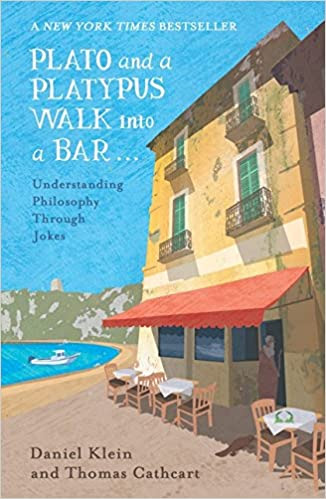
Just Finished Reading: Plato and a Platypus Walk into a Bar.... Understanding Philosophy Through Jokes by Daniel Klein and Thomas Cathcart (FP: 2006) [180pp] 

Even if I wasn’t hankering after some Philosophy reading after too long a break, it’d be hard to turn down a title like this one. I’m not exactly sure what I was expecting from this slim volume but what it turned out to be was a high-level overview of various Philosophical Schools or viewpoints illustrated (kind of) by a scattering of fairly funny and generally related jokes. I think what I had hoped (or expected maybe?) was more focus on the philosophy of jokes – indeed on philosophy itself – which left me a bit disappointed in the whole thing.  As a gentle introduction into the world of philosophical thinking this wasn’t a bad effort. The addition of philosophically appealing jokes was a nice idea, especially as a few of them were really funny and rather philosophical too! Unfortunately, an Introduction to Philosophy wasn’t something I was looking for. Although it’s been a while since I’ve read any ‘real’ philosophical works – rather than general or pop-cultural works about philosophy – I didn’t really need to go back to basics. I’m not sure what else to say really, if you’re wondering what Philosophy is all about but are too afraid to dive straight in, this might just be the way to whet your appetite. If you already have some idea of the basics, then you’ll need something a bit more substantial to take you to the next level. Reasonable.   

[Labels Added: 1, Labels Total: 38] 

Thursday, June 09, 2022


Just Finished Reading: Age of Anger – A History of the Present by Pankaj Mishra (FP: 2017) [346pp] 

I’m definitely not alone in wondering just WTF is going on with the world. I know I’m probably looking back on my youth with rose tinted glasses but even the 1970’s and, yes, even the 1980’s seemed much simpler and most definitely calmed times than today. So, what changed? Essentially, no so much according to this thought provoking and often fascinating thesis. 

Yet again I was surprised where this book went and what it focused on (that seems to be a habit with me these days) as I fully expected it to dissect the ‘present situation’ seen from the year or so before publication date. But that’s where things got really interesting and gave me LOTS of food for thought which I’m still (slowly) digesting after finishing this around 3 weeks ago. Where the author points his well-read finger is back to The Enlightenment and especially to the French philosophers of that turbulent time. The problem, as he intriguingly points out, is that these men (not surprisingly exclusively male for the time & place), sitting around in their salons putting the world ‘to rights’ were generally rich, well connected – to each other – and had almost zero idea of what it was like in the real world. What was worse, for the worlds they gave birth to, was that they never intended for their ideas of liberty or ‘personal growth’ to be applied to everyone. Indeed, they would have probably been horrified at the idea, once they stopped laughing, that the servant bringing their wine could have, use or even want, the same privileges, rights or liberties that they demanded for themselves contra the wishes and powers of monarchy or aristocracy. Despite often being anti-monarchy and anti-church they were most definitely not, as a rule, pro-democracy. The very idea to them was simply absurd and that’s where it became a problem. Each of the philosophers, in their own way and (largely) for their own benefit and that of their class of intellectuals, produced tracts, pamphlets and books which, rather inevitably, fell into the hands of those they were never intended to – the moderately educated and relatively poor lower classes (probably what we would call the proto-middle class and then further ‘down’ to the increasingly educated proto-proletariat). Ideas of liberty, individualism, democracy and much else naturally spread like wildfire and, once out of the bottle (or the book) could no longer be reclaimed. We forget, again pointed out by the author, that the post-Enlightenment, post-Industrial Revolution world was one of revolution, unrest, assassination and upheaval. As their ideas spread across the globe, translated, copied, understood and misunderstood, chaos followed just as it had in its European home during its painful and bloody birthing. Should we be surprised, therefore, that a similar round of revolution, unrest, assassination and upheaval has followed in their wake? 

Once I got my head around it (as the author delves DEEPLY into the ideas of the 18th century Europe and their immediate consequences), I found the authors central idea both interesting and compelling. Proposing the idea that the Enlightenment philosophers were dangerously divorced from common human experience and that their subsequently flawed ideas were never actually intended for universal application has significant explanatory power. Our forgetful ignorance of the consequences of their ideas being adopted by those they were never intended for and too often applied in ways that would not have worked – even in the ideal world of those who created the ideas – explains why we are surprised by the chaos we see around us today and why we shouldn’t be. Of course, it also means that this age of upheaval isn’t going away anytime soon and will, in fact, probably get worse as global problems multiply and increasing numbers of people become increasingly frustrated at the failure of ‘the system’ to satisfy their needs, ‘rights’ and expectations that, again all too often, is and always has been beyond its capability. This is a densely argued and sober read. It is definitely something you cannot simply skim through to pick up the gist to bring up in casual conversation. With MANY historical references throughout, it would help if you knew your Dreyfus from your Durkheim, your Rousseau from your Romanov and your Spencer from your Stirner. Luckily, with my reading over the years and my later University studies I had at least heard of many (if not all) of the intellects mentioned between these covers. Overall, this is not an easy read but, I think, it is very much worth the effort to do so. Like all good books of this type this will provide you with a framework, a viewpoint, to see the world and events within it in a new light. A very impressive line of argument and definitely a recommended book. 

Thursday, April 07, 2022


Just Finished Reading: Hiking With Nietzsche – Becoming Who You Are by John Kaag (FP: 2018) [229pp] 

Unlike the author of this rather strange but intriguing sideways look at the ever-controversial German philosopher, I don’t believe I ever studied Nietzsche at an undergraduate level. My BA (1983-86) was in Social Ethics and although it had at least one Philosophy unit I don’t think we ever actually studied any of his works. Naturally I knew about him, I mean who doesn’t, but I only actually, formally, studied part of his work much later. I can see why.  

This is as far from a ‘straight’ look at Nietzsche and his work as you could probably get. The book consists of several interweaving strands that, together, make a both interesting and compelling narrative. Of course, Nietzsche and his works are at the core of things, how could they not be. The author gives insights into Nietzsche’s life, his relationship with his father (mirrored to an extend by the authors relationship with his father) and his troubled/complex relationship with women. The potted biography formed the skeleton of the text to which the author attached discussions of Nietzsche’s works – the philosopher’s location and relationship status being directly related to his philosophical output (in a way I found very interesting and often overlooked). Interwoven with this were the experiences of the author himself both hiking in the Swiss Alps during his undergraduate period – and deciding there NOT to commit suicide! - and a follow up visit with his 2nd wife and their child now as a university professor. 

I learnt a lot here – not just about the man himself (Nietzsche that is!) but also about the underlying philosophical and psychological foundations of his thoughts. Naturally merely reading this thin volume won’t mean you’ll understand everything that Nietzsche was getting at – that's a lifetime quest I think – but it’ll give you paths to follow and an idea of whether you’re ready to follow the easier grades or are ready to try your hand on the slopes with the mountain goats. Nietzsche, as you might guess, is not the most accessible and easy to understand modern philosopher. His work takes work to get the most out of. But, I think, the effort can be worth it. 

I studied Nietzsche for one unit of my Philosophy Master's degree (2008-10) and I remember, just before the course started, the Head of the Department popped in for a chat. She said that she always worried about teaching Nietzsche, especially to undergraduates, because his ideas were so radical, so powerful, and especially so to youth (most of the students in that class were under 25 – I was 50). I can agree. I compared his work – or at least the one we studied (The Genealogy of Morality) - to breathing pure oxygen. It certainly felt like that some weeks. The unit we studied blew me away and I decided that I’d do my Dissertation on an aspect of Nietzsche's ideas and really enjoyed producing the resultant piece of work. It wasn’t easy (being Nietzsche based!) but it was definitely mind expanding. 

Overall, this volume provided some interesting insights into the mind and works of one of the most misunderstood and misrepresented European philosophers of modern times. If you’ve ever wondered what all of the fuss was about but didn’t know where to start (or were too afraid to ask!) this is a pretty good place to begin your journey into the foothills before trying anything requiring pitons. Recommended. More Philosophy to come.         

Monday, February 14, 2022

Just Finished Reading: Carpe Diem Regained – The Vanishing Art of Seizing the Day by Roman Krznaric (FP: 2017) [236pp] 

I’ve heard it said that spontaneity has its time and place. In a way the author would agree. In a rather counterintuitive move, he proposes that we can (or should) schedule in a recuring place where we have the opportunity to ‘seize the day’ and be more open to the unplanned moments in life. Today, with the all too pervasive “Fear of Missing Out” (FOMO), we tend to try to cram in as much of life as possible – by rigidly planning every moment of our waking lives. We are, in effect, attempting to seize our days by removing that essential quality that allows us to do just that. Rather than just ‘doing it’ we, instead, just ‘plan it’. No wonder so many people are increasingly frustrated and confused. With so much on offer to so many the idea of NOT having anything planned is anathema. Paradoxically this attitude reduces the possibility of carping that diem and sometimes eliminating it entirely. This is the thing that the author argues against most in this intriguing little book.  

Of course, it's easy to say that we should seize our (limited in number) days. If only things were that easy! The author readily recognises that we are not all free to do so. Some of those things stopping us can be, and he maintains should be, overcome. Our fears of failure, of public ridicule, of ‘standing out’, of being seen as odd or different, can be overcome. Other things are more difficult – responsibilities for example. It’s easy to say that we should capre when we don’t have children, or a mortgage to pay off or sick relatives to care for. It’s even easier to seize the day when you have some disposable income or time to do so. Many people simply don’t have the luxury. But even this shouldn’t stop you completely. Carpe Diem doesn’t simply mean dropping everything on a whim to spend the next year learning to surf in California. It means being open to possibilities, to be able to recognise that opportunity when it arises and being willing to seize that opportunity if you can do so. It’s not about living irresponsibly it’s about giving yourself the room to be you, to know what you want, to carve out some territory where you can be you.  

I’ve never really been a planner – at least not until I joined a planning team at work and had to plan for a day job. But I’ve never been particularly spontaneous either. I kind of relied on friends to be spontaneous on my behalf. They’d have crazy ideas and my part of the equation was deciding if I wanted to be involved in the scheme or not. On my crazier days I’d say yes – the author quite rightly says that we shouldn’t simply say ‘yes’ to EVERY opportunity that comes our way – and we’d have an adventure. On other days I’d say no and they’d go off and do stuff without me (often in a mildly confused state as to why I wouldn’t jump off something or whatever they’d decided to do with the day). To be honest the ‘Carpe Diem’ mindset is hard. It’s not just that it’s been hijacked by a ‘just plan it’ or ‘just buy it’ mentality (we all know how easy it is to think we’re being spontaneous by ‘impulse’ buying something we don’t need – or actually want – with money we don’t really have). To be aware of opportunities to take advantage of we first need to be generally aware of what’s going on around us rather than starring at our phones wishing we had other people’s lives. Then we need to courage to take the leap – however small – as well as the courage to stick with something or to let it go later. Too much Carpe can easily lead to disaster, too little to stagnation and boredom. This was an interesting read. I’m not totally convinced that the author made a strong enough case but he certainly gave me things, ideas and strategies to think about. A ‘sprinkle’ of carpe diem should, I think, be part of all of our lives. Reading this book might encourage you to add that sprinkle or maybe just to add a bit more. Recommended.      

Monday, March 29, 2021


Just Finished Reading: The Most Human Human – What Artificial Intelligence Teaches Us About Being Alive by Brian Christian (FP: 2011) [271pp]

The Test existed, at least on paper, long before there were any contestants even theoretically capable of taking it. In 1950 mathematician and early computer scientist Alan Turing devised a way of determining if a machine was exhibiting intelligent behaviour. If it could communicate with others without them being aware that they were talking to a machine, rather than an actual flesh and blood person, then at least in theory it could be argued that the machine, computer or software programme exhibited recognisable intelligence. Essentially, in order to pass the Turing Test and win any prize on offer, the idea is to create a machine that can imitate human communication (hence calling it the ‘Imitation Game’) enough to fool a set of interrogators over a 20 minute period. The rules have varied over the years but, as yet anyway, the Turing Prize has yet to be won. But that’s only one aspect of what’s going on in Turing territory – as the author discovered.


The present Test has another aspect that I hadn’t known about until picking up this fun and fascinating book. Apart from the prize given to the Most Human Machine there is another given to the Most Human Human. As part of the test the set of interrogators ‘interview’ both the machine competitors as well as a few actual humans who’s remit is the act as human as possible. The author, coming from a background in both computer science and philosophy, knew that wasn’t anywhere near as easy as it sounds – so he decided to ‘train’ for the event by speaking to experts in the field of language, communications, chess programmes (including some world class players who are not amused at all at being beaten by computer programmes on a regular basis – so much so that many people the era of competitive chess is dead), video-game design, speed-dating, criminal law, neurology and psychiatry. It was an interesting ride! I’ve always had an interest in how we ‘read’ other people and especially how we can tell if other people are being less than honest with us. How the brain does that and how e-mail scammers try to circumvent that ability was just one of the avenues the author explored to help him ensure victory for humankind.


We increasingly live in a machine world – a world built by machines and, increasingly, a world built for machines. Algorithms help us pick our next book, our next movie or next meal. Algorithms increasingly advise us on who should be our friends and what news we should listen to. They do this, at least in part, by parsing what they can understand as ‘human nature’ into a digital format that can be processed, manipulated and fed back to us. Ironically it could be argued that the Turing Test is becoming easier year on year, not just because computers are becoming more powerful or algorithms are becoming more sophisticated but because we humans are becoming more machine like in our thoughts, our actions and our communications. The author, rather brilliantly, decided to go the other way and to display everything that makes human communication and humanity itself so interesting, so nuanced and so much fun (and so frustrating and a complete pain in the ass at times!). Definitely a unique look at AI, future tech and the world we’ll all be inhabiting much sooner than many of us expect and a guidebook to keeping hold of our humanity as we get there. Recommended.