About Me

My photo
I have a burning need to know stuff and I love asking awkward questions.
Showing posts with label Climate. Show all posts

Friday, July 31, 2026


England and Wales on Track for Driest July in 190 Years

Provisional Met Office data shows England and Wales are on course for their driest July since records began in 1836, with rainfall at just 8% of long‑term averages and drought declared across more than half of England and all of Wales.

Rainfall and Records

England: 5.6 mm of rain so far in July 2026 — 8% of the monthly average, less than half the previous record of 13.4 mm set in 1911.

Wales: 7.9 mm — also 8% of average, almost a third of the 1911 record of 22.6 mm.

UK overall: Third‑driest July on record, driest since 1868.

Southern England: Just 1.5 mm (2% of average)

Monday, January 22, 2024


Just Finished Reading: Nature’s Mutiny – How the Little Ice Age Transformed the West and Shaped the Present by Philipp Blom (FP: 2017) [284pp] 

Around the middle of the 17th century things were obviously wrong. The summer became more overcast and wet, whilst the winters became increasingly colder and often extended far into what used to called spring. The gradual cooling the whole world was experiencing was having real, indeed potentially fatal effects. With Europe especially an essentially subsistence economy where food was, by and large, both produced and consumed locally a series of poor crops could cause serious famine and this is what exactly began to happen more and more. The initial response was widespread prayers, calls to turn away from sin and processions asking for divine intervention. When these failed to change things – indeed things became progressively worse – other things were tried. Innovations in crop rotation, better use of fertiliser, the expansion of farmland into common areas all increased crop yields but it still wasn’t enough. Looking beyond local agriculture and towards areas less affected by the worsening climate than others, the transport and importation of foodstuffs increased everywhere. But this meant payment in cash, not kind, the writing and enforcement of contracts, increased diplomatic contact, improved ports and roads, more and bigger ships to carry grain and return with goods for sale, the need for more effective taxation schemes, increased military spending to protect what you had, and others wanted, exploration of foreign lands and the return of exotic plants like the potato... With each new coping mechanism put in place to ameliorate the effects of the cold and damp conditions things began to change, indeed everything began to change. The old, almost medieval ways gave way to Mercantilism and eventually Capitalism. Money in the form of hard and then paper currency became much more common. New companies making healthy profits from increased trade needed secure ways to finance their ventures so corporations, stock exchanges and banks emerged to support them. A growing middle class demanded more say in their local politics and began using their newfound wealth to buy their way into the upper echelons of society. Power shifted away from nobles and towards the nouveau riche.         

Although I’ve known about the Little Ice Age for a while, I’d never really realised just how long it lasted – around three HUNDRED years! - nor had I realised exactly what effect it had on Europe and the larger world. By groping towards often local problems of supply and demand (largely for food) without actually understanding what they were dealing with, the great and the good of Europe started an unstoppable cascade of change that, eventually, produced the modern world we live it. This honestly riveting book has changed the way I now look at modern European/world history. Most (to be honest almost all) of the history I’ve read so far barely mentions things like the weather or climate and how such things have lasting impacts on historical events. But looking at the history of that period through the lens of sudden climate change explains a GREAT deal of what was going on then. People didn’t just start exploring the world and changing things around them on a whim. They did it because they really wanted to KNOW where their next meal was coming from and how (if possible) they could make a bit of ready cash on the side. Because the climate downturn extended across generations the changes that were made to cope with the new climate stuck and became the new default socio-economic position. A few bad winters simply wouldn’t have changed that much, but three hundred years of bad weather has a tendency to change how people think about the world – and it did.  

I’m confident that this, even so early in the year, will be one of the best History books of 2024. If you want to get a handle on European history between the 17th – 19th centuries, you could do a LOT worse than start here. Highly recommended and more from this excellent author to come. 

Translated from the German by the author.   

Monday, October 09, 2023


Just Finished Reading: The Weather Detective – Rediscovering Nature’s Secret Signs by Peter Wohlleben (FP: 2012) [161pp] 

We Brits LOVE talking about, thinking about and complaining about the weather. Anyone who has lived here for any length of time can appreciate why: because we have SO much of it. Experiencing all four seasons in a single day hardly deserves a comment, while moving just a few miles in any direction can feel like climatic time travel. Just today I heard a radio announcer say that people are wearing flip-flops in the Southeast and flippers in Scotland where some areas had two weeks' worth of usual October rain in just 8 hours. So, you can probably imagine how much I was looking forward to reading this slim volume – the only problem is that it wasn’t really about the weather. 

Although I wouldn’t classify the title or the blurb as 100% misleading, I think it was the high 80’s. The author did indeed mention the weather (and indeed climate) reasonable often and even, as per the blur/title, showed how observing nature can inform us (or at least indicate) as to what the weather is doing, about to do, or has recent done. But the overwhelming majority of this book is about a different subject entirely – gardening! Now, I’ll be the very first to admit that I am not a natural gardener. My idea of gardening is generally cutting back the growth enough to see my back fence and stopping any of my plants annoying the neighbours – the less said about me dropping a small tree I had just cut down into my rather shocked neighbours' garden the better here! 

So, did I hate this book? Surprisingly, no I didn’t. For one thing I really liked the author's style. It felt as if I was a young kid who had almost unthinkingly offered to help my Grandpa on his allotment and, as we wandered around the plot, weeding here and digging there, he and his friend's discussed nature, climate change, local animals, birds and insects and, yes, the weather. It was a very ‘chatty’ and honestly lovely to read kind of book – just not on the subject I was hoping for. So, this is definitely not a bad book. If you’re interested in gardening – specifically in Northern Europe – and like hearing advice from people who certainly know what they’re talking about this could definitely be the book for you. It’s a cosy, warm hearted, chatty, pleasant read that will leave you feeling somewhat more informed and just a little bit closer to nature. Recommended – especially for the gardeners out there!    

Translated from the German by Ruth Ahmedzai Kemp 

[Labels Added: 1, Labels Total: 70]

Thursday, December 29, 2022


Just Finished Reading: Frostquake – How the Frozen Winter of 1962 Changed Britain Forever by Juliet Nicolson (FP: 2021) [319pp] 

England, 1962. It wasn’t quite a white Christmas but when it started snowing on December 26th at least the children were happy with the prospect of snowmen and sledging before they returned to school after the holidays. But as temperatures continued to drop and snow continued to fall everyone, including the children, just wanted the winter to finally end. They had a long wait ahead of them as the snow would fall for another 10 weeks. The winter of 1962/63 turned out to be one of the coldest and longest ever recorded. In some places the sea froze, in others diesel fuel in trucks and buses froze overnight, greatly restricted travel and deliveries of vital supplies. Army helicopters dropped hay to starving farm animals and across Britain hundreds of birds, apparently frozen in flight, fell dead onto ever deepening snow drifts. No one could remember anything quite like it. Yet the country failed to grind to a complete halt. Milkmen on skies (as on the front cover) delivered frozen milk to grateful housewives, bands like the up-and-coming Beatles kept on touring despite the weather and millions of television viewers stayed warm enjoying breakthrough satirical shows that poked fun at the Establishment in ways never seen before. Under the deepening blanket of snow things were changing, women like the designer Mary Quant and model Jean Shrimpton were making names for themselves and making money too, the old deference for authority was starting to crumble helped on by the political crisis brought on by the Profumo Affair and the people longed to break free of austerity Britain and start having fun. The ‘Swinging Sixties’ was just around the corner – once the ice melted. 

Although I was alive at the time – aged 2 ½ - I have no memory of this momentous winter. I can’t believe that living in a Victorian terraced house in Liverpool we were somehow immune to the cold, but I guess that I was simply too young or too unaware of events for it to have stuck with me. The author was 8 at the time and weaves her own and her family's story into the narrative which I thought was a good way to thread things together. I also liked the fact that, although she stayed in London and the Southeast for most of the events portrayed, the narrative covered the North as well as the South with interesting snippets of history around the early days of the ‘Mersey Beat’ and somewhat briefer mentions of the Rolling Stones and Bob Dylan. Although I’d only recently read a whole book on the Profumo Affair, I was impressed that the author had managed to add a few more facts that I’d been unaware of. Overall, this was solid Social History and I enjoyed it quite a lot. I always find there’s something slightly odd about reading history books about a time that you lived through. There’s a kind of temporal ‘echo’ working faintly in the background. But as this was very early in my life the ‘echo’ was very faint indeed so didn’t distract from the narrative. Recommended for any fans of 60’s Britain. 

This is the last review of 2022. My 'Best of the Year' List will be coming on Saturday.

Monday, November 21, 2022


Just Finished Reading: The Uninhabitable Earth – A Story of the Future by David Wallace-Wells (FP: 2019) [238pp] 

You just know there will be no sugar coating of the issue of Global Warming/Climate Change when the author opens with this sentence: It is worse, much worse, than you think. Sitting in the affluent west it’s easy to be comforted by a number of pervasive climate myths – that climate change is happening slowly and that we have plenty of time to respond, or indeed that it’s happening slowly enough that we’ll be long dead before it happens, that it’s happening elsewhere, to other much poorer people and that although we care (and donate to various disaster appeals) it doesn’t really affect us, that we, in the rich western world, will be able to buy our way or build our way out of it and live full rich lives behind our flood defences. This, to an extent at least, has some truth to it. Poor countries will be hit harder by the effects of climate change and will be less able to cope with these changes. Rich countries can afford much more money to spend on mitigation strategies which will reduce the overall effect of climate change. But the one thing we can’t sidestep or talk our way around is the time argument. Global Warming isn’t coming in 100 years or even 50 years, it’s here now, today. What we see on our television screens or by simply looking out of the window is happening today and will continue to happen tomorrow, next month and in the years to come. But the droughts, floods, fires, mudslides, hurricanes and much else we’re experiencing isn’t the new normal – far from it. What we’re seeing now isn’t the new equilibrium, the new steady state. What millions of people are experiencing across the globe is the start of things, the tip, as it were, of the melting iceberg. We really haven’t seen anything yet. If nothing is done, as largely nothing has been done so far, we will experience longer hotter heatwaves, deeper longer droughts, much more flooding and sea level rises, more and stronger hurricanes as well as all the known knock-on effects we are becoming all too familiar with – the spread of ‘exotic’ diseases and pests, climate refugees growing year on year, increasing climate related conflict over basic resources such as water and on and on. It is not, indeed far from it, a pleasant picture to behold. 

As you can imagine this is FAR from an easy read. It is, to be honest, more than a little depressing and if you easily fall into that state looking at the world today, I’d recommend you don’t read this. If on the other hand you can face reality, no matter how bad, this will give you a good foundation on which to build. Covering the facts as we know them, plus the effects of feedback loops and possible cascade failures, the author gives a reasoned view on what will happen if we do nothing. As base temperatures increase things will get worse. Even holding the rise to the much talked about 2 degrees will still result in a lot of negative effects. Doing nothing, or nowhere near enough as we are now, might lead to a 3, 4 or 5 degree rise. This would literally make parts of the planet uninhabitable just from the heat experienced there to say nothing of the land inundated by sea level rises. All this well understood science is what should be driving us to avoid these futures the author maps out. They’re not inevitable. We created this situation, and we could do something about it if we just had the will to do so. It’s not rocket science. We’ve been adding ‘greenhouse’ gases into our atmosphere since the Industrial Revolution at a steady increasing pace. We need to start cutting that drastically. We also need to start paying more attention to taking out some of the gases that we’ve already put there. But we also need to plan for what's coming and start building our flood defences and increasing our drainage infrastructure before we desperately need it. We have a lot of work to do and not a lot of time to do it. No matter what happens, the next 100 years are going to be rough. If you can handle it and want to be informed, then this is the book for you.   

Tuesday, July 04, 2006

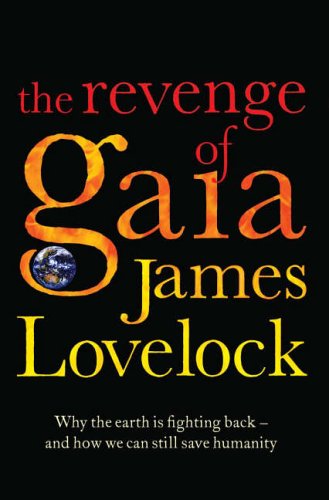
Just Finished Reading: The Revenge of Gaia by James Lovelock

This book was just SO disappointing. I read two of his previous books outlining Gaia theory (basically that the Earth reacts to change as if it were a living organism) and thought that the idea was well thought out and had great merit.

Then he goes and ruins it all by writing this…… polemic. What a waste.

In the book Professor Lovelock came across as a bitter old man who has foreseen the end of human civilisation and wants to tell the world about it. Typically these people wander the streets of London holding placards with quotes from the Bible on them, but in this case the author acquired a book deal on the back of his reputation.

The book is pro-nuclear, anti sustainable development and dismissive of environmentalism – except rather strangely the ‘Deep Greens’ who value the natural world far above mere humanity. It also put forward what I thought was the absurd idea that we are already doomed and, as in the disaster movie The Day After Tomorrow, we should try and save as many people and as much of our hard won knowledge as we can.

In my opinion Professor Lovelock is being far too pessimistic. Sure, Global Warming is very real and is a ‘real and present’ danger but he takes the implications too far. Whilst true that many will die before everyone recognises the level of the threat we face I don’t think that we are anywhere need the end of civilisation scenario that Lovelock paints. Humanity is pretty stupid I agree. But we’re not that stupid. Even I have more faith in us that that. When pushed into a corner we have a great ability to move Heaven and Earth to fix things. Obviously the longer we wait the worse things will get but I have confidence in our ability as survivors. All is definitely not lost – unless maybe you believe this book.