 Poster Time.
About Me

- CyberKitten
- I have a burning need to know stuff and I love asking awkward questions.
Wednesday, January 31, 2007

Tuesday, January 30, 2007
EU Urged to Lead on Human Rights as U.S. Loses Moral Authority
by Haider Rizvi for OneWorld.net
January 12, 2007
NEW YORK - The Bush administration's failure to address international human rights concerns has prompted an unusual call from one of the world's leading human rights organizations. With U.S. credibility undermined by the use of torture and detention without trial, the European Union must fill the global leadership void on human rights, New York-based Human Rights Watch said Thursday in releasing its World Report 2007.
"Since the U.S. can't provide credible leadership on human rights, European countries must pick up the slack," said the organization's executive director Kenneth Roth, who observed that instead, "the European Union is punching well below its weight." The organization urged European countries to overcome bureaucratic obstacles that leave its leaders "mired in procedures," effectively tying the hands of those seeking a tougher approach to serious rights abuses. The call came on the day that marked five years since the United States started sending terrorism suspects to Guantanamo Bay, the U.S. military base located in Cuba. The authors of the 556-page report, which documents worldwide violations of human rights, said the U.S. abuses against detainees in Washington's so-called "war on terror" remained a major concern, as the Bush administration continued to defend torture by referring to it as "an alternative set of [interrogation] procedures."
Though a few prisoners have been released, more than 600 people are still locked up in the Guantanamo camp, where many have complained of severe torture and inhumane and degrading treatment at the hands of their captors. Human Rights Watch and many other rights advocacy groups made fresh calls for the closure of the camp Thursday, noting that it was "long past time" to either bring to trial or set free the detainees who remain there. Last October, when the international community and human rights organizations demanded fair trials for the prisoners, the Republican-led U.S. Congress flatly refused to entertain such requests. But with the change of leadership in the Congress, it seems organizations like Human Rights Watch may find some reason to be hopeful about their demands. "The U.S. Congress must act now to remedy the worst abuses of the Bush administration," said Roth. "Without firm and principled congressional action, the loss of U.S. leadership will likely persist."
Responding to a question Wednesday, new UN chief Ban Ki-moon, like his predecessor Kofi Annan, refused to accept the Bush administration's line of reasoning on indefinite detentions. "(The) prison at Guantanamo should be closed," he told reporters at his first-ever formal news conference. Ban is due to meet Bush at the White House next week. In addition to its criticism of U.S. behavior, authors of the Human Rights Watch report said worldwide many human rights challenges were in need of urgent action. That includes the killing of innocent civilians in Iraq as a result of sectarian violence and frequent abuses of human rights by repressive regimes in Burma and Turkmenistan. While deploring the persistence of dictatorships in Saudi Arabia and Syria, the authors note that China is "moving backwards" and there has been no end to crack downs against non-governmental organizations in Russia and Egypt. The report is also highly critical of human rights violations of various descriptions in Zimbabwe, Sri Lanka, Afghanistan, Colombia, Israel, and Lebanon.
Noting that no situation is "more pressing" than the bloody crisis in Darfur, where estimates of the dead range from 200,000 to nearly half a million, the report chastised the UN Security Council for its inaction. "Civilians in Darfur are under constant attack, and the conflict is spilling across Sudan's borders," said Roth, "yet the five permanent members of the Security Council managed little more than to produce stacks of unimplemented resolutions." The report's authors said they noted "some positive developments" coming out of the global South, including African leaders' support for the trials of former Liberian president Charles Taylor and Chad's Hissene Habre. They also praised Latin American support for the International Criminal Court. However, they also urged southern democracies to "do more" to protect human rights, such as breaking with abusive regional leaders to play a "more constructive role" at the UN Human Rights Council.
"Because many new democracies of the South have emerged from periods of extreme repression, whether colonialism, apartheid, or dictatorship, they could have special moral authority on human rights," Roth said. "But few have shown the consistency and commitment to emerge as real human rights leaders."
by Haider Rizvi for OneWorld.net
January 12, 2007
NEW YORK - The Bush administration's failure to address international human rights concerns has prompted an unusual call from one of the world's leading human rights organizations. With U.S. credibility undermined by the use of torture and detention without trial, the European Union must fill the global leadership void on human rights, New York-based Human Rights Watch said Thursday in releasing its World Report 2007.
"Since the U.S. can't provide credible leadership on human rights, European countries must pick up the slack," said the organization's executive director Kenneth Roth, who observed that instead, "the European Union is punching well below its weight." The organization urged European countries to overcome bureaucratic obstacles that leave its leaders "mired in procedures," effectively tying the hands of those seeking a tougher approach to serious rights abuses. The call came on the day that marked five years since the United States started sending terrorism suspects to Guantanamo Bay, the U.S. military base located in Cuba. The authors of the 556-page report, which documents worldwide violations of human rights, said the U.S. abuses against detainees in Washington's so-called "war on terror" remained a major concern, as the Bush administration continued to defend torture by referring to it as "an alternative set of [interrogation] procedures."
Though a few prisoners have been released, more than 600 people are still locked up in the Guantanamo camp, where many have complained of severe torture and inhumane and degrading treatment at the hands of their captors. Human Rights Watch and many other rights advocacy groups made fresh calls for the closure of the camp Thursday, noting that it was "long past time" to either bring to trial or set free the detainees who remain there. Last October, when the international community and human rights organizations demanded fair trials for the prisoners, the Republican-led U.S. Congress flatly refused to entertain such requests. But with the change of leadership in the Congress, it seems organizations like Human Rights Watch may find some reason to be hopeful about their demands. "The U.S. Congress must act now to remedy the worst abuses of the Bush administration," said Roth. "Without firm and principled congressional action, the loss of U.S. leadership will likely persist."
Responding to a question Wednesday, new UN chief Ban Ki-moon, like his predecessor Kofi Annan, refused to accept the Bush administration's line of reasoning on indefinite detentions. "(The) prison at Guantanamo should be closed," he told reporters at his first-ever formal news conference. Ban is due to meet Bush at the White House next week. In addition to its criticism of U.S. behavior, authors of the Human Rights Watch report said worldwide many human rights challenges were in need of urgent action. That includes the killing of innocent civilians in Iraq as a result of sectarian violence and frequent abuses of human rights by repressive regimes in Burma and Turkmenistan. While deploring the persistence of dictatorships in Saudi Arabia and Syria, the authors note that China is "moving backwards" and there has been no end to crack downs against non-governmental organizations in Russia and Egypt. The report is also highly critical of human rights violations of various descriptions in Zimbabwe, Sri Lanka, Afghanistan, Colombia, Israel, and Lebanon.
Noting that no situation is "more pressing" than the bloody crisis in Darfur, where estimates of the dead range from 200,000 to nearly half a million, the report chastised the UN Security Council for its inaction. "Civilians in Darfur are under constant attack, and the conflict is spilling across Sudan's borders," said Roth, "yet the five permanent members of the Security Council managed little more than to produce stacks of unimplemented resolutions." The report's authors said they noted "some positive developments" coming out of the global South, including African leaders' support for the trials of former Liberian president Charles Taylor and Chad's Hissene Habre. They also praised Latin American support for the International Criminal Court. However, they also urged southern democracies to "do more" to protect human rights, such as breaking with abusive regional leaders to play a "more constructive role" at the UN Human Rights Council.
"Because many new democracies of the South have emerged from periods of extreme repression, whether colonialism, apartheid, or dictatorship, they could have special moral authority on human rights," Roth said. "But few have shown the consistency and commitment to emerge as real human rights leaders."
Monday, January 29, 2007

Sunday, January 28, 2007
God. Who knows?
By Mark Vernon
Monday, 4 December 2006
We are in a period of intense debate about religion. It seems there are believers, secularists and atheists - in their manifold varieties - arguing over their various concerns. Veils. Intelligent design v evolution. Ordaining gays and women. Contraception and Aids. But there is one voice that is squeezed out, partly because it can equivocate, partly because it tires of the tit-for-tat that the debate is so often reduced to. That is the agnostic.
It is a position that interests me because I used to be a priest in the Church of England. Then, to cut a long story short, I left - and I left a confirmed atheist. After a while, I found unbelief as dissatisfying as full-blown Christianity. It seems to entail a kind of puritanism, as if certain areas of human experience must be put off-limits, for fear that they smack of religion. So I became an agnostic. Now, many atheists and believers alike think agnosticism weak. Atheists would bundle us in with them; liberal believers likewise. But this does us a disservice. In fact, I have become really quite evangelical about the need for a passionate, committed agnosticism. Why? How else to deal with something that lies at the heart of the human condition: uncertainty. Thus, a corresponding "lust for certainty" characterises many of the debates currently doing the rounds. In religion, fundamentalism is the obvious case in point.
A similar lust for certainty also increasingly characterises mainstream religion, such as the crisis about homosexuality in the Church of England. For conservative evangelicals, what you think about gay love-making is a test of what you think about the truth of the Bible. To be for one is to be against the other. When it comes to the scientific worldview, a lust for certainty is manifest in different ways. Think of the way that some atheists go on at great length about the need to throw off superstitious belief and don the freedom and reason of the Enlightenment. What they will not accept is what the inventor of the word "agnostic" sought to highlight. TH Huxley meant his neologism as a rebuke to all who peddle their opinions as facts - notably their opinion, scientific or religious, about God. For whether or not God exists is neither proven nor, he thought, provable. God just isn't that kind of concept. Einstein, another agnostic, looked at the universe and saw the workings of a "spirit" beyond our understanding, an intuition the atheist would stumble over.
The lust for certainty spills over into other walks of modern life too. Take the so-called politics of fear - the constant reference to risks, from hoodies on the street corner to international terrorism. Whatever the truth of these risks and the best ways of dealing with them, the politics of fear plays on an assumption that people cannot bear the uncertainties associated with them. Politics then becomes a question of who can better deliver an illusion of control. Being agnostic can amount to little more than a shrug of the shoulders. But can it be a weighty way of life? It can, because it has great traditions to draw on - no lesser traditions than those of philosophy, religion and science. At their richest, all three are riven through and through with an agnostic spirit. Take philosophy. Socrates was a genius because he realised that the key to wisdom is not how much you know, but how well you understand how little you know. That is why he irritated so many powerful people in ancient Athens; his philosophy burst the bubble of their misplaced confidence. Similarly, Saint Augustine of Hippo (354-430) said that to be human is to be "between beasts and angels". He meant that we are not ignorant like the animals. But we are also far from wise. Faith for Augustine was about deepening the capacity to enter this cloud of unknowing, rather than opting for the shallow certainties that religion can deliver.
Finally, in science, the best sort - in the sense of the most humanly enriching - is that which answers questions by opening up more questions, and in particular links to questions that are beyond science alone answer. This is the spirit that you see in cosmology. On one level, cosmologists understand an extraordinary amount about the universe. But simultaneously, this only deepens the sense of the universe's tremendousness. The science keeps pointing to the big question of why we here at all. The revival of a committed, passionate agnosticism in philosophy, religion and science is vital for our age. Without it religion will become more extreme; science will become more triumphalist; and our politics increasingly based on fear.
[Mark Vernon is making some interesting points here. However, science does not look for certainty. That's not how science works. Science understands that all knowledge is provisional. This is one of the reasons why I feel that science is by far the best way to understand the Universe and everything in it. To paraphrase Laplace - I have no need of the God Hypothesis.]
By Mark Vernon
Monday, 4 December 2006
We are in a period of intense debate about religion. It seems there are believers, secularists and atheists - in their manifold varieties - arguing over their various concerns. Veils. Intelligent design v evolution. Ordaining gays and women. Contraception and Aids. But there is one voice that is squeezed out, partly because it can equivocate, partly because it tires of the tit-for-tat that the debate is so often reduced to. That is the agnostic.
It is a position that interests me because I used to be a priest in the Church of England. Then, to cut a long story short, I left - and I left a confirmed atheist. After a while, I found unbelief as dissatisfying as full-blown Christianity. It seems to entail a kind of puritanism, as if certain areas of human experience must be put off-limits, for fear that they smack of religion. So I became an agnostic. Now, many atheists and believers alike think agnosticism weak. Atheists would bundle us in with them; liberal believers likewise. But this does us a disservice. In fact, I have become really quite evangelical about the need for a passionate, committed agnosticism. Why? How else to deal with something that lies at the heart of the human condition: uncertainty. Thus, a corresponding "lust for certainty" characterises many of the debates currently doing the rounds. In religion, fundamentalism is the obvious case in point.
A similar lust for certainty also increasingly characterises mainstream religion, such as the crisis about homosexuality in the Church of England. For conservative evangelicals, what you think about gay love-making is a test of what you think about the truth of the Bible. To be for one is to be against the other. When it comes to the scientific worldview, a lust for certainty is manifest in different ways. Think of the way that some atheists go on at great length about the need to throw off superstitious belief and don the freedom and reason of the Enlightenment. What they will not accept is what the inventor of the word "agnostic" sought to highlight. TH Huxley meant his neologism as a rebuke to all who peddle their opinions as facts - notably their opinion, scientific or religious, about God. For whether or not God exists is neither proven nor, he thought, provable. God just isn't that kind of concept. Einstein, another agnostic, looked at the universe and saw the workings of a "spirit" beyond our understanding, an intuition the atheist would stumble over.
The lust for certainty spills over into other walks of modern life too. Take the so-called politics of fear - the constant reference to risks, from hoodies on the street corner to international terrorism. Whatever the truth of these risks and the best ways of dealing with them, the politics of fear plays on an assumption that people cannot bear the uncertainties associated with them. Politics then becomes a question of who can better deliver an illusion of control. Being agnostic can amount to little more than a shrug of the shoulders. But can it be a weighty way of life? It can, because it has great traditions to draw on - no lesser traditions than those of philosophy, religion and science. At their richest, all three are riven through and through with an agnostic spirit. Take philosophy. Socrates was a genius because he realised that the key to wisdom is not how much you know, but how well you understand how little you know. That is why he irritated so many powerful people in ancient Athens; his philosophy burst the bubble of their misplaced confidence. Similarly, Saint Augustine of Hippo (354-430) said that to be human is to be "between beasts and angels". He meant that we are not ignorant like the animals. But we are also far from wise. Faith for Augustine was about deepening the capacity to enter this cloud of unknowing, rather than opting for the shallow certainties that religion can deliver.
Finally, in science, the best sort - in the sense of the most humanly enriching - is that which answers questions by opening up more questions, and in particular links to questions that are beyond science alone answer. This is the spirit that you see in cosmology. On one level, cosmologists understand an extraordinary amount about the universe. But simultaneously, this only deepens the sense of the universe's tremendousness. The science keeps pointing to the big question of why we here at all. The revival of a committed, passionate agnosticism in philosophy, religion and science is vital for our age. Without it religion will become more extreme; science will become more triumphalist; and our politics increasingly based on fear.
[Mark Vernon is making some interesting points here. However, science does not look for certainty. That's not how science works. Science understands that all knowledge is provisional. This is one of the reasons why I feel that science is by far the best way to understand the Universe and everything in it. To paraphrase Laplace - I have no need of the God Hypothesis.]

Saturday, January 27, 2007
 Just Finished Reading: H.M.S Ulysses by Alistair Maclean
The experienced officers and crew of the heavy cruiser HMS Ulysses are close to breaking point when they are ordered to escort their twentieth convoy on the murderous Murmansk run. After an abortive mutiny they sail from Scapa Flow into the teeth of the worst artic storm in living memory. But this is only the first stage in a nightmare journey where the weather is the least of their worries. As the U-boats of the Kriegsmarine and the bombers of the Luftwaffe take more and more ships the Admiral commanding the Ulysses is given a final order: to get through at all costs.
Written just 10 years after the end of the Second World War this must have touched some pretty raw nerves. Maclean describes in brutal uncompromising tones the almost unbelievable struggle to get ships and cargo to aid the Russians in their fight against German aggression. The Murmansk convoys where notorious for their high loss rates and the unrelenting danger to the crews of both merchantmen and escorts. If the reality was anything like Maclean's fictionalised account it must have been close to hell on earth to all those involved. Highly recommended to any fan of military fiction. Expect to be blown away.
Friday, January 26, 2007
 Blair goes on ID card offensive
From BBC News
6 November 2006
Prime Minister Tony Blair has said he will push on with ID cards - insisting that as with CCTV and DNA the issue is one of "modernity" not civil liberties.
An "action plan" would be published by the Home Office in December to "explore the benefits" people could get from ID cards in 10 years' time, he said. He told his monthly news briefing all non-EU nationals will need them to work or access public services from 2008. But he also confirmed the timetable for Britons' cards has slipped to 2009. The Tories and Lib Dems oppose ID cards - which are not due to become compulsory until at least 2010 - and say they would scrap them if they got into power.
Mr Blair said ID cards would become compulsory first for non-EU overseas residents who come to Britain for more than three months. They would help tackle illegal immigration, terrorism and identity fraud, while also protecting the vulnerable and the solving of crimes, he said. Mr Blair dismissed critics of the scheme's cost, insisting the project was on budget. He said biometric passports had to be introduced anyway and they made up 70% of the cost of ID cards. Mr Blair, who also highlighted government IT schemes which he said showed such a large database could be made to work, said he wanted to make a major effort to sell the potential gains for people. "We need to lift our sights a little. I don't think, in the debate so far, that we have even begun to explore the benefits that we will see in, say, ten years time," he said.
"We are building a new part of our national infrastructure here. And like other such projects the gains to citizens will be much larger and more extensive than anyone could say at the time," he added. ID cards and other issues, such as measures to tackle anti-social behaviour, CCTV cameras and the growing DNA database, were often portrayed as civil liberties issues, he said. But he believed that it was more an issue of "modernity" and of "modern life" - and he backed the use of these new technologies to tackle the new types of crime. For the Conservatives, shadow home secretary David Davis said: "He claims they will deal with benefit fraud, whilst his own minister pointed out that 95% of benefit fraud is caused by people lying about their circumstances, not their identity. "He claims they will tackle terrorism, whilst his home secretary on the 7th July last year said 'I doubt it would make a difference'. And he claims it will tackle identity fraud when Microsoft tells us it is more likely to trigger identity fraud on a massive scale.... it will almost certainly cost £20bn, will solve very few problems... it will be Labour’s final act of ineffective and expensive authoritarianism."
For the Liberal Democrats, home affairs spokesman Nick Clegg said: "Tony Blair must be living in cloud-cuckoo land if he seriously believes that the creation of the world's largest identity database will be a magic cure for identity fraud. All the evidence from Britain and abroad shows that big government databases just become the favoured target for ever more sophisticated organised criminals."
[So, the National Identity Card together with other means of surveillance and privacy intrusion are issues of ‘modernity’ rather than civil liberties? If that’s the case, then call me ‘old-fashioned’.]
Thursday, January 25, 2007


Tuesday, January 23, 2007
No religion and an end to war: how thinkers see the future
By Alok Jha for The Guardian
January 1, 2007
People's fascination for religion and superstition will disappear within a few decades as television and the internet make it easier to get information, and scientists get closer to discovering a final theory of everything, leading thinkers argue today. The web magazine Edge (www.edge.org) asked more than 150 scientists and intellectuals: "What are you optimistic about?" Answers included hope for an extended human life span, a bright future for autistic children, and an end to violent conflicts around the world.
Philosopher Daniel Denett believes that within 25 years religion will command little of the awe it seems to instil today. The spread of information through the internet and mobile phones will "gently, irresistibly, undermine the mindsets requisite for religious fanaticism and intolerance".
Biologist Richard Dawkins said that physicists would give religion another problem: a theory of everything that would complete Albert Einstein's dream of unifying the fundamental laws of physics. "This final scientific enlightenment will deal an overdue death blow to religion and other juvenile superstitions." Part of that final theory will be formulated by scientists working on the Large Hadron Collider, a particle accelerator at Cern in Geneva, which is to be switched on this year. It will smash protons together to help scientists understand what makes up the most fundamental bits of the universe.
Steven Pinker, a psychologist at Harvard University, highlighted the decline of violence: "Most people, sickened by the bloody history of the 20th century, find this claim incredible. Yet, as far as I know, every systematic attempt to document the prevalence of violence over centuries and millennia (and, for that matter, the past 50 years), particularly in the west, has shown the overall trend is downward."
John Horgan, of the Stevens Institute of Technology, New Jersey, was optimistic "that one day war - large-scale, organised group violence - will end once and for all".
This will also be the year that we get to grips with our genomes. George Church, a geneticist at Harvard Medical School, believes we will learn "so much more about ourselves and how we interact with our environment and fellow humans".
Simon Baron-Cohen, a psychologist at Cambridge University, focused on autistic children, saying their outlook had never been better. "There is a remarkably good fit between the autistic mind and the digital age," he said. "Many develop an intuitive understanding of computers, in the same way other children develop an intuitive understanding of people."
Leo Chalupa, a neurobiologist at the University of California, Davis, predicted that, by the middle of this century, it would not be uncommon for people to lead active lives well beyond the age of 100. He added: "We will be able to regenerate parts of the brain that have been worn out. So better start thinking what you'll be doing with all those extra years."
[Interesting – though I think some of the hopes and predictions are just a little too optimistic, especially Daniel Denett’s prediction of the ‘end of religion’ in 25 years…. It could possibly happen in 250 years with a concerted global effort but I think that rather unlikely, don’t you?]
By Alok Jha for The Guardian
January 1, 2007
People's fascination for religion and superstition will disappear within a few decades as television and the internet make it easier to get information, and scientists get closer to discovering a final theory of everything, leading thinkers argue today. The web magazine Edge (www.edge.org) asked more than 150 scientists and intellectuals: "What are you optimistic about?" Answers included hope for an extended human life span, a bright future for autistic children, and an end to violent conflicts around the world.
Philosopher Daniel Denett believes that within 25 years religion will command little of the awe it seems to instil today. The spread of information through the internet and mobile phones will "gently, irresistibly, undermine the mindsets requisite for religious fanaticism and intolerance".
Biologist Richard Dawkins said that physicists would give religion another problem: a theory of everything that would complete Albert Einstein's dream of unifying the fundamental laws of physics. "This final scientific enlightenment will deal an overdue death blow to religion and other juvenile superstitions." Part of that final theory will be formulated by scientists working on the Large Hadron Collider, a particle accelerator at Cern in Geneva, which is to be switched on this year. It will smash protons together to help scientists understand what makes up the most fundamental bits of the universe.
Steven Pinker, a psychologist at Harvard University, highlighted the decline of violence: "Most people, sickened by the bloody history of the 20th century, find this claim incredible. Yet, as far as I know, every systematic attempt to document the prevalence of violence over centuries and millennia (and, for that matter, the past 50 years), particularly in the west, has shown the overall trend is downward."
John Horgan, of the Stevens Institute of Technology, New Jersey, was optimistic "that one day war - large-scale, organised group violence - will end once and for all".
This will also be the year that we get to grips with our genomes. George Church, a geneticist at Harvard Medical School, believes we will learn "so much more about ourselves and how we interact with our environment and fellow humans".
Simon Baron-Cohen, a psychologist at Cambridge University, focused on autistic children, saying their outlook had never been better. "There is a remarkably good fit between the autistic mind and the digital age," he said. "Many develop an intuitive understanding of computers, in the same way other children develop an intuitive understanding of people."
Leo Chalupa, a neurobiologist at the University of California, Davis, predicted that, by the middle of this century, it would not be uncommon for people to lead active lives well beyond the age of 100. He added: "We will be able to regenerate parts of the brain that have been worn out. So better start thinking what you'll be doing with all those extra years."
[Interesting – though I think some of the hopes and predictions are just a little too optimistic, especially Daniel Denett’s prediction of the ‘end of religion’ in 25 years…. It could possibly happen in 250 years with a concerted global effort but I think that rather unlikely, don’t you?]
Sunday, January 21, 2007
Why I am a Vegetarian
I pride myself in being rational about things – or at least trying to be rational. That philosophy informs the way I view the world, why I don’t believe in the Supernatural and much else besides. However, deep down my reasons for being a veggie are more emotional than rational.
This is the second time I’ve been a vegetarian. The first time lasted about six months. So far this time I’ve been meat-free for about 8-9 years. My family have never been what I would call big meat-eaters. We never had meat with every meal. Probably in the early days it was because we just couldn’t afford it. Later I guess it was a Sunday treat but even then meat was never a big thing in our lives.
What probably started me off as a long term veggie was seeing a Sunday roast defrosting in my Mothers kitchen. As it defrosted it started leaking blood into the kitchen sink and made me realise just what we were about to eat. It turned my stomach and I informed my Mother that I wouldn’t be having any roast that day. After that I couldn’t look at meat in quite the same way. It was as if something had shifted in my mind enabling me to see the trade in animals in a new light.
Animal welfare issues certainly had an impact on my early vegetarianism. They way we treat or food animals is often deeply disturbing and I think that most people are in real denial about the whole issue. That’s why meat is often packaged not to look like lumps of dead flesh. That’s why meat is often pre-prepared so that people don’t have to get their hands dirty and are reminded that the creature they are about to eat was (fairly recently) a living, breathing creature.
The other issue that informed my growing revulsion with meat eating was that of health. I’ve lost count of the number of health scares associated with modern farming practices. The big one for a lot of people was a BSE crisis of course where the disturbing practice of feeding herbivores their dead brethren came to light. The long term effect of this practice on the human population is still unknown.
Stopping eating meat has been pretty easy for me. At the time most of my friend were veggies as was my girlfriend – though I subsequently found out she ate fish from time to time. My Mother had some difficulty understanding my new dietary requirements but after a few misunderstandings adapted to the idea. The range of vegetarian food in the supermarkets helped too of course. I got some fairly gentle ribbing from my meat-eating friends but nothing I couldn’t handle.
I can’t really envisage ever going back to eating meat. Not without a radical shift in my beliefs anyway. Obviously if it was a matter of life and death my choice not to eat meat would come second but apart from that…. It’s strange actually that the longer I’m a vegetarian the more the idea of eating meat disgusts me. I’m not entirely clear why that is so. As I said earlier my vegetarianism is based far more on emotion than on reason. Why that is so I’ve yet to determine.
Though I do feel deeply about the issue I’m certainly not a ‘fundamentalist’ about it. Though I would not cook meat in my house I’ve had no objections to people ordering meat-based pizza during some of the get-togethers I’ve held here. Likewise I’ve been to BBQ’s at peoples houses where the provided a separate BBQ for the attending veggies. I have no problem sitting next to meat-eaters in restaurants and tend to keep my views to myself – unless asked. Funnily my vegetarianism was questioned some time ago when I mentioned that I had a cat. Apparently such a thing invalidated me being a veggie. Sure my cat was a meat eater but it’s not like she had any choice in the matter. Cats need a meat based diet to live. Unlike dogs (which are omnivorous like ourselves) cats are true carnivores and need meat to remain healthy. I know dogs can live quite happily on a vegetarian diet but personally I wouldn’t seek to impose my beliefs onto my pets even if I could. I do not expect friends and family members to hold my views on the subject nor would I even think of cutting them out of my life because of their dietary habits. That’s just silly.
Reading back I’m not sure that I’ve explained myself very well. Maybe it’s because I’m trying to rationalise something which, at least for me, isn’t all that rational. Part of an explanation is possibly a ‘leakage’ of one of my philosophical beliefs about the human realm into the animal one. I believe that people are and should be treated as ends in themselves and not as a means to an end. That means we shouldn’t be using other people to get what we want out of life, that other people should be treated with more respect than that. Likewise I’m increasing coming to the opinion that we shouldn’t be treating animals as objects for our own exclusive use, that just because we can feed them and then eat them doesn’t make it right that we can do so.
As I said in the previous veggie post I never expected this ‘argument’ to be logical, coherent or rational. It does feel very much like a work in progress still. Ask me again in ten years when I’ve had a chance to think about it a bit more.
I pride myself in being rational about things – or at least trying to be rational. That philosophy informs the way I view the world, why I don’t believe in the Supernatural and much else besides. However, deep down my reasons for being a veggie are more emotional than rational.
This is the second time I’ve been a vegetarian. The first time lasted about six months. So far this time I’ve been meat-free for about 8-9 years. My family have never been what I would call big meat-eaters. We never had meat with every meal. Probably in the early days it was because we just couldn’t afford it. Later I guess it was a Sunday treat but even then meat was never a big thing in our lives.
What probably started me off as a long term veggie was seeing a Sunday roast defrosting in my Mothers kitchen. As it defrosted it started leaking blood into the kitchen sink and made me realise just what we were about to eat. It turned my stomach and I informed my Mother that I wouldn’t be having any roast that day. After that I couldn’t look at meat in quite the same way. It was as if something had shifted in my mind enabling me to see the trade in animals in a new light.
Animal welfare issues certainly had an impact on my early vegetarianism. They way we treat or food animals is often deeply disturbing and I think that most people are in real denial about the whole issue. That’s why meat is often packaged not to look like lumps of dead flesh. That’s why meat is often pre-prepared so that people don’t have to get their hands dirty and are reminded that the creature they are about to eat was (fairly recently) a living, breathing creature.
The other issue that informed my growing revulsion with meat eating was that of health. I’ve lost count of the number of health scares associated with modern farming practices. The big one for a lot of people was a BSE crisis of course where the disturbing practice of feeding herbivores their dead brethren came to light. The long term effect of this practice on the human population is still unknown.
Stopping eating meat has been pretty easy for me. At the time most of my friend were veggies as was my girlfriend – though I subsequently found out she ate fish from time to time. My Mother had some difficulty understanding my new dietary requirements but after a few misunderstandings adapted to the idea. The range of vegetarian food in the supermarkets helped too of course. I got some fairly gentle ribbing from my meat-eating friends but nothing I couldn’t handle.
I can’t really envisage ever going back to eating meat. Not without a radical shift in my beliefs anyway. Obviously if it was a matter of life and death my choice not to eat meat would come second but apart from that…. It’s strange actually that the longer I’m a vegetarian the more the idea of eating meat disgusts me. I’m not entirely clear why that is so. As I said earlier my vegetarianism is based far more on emotion than on reason. Why that is so I’ve yet to determine.
Though I do feel deeply about the issue I’m certainly not a ‘fundamentalist’ about it. Though I would not cook meat in my house I’ve had no objections to people ordering meat-based pizza during some of the get-togethers I’ve held here. Likewise I’ve been to BBQ’s at peoples houses where the provided a separate BBQ for the attending veggies. I have no problem sitting next to meat-eaters in restaurants and tend to keep my views to myself – unless asked. Funnily my vegetarianism was questioned some time ago when I mentioned that I had a cat. Apparently such a thing invalidated me being a veggie. Sure my cat was a meat eater but it’s not like she had any choice in the matter. Cats need a meat based diet to live. Unlike dogs (which are omnivorous like ourselves) cats are true carnivores and need meat to remain healthy. I know dogs can live quite happily on a vegetarian diet but personally I wouldn’t seek to impose my beliefs onto my pets even if I could. I do not expect friends and family members to hold my views on the subject nor would I even think of cutting them out of my life because of their dietary habits. That’s just silly.
Reading back I’m not sure that I’ve explained myself very well. Maybe it’s because I’m trying to rationalise something which, at least for me, isn’t all that rational. Part of an explanation is possibly a ‘leakage’ of one of my philosophical beliefs about the human realm into the animal one. I believe that people are and should be treated as ends in themselves and not as a means to an end. That means we shouldn’t be using other people to get what we want out of life, that other people should be treated with more respect than that. Likewise I’m increasing coming to the opinion that we shouldn’t be treating animals as objects for our own exclusive use, that just because we can feed them and then eat them doesn’t make it right that we can do so.
As I said in the previous veggie post I never expected this ‘argument’ to be logical, coherent or rational. It does feel very much like a work in progress still. Ask me again in ten years when I’ve had a chance to think about it a bit more.
Saturday, January 20, 2007
 School tells youth to drop sword
From the BBC.
Sunday, 14 January 2007
A 17-year-old US student who enjoys re-enacting medieval battles has been banned from wielding his favourite sword in his graduation yearbook. Portsmouth High School in the US state of Rhode Island has asked Patrick Agin to submit a new photo after he first posed in full chain-mail and armour. The school rejected the photo, saying it contravened a strict zero-tolerance policy on weapons. In response, the Agin family is suing the school for restricting free speech. Patrick Agin picked up the medieval battle habit from his mother, Heidi Farrington, who makes and sells period clothing.
The student's interest in the battles of a bygone era has grown along with his knowledge of the textile techniques of the middle ages. As well as regular bouts of sword-fighting and medieval feasting, Patrick and thousands of others across the US stage learn oft-forgotten arts and crafts and stage large-scale re-enactments of major historical events. Tamara Griggs, of the 35,000-member Society for Creative Anachronism, said the student's decision to pose in full costume was perfectly understandable. "It's no different from wanting to appear in a Boy Scout uniform," she said.
But the principal of Portsmouth High School, Robert Littlefield, said the flagrant wielding of a potentially lethal weapon was a clear violation of school regulations. "I don't see our action as discouraging anyone's hobby," he said. But he added: "I don't see our yearbook as a vehicle where we guarantee everyone an opportunity to broadcast their hobby to our audience." Legal organisation the American Civil Liberties Union has taken up Patrick's case, filing a lawsuit in a federal court in December, the Associated Press reports.
Friday, January 19, 2007
 Hitler Was Not An Atheist
by John Patrick Michael Murphy for Free Inquiry
December 4, 2005
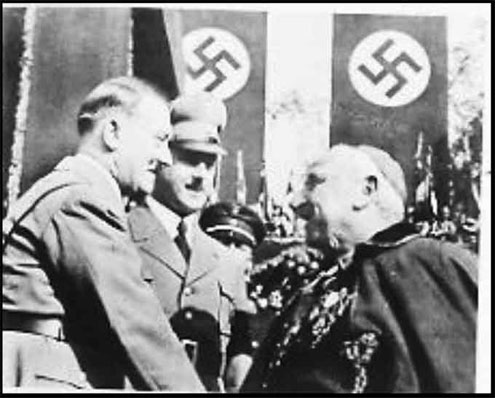
In George Orwell's 1984, it was stated, "Who controls the past controls the future, who controls the present controls the past." Who is going to control the present-fundamentalism or freedom? History is being distorted by many preachers and politicians. They are heard on the airwaves condemning atheists and routinely claim Adolph Hitler was one. Hitler was a Roman Catholic, baptized into that religio-political institution as an infant in Austria. He became a communicant and an altar boy in his youth and was confirmed as a "soldier of Christ" in that church. Its worst doctrines never left him. He was steeped in its liturgy, which contained the words "perfidious jew." This hateful statement was not removed until 1961. "Perfidy" means treachery.
In his day, hatred of Jews was the norm. In great measure it was sponsored by two major religions of Germany, Catholicism, and Lutheranism. He greatly admired Martin Luther, who openly hated the Jews. Luther condemned the Catholic Church for its pretensions and corruption, but he supported the centuries of papal pogroms against the Jews. Luther said, "The Jews deserve to be hanged on gallows, seven times higher than ordinary thieves," and "We ought to take revenge on the Jews and kill them." "Ungodly wretches" he called the Jews in his book Table Talk. Hitler seeking power, wrote in Mein Kampf, "... I am convinced that I am acting as the agent of our Creator. By fighting off the Jews. I am doing the Lord's work." Years later, when in power, he quoted those same words in a Reichstag speech in 1938.
Three years later he informed General Gerhart Engel: "I am now as before a Catholic and will always remain so." He never left the church, and the church never left him. Great literature was banned by his church, but his miserable Mein Kampf never appeared on the index of Forbidden Books. He was not excommunicated or even condemned by his church. Popes, in fact, contracted with Hitler and his fascist friends Franco and Mussolini, giving them veto power over whom the pope could appoint as a bishop in Germany, Spain, and Italy. The three thugs agreed to surtax the Catholics of these countries and send the money to Rome in exchange for making sure the state could control the church. Those who would make Hitler an atheist should turn their eyes to history books before they address their pews and microphones. Acclaimed Hitler biographer John Toland explains his heartlessness as follows: "Still a member in good standing of the Church of Rome despite the detestation of its hierarchy, he carried within him its teaching that the Jews was the killer of god. The extermination, therefore, could be done without a twinge of conscience since he was merely acting as the avenging hand of god. ..."
Hitler's Germany amalgamated state with church. Soldiers of the vermacht wore belt buckles inscribed with the following: "Gott mit uns" (God is with us). His troops were often sprinkled with holy water by the priests. It was a real Christian country whose citizens were indoctrinated by both state and church and blindly followed all authority figures, political and ecclesiastical. Hitler, like some of the today's politicians and preachers, politicized "family values." He liked corporeal punishment in home and school. Jesus prayers became mandatory in all schools under his administration. While abortion was illegal in pre-Hitler Germany, he took it to new depths of enforcement, requiring all doctors to report to the government the circumstances of all miscarriages. He openly despised homosexuality and criminalized it. If past is prologue, we know what to expect if liberty becomes license.
As a young child, I remember my late father, Martin J. Murphy, practicing a speech and loudly quoting the following: "Light up the mountain. Bring out the wild and fiery steed. Let it be known, that I, Gustavus, have insulted the King." Thinking for yourself and speaking your true thoughts - now that's a real family value.
Thursday, January 18, 2007

Wednesday, January 17, 2007
Vegetarianism: the Choice of the 'More Intelligent' Child
by Jeremy Laurance for the Inter Press Service
December 15, 2006
It's official - vegetarians really are smarter. But it is not because of what they eat. Bright children are more likely to reject meat and opt to become vegetarians when they grow up, a study has shown. Clever veggies are born not made. The finding helps explain how a team of vegetarians won the BBC Test the Nation competition in September, when they beat off competition from six other teams including butchers, public school pupils and footballers' wives to achieve the highest overall IQ score. The top scoring individual in the contest, Marie Bidmead, 68, a mother of five from Churcham, Gloucester, was also a vegetarian. "I think it shows we veggies are good thinkers. We think about what we eat for a start," she said.
Researchers from the University of Southampton who conducted the study agree. They suggest that vegetarians are more thoughtful about what they eat. But they say it is unclear whether bright children choose to become vegetarians for the health benefits or for other reasons, such as a concern for animals, or as a lifestyle choice. The scientists began investigating the link between IQ and vegetarianism because people with higher intelligence have a lower risk of heart disease, which has long puzzled doctors. A vegetarian diet is associated with a lower cholesterol level, lower blood pressure and less obesity - all risk factors for heart disease. The researchers wondered if this could explain the health advantage of having a high IQ. They cite Benjamin Franklin, the 18th-century statesman and scientist, who said that a vegetarian diet results in a "greater clearness of head and quicker comprehension". He may not have realised that this was because of whom was eating rather than what was eaten.
However, early last century doctors were less enamoured of the practice. Robert Hutchison told the British Medical Association in 1930: "Vegetarianism is harmless enough though it is apt to fill a man with wind and self-righteousness." The study, published in the British Medical Journal, was based on more than 8,000 people born in 1970 whose IQ was measured at age 10. Now aged 36, the researchers found 366, just under one in 20, said they were vegetarians (a third of these ate chicken or fish but none touched red meat). As well as being brighter, the vegetarians were better educated and of higher social class but the link with intelligence remained statistically significant even after adjusting for these factors. Despite their intelligence they were not wealthier and more likely to be working for charities or in education. "It may be that ethical considerations determined not just their diet but also their choice of employment," the report said.
It concludes: "Our finding that children with greater intelligence are more likely to report being vegetarian as adults, coupled with the evidence on the potential health benefits of a vegetarian diet, may help to explain why higher IQ in childhood or adolescence is linked with a reduced risk of coronary heart disease in adult life."
[Well, I was always told that I was bright as a child or “Too smart for my own good” – which is just another way of saying it really. I guess that being a veggie for…. Oh 8-9 years now is proof then…?]
by Jeremy Laurance for the Inter Press Service
December 15, 2006
It's official - vegetarians really are smarter. But it is not because of what they eat. Bright children are more likely to reject meat and opt to become vegetarians when they grow up, a study has shown. Clever veggies are born not made. The finding helps explain how a team of vegetarians won the BBC Test the Nation competition in September, when they beat off competition from six other teams including butchers, public school pupils and footballers' wives to achieve the highest overall IQ score. The top scoring individual in the contest, Marie Bidmead, 68, a mother of five from Churcham, Gloucester, was also a vegetarian. "I think it shows we veggies are good thinkers. We think about what we eat for a start," she said.
Researchers from the University of Southampton who conducted the study agree. They suggest that vegetarians are more thoughtful about what they eat. But they say it is unclear whether bright children choose to become vegetarians for the health benefits or for other reasons, such as a concern for animals, or as a lifestyle choice. The scientists began investigating the link between IQ and vegetarianism because people with higher intelligence have a lower risk of heart disease, which has long puzzled doctors. A vegetarian diet is associated with a lower cholesterol level, lower blood pressure and less obesity - all risk factors for heart disease. The researchers wondered if this could explain the health advantage of having a high IQ. They cite Benjamin Franklin, the 18th-century statesman and scientist, who said that a vegetarian diet results in a "greater clearness of head and quicker comprehension". He may not have realised that this was because of whom was eating rather than what was eaten.
However, early last century doctors were less enamoured of the practice. Robert Hutchison told the British Medical Association in 1930: "Vegetarianism is harmless enough though it is apt to fill a man with wind and self-righteousness." The study, published in the British Medical Journal, was based on more than 8,000 people born in 1970 whose IQ was measured at age 10. Now aged 36, the researchers found 366, just under one in 20, said they were vegetarians (a third of these ate chicken or fish but none touched red meat). As well as being brighter, the vegetarians were better educated and of higher social class but the link with intelligence remained statistically significant even after adjusting for these factors. Despite their intelligence they were not wealthier and more likely to be working for charities or in education. "It may be that ethical considerations determined not just their diet but also their choice of employment," the report said.
It concludes: "Our finding that children with greater intelligence are more likely to report being vegetarian as adults, coupled with the evidence on the potential health benefits of a vegetarian diet, may help to explain why higher IQ in childhood or adolescence is linked with a reduced risk of coronary heart disease in adult life."
[Well, I was always told that I was bright as a child or “Too smart for my own good” – which is just another way of saying it really. I guess that being a veggie for…. Oh 8-9 years now is proof then…?]
Monday, January 15, 2007
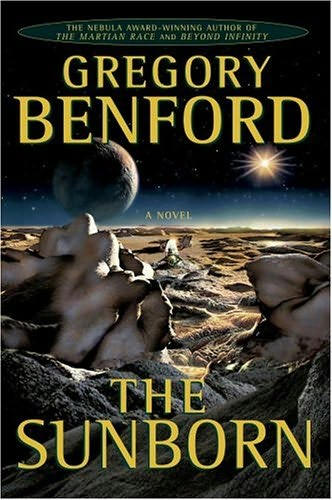 Just Finished Reading: The Sunborn by Gregory Benford.
Eighteen years after the events in the previous book - The Martian Race - scientists based on Mars are still puzzling over the complex lifeform known as the Marsmat. Meanwhile an expedition is sent to investigate strange events on and around Pluto. Deep space scans reveal that the planet is inexplicably warming and its moon Charon is slowing down in its orbit. Nothing has prepared the survey crew for what they find: Life. But more surprises are in store as the source of both the heating and the amazing life forms becomes clear.
This was a very creditable sequel. Written by a physics professor it drips with hard science (and even a few diagrams) which gave it a feeling of realism I found most enjoyable. Together with good characterisation and a seemingly never ending reservoir of mind expanding ideas this is a delight for any fan of hard science-fiction. It’s nice to see that even after 30 years of reading the genre it can still make me go ‘Wow’. Highly recommended.
Sunday, January 14, 2007
I’ve been Tagged………
Sadie Lou (over at Sadico Junction) tagged me recently about the Christmas presents I gave out and received this year.
For the second year in a row I guess that I’ve been pretty boring and lazy (or just clever maybe) by buying my friends presents from their Amazon Wish Lists. It certainly takes a LOT of the stress out of buying during the Holiday Season. This year I bought mostly DVD’s for people with the rather strange exception – at least I thought it was strange anyway – of a pair of bathroom scales. Well, it was what she wanted….
As to gifts received – as I said on Sadie’s Blog “What do you get for a kitten who already has everything?” I have the idea that I’m difficult to buy for (hence I have an Amazon Wish List too for people to use) because of part of my life’s philosophy: See it, Want it, Buy it. I’m also a bookaholic – so the chances are that if you think I would like a particular book the probability is high that I’ve already got it. Aginoth and Juggling Mother found this out this year. Their choice of present was very good. They thought, rightly I admit, that I would enjoy reading The God Delusion by Richard Dawkins. It is, after all, a book that’s right up my street. Unfortunately my life philosophy had already kicked in and as soon as I heard of its existence I pre-ordered it on Amazon (you’re seeing a pattern here no doubt) and had it delivered the day it was published.
So, what did I actually receive this year? Books, of course! Six Impossible things before breakfast, YOU back the attack! We’ll bomb who we want, The Devil’s Doctor, Misquoting Jesus, The Children of Men, The Prestige and A Kiss of Shadows. No doubt I shall be reviewing these at some future date.
I wonder what I’ll get for my birthday? Books maybe?
Sadie Lou (over at Sadico Junction) tagged me recently about the Christmas presents I gave out and received this year.
For the second year in a row I guess that I’ve been pretty boring and lazy (or just clever maybe) by buying my friends presents from their Amazon Wish Lists. It certainly takes a LOT of the stress out of buying during the Holiday Season. This year I bought mostly DVD’s for people with the rather strange exception – at least I thought it was strange anyway – of a pair of bathroom scales. Well, it was what she wanted….
As to gifts received – as I said on Sadie’s Blog “What do you get for a kitten who already has everything?” I have the idea that I’m difficult to buy for (hence I have an Amazon Wish List too for people to use) because of part of my life’s philosophy: See it, Want it, Buy it. I’m also a bookaholic – so the chances are that if you think I would like a particular book the probability is high that I’ve already got it. Aginoth and Juggling Mother found this out this year. Their choice of present was very good. They thought, rightly I admit, that I would enjoy reading The God Delusion by Richard Dawkins. It is, after all, a book that’s right up my street. Unfortunately my life philosophy had already kicked in and as soon as I heard of its existence I pre-ordered it on Amazon (you’re seeing a pattern here no doubt) and had it delivered the day it was published.
So, what did I actually receive this year? Books, of course! Six Impossible things before breakfast, YOU back the attack! We’ll bomb who we want, The Devil’s Doctor, Misquoting Jesus, The Children of Men, The Prestige and A Kiss of Shadows. No doubt I shall be reviewing these at some future date.
I wonder what I’ll get for my birthday? Books maybe?
Saturday, January 13, 2007
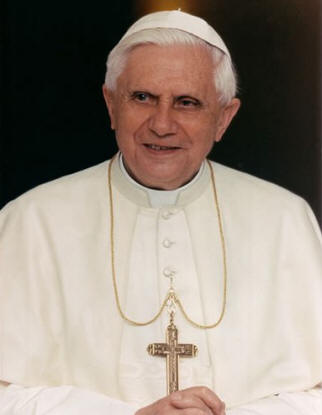 Pope Benedict's Hierarchy of Truth, Faith
by James Carroll for the Boston Globe
September 25, 2006
Rome has spoken. Once, that meant the question was settled. Now that means the question has been inflamed. In this case, the question is whether to accept Osama bin Laden's invitation to the clash of civilizations. Sure, why not?
Pope Benedict XVI celebrated the fifth anniversary of 9/11 by citing, on the next day, a 14th-century slur that Mohammed brought ``things only evil and inhuman, such as his command to spread by the sword the faith he preached." The patently false characterization of Mohammed's teaching, displaying an ignorance of the Koran, of the magnificence of Islamic devotion, and of history was offered almost as an aside in the pope's otherwise esoteric lecture about reason and faith. After Muslim uproar, the pope, while not really apologizing, insisted he had meant no harm.
President Bush famously used the word ``crusade," then backed away from it. But playing by bin Laden's script, Bush launched a catastrophic war that has become a crusade in all but name. Now Benedict has supplied a religious underpinning for that crusade. Claiming to defend rationality and non-violence in religion, the pope has made irrationality and violence more likely, not less. Bush and Benedict are in sync, and bin Laden is grinning. Even abstracting from the offending citation, the pope's lecture reveals a deeper and insulting problem. Benedict properly affirms the rationality of faith, and the corollary that faith should be spread by reasoned argument and not by violent coercion. But he does so as a way of positing Christian superiority to other faiths.
That was the point of the passing comparison with Islam -- which, supposedly, is irrational and therefore intrinsically violent, unlike Christianity which is rational and intrinsically eschews coercion. But this ignores history: Christianity, beginning with Constantine and continuing through the Crusades up until the Enlightenment, routinely ``spread by the sword the faith" it preached; Islam sponsored rare religious amity among Jews, Christians, and Muslims in the very period from which the insulting quote comes.
More significant, though, for any discussion of reason and faith is the fact that Christian theology's breakthrough embrace of the rational method, typified by St. Thomas Aquinas's appropriation of Aristotle, and summarized by Benedict as ``this inner rapprochement between Biblical faith and Greek philosophical inquiry," was made possible by such Islamic scholars as Averroes, whose translations of Aristotle rescued that precious tradition for the Latin West. Benedict makes no mention of this Islamic provenance of European and Christian culture. Indeed, he cannot, because his main purpose in this lecture is to emphasize the exclusively Christian character of that culture. The ``convergence" of Greek philosophy and Biblical faith, ``with the subsequent addition of the Roman heritage, created Europe and remains the foundation of what can be rightly called Europe." Europe remains Christian. That is why the pope, as Cardinal Ratzinger, opposed the admission of Muslim Turkey to the European Union.
Benedict seems to have forgotten that the European rejection of violent coercion in religion came about not through religion but through the secular impulses of the Enlightenment. The separation of church and state, in defense of the primacy of individual conscience, was the sine qua non of that rejection of religious coercion -- an idea that the Catholic Church fought into the 20th century. Even now, Benedict campaigns against basic tenets of Enlightenment politics, condemning pluralism, for example, and what he calls the ``dictatorship of relativism."
The pope's refusal to reckon with historical facts that contradict Catholic moral primacy has been particularly disturbing in relation to the church's past with Jews. Last year, he said Nazi anti-Semitism was ``born of neo-paganism," as if Christian anti-Judaism was not central. This year, at Auschwitz, he blamed the Holocaust on a ``ring of criminals," exonerating the German nation. By exterminating Jews, the Nazis were ``ultimately" attacking the church. He decried God's silence, not his predecessor's. A pattern begins to show itself. Forget church offenses against Jews. Denigrate Islam. Caricature modernity and dismiss it. In all of this, Benedict is defending a hierarchy of truth. Faith is superior to reason. Christian faith is superior to other faiths (especially Islam). Roman Catholicism is superior to other Christian faiths. And the pope is supreme among Catholics. He does not mean to insult when he defends this schema, yet seems ignorant of how inevitably insulting it is. Nor does the pope understand that, today, such narcissism of power comes attached to a fuse.
Subscribe to:
Posts (Atom)