Poll Finds Waning Faith in Military Interventions
by Jim Lobe for the Inter Press Service
September 7, 2006
WASHINGTON - Five years after "9/11", the U.S. public is considerably less enthusiastic about projecting military power abroad, according to a major new survey, the first of a spate of polls that are likely to released in the run-up to Monday's fifth anniversary of the attacks on New York and the Pentagon. The survey, conducted by the Pew Research Centre for the People and the Press here, found that Republicans remained substantially more supportive of military deployments overseas than both Democrats and independents who also believe -- by a three to one margin -- that the U.S. has lost respect in the world over the last few years.
The survey of more than 1,500 randomly selected adults also found that nearly half (46 percent) of the respondents consider U.S. support for Israel a "major reason" for the rise in anti-U.S. sentiment around the world, a significant increase since Pew last posed the question 10 months ago. Significantly, that view was held by similar percentages of self-described Republicans and Democrats who, on most other foreign policy questions, showed wide partisan differences.
The survey, however, was conducted Aug. 9-13, just before the ceasefire that ended the month-long war between Israel and Hezbollah, when international pressure on Washington to persuade the Jewish State to stop its bombing campaign in Lebanon was at its height. Publication of the Pew survey coincided with the release of a second poll released Wednesday by CNN which found widespread scepticism over claims by the administration of President George W. Bush that the U.S. is making progress in the war on Iraq and that the war is related to the larger "global war on terrorism" launched after 9/11.
Only one in four respondents in that poll, which was conducted Aug. 30 to Sep. 2, thought that Washington and its allies were winning the war, compared to 13 percent who said the insurgents were winning and 62 percent who said that the war was essentially stalemated. Despite repeated and increasingly frequent assertions by Bush that the war in Iraq has become the "central front" in the war on terrorism, a majority of 53 percent said it was "an entirely separate military action." A larger majority of 58 percent said they opposed the war, compared to 39 percent who said they favoured it -- a margin that has not changed substantially over recent months.
The most interesting finding of the latest Pew poll appeared to be the growing public disillusionment with U.S. military intervention. By a 45 percent to 32 percent margin, respondents said they believed that the most effective way to reduce the threat of terrorist attacks on the U.S. is to "decrease" rather than "increase" Washington's military presence abroad. As noted in an accompanying analysis by the Pew Centre, that finding marks a "stark reversal" from the public's position on the first anniversary of the 9/11 attacks. At that time, a plurality of 48 percent of the public said expanding U.S. military deployments overseas was the best way to protect against future attacks, while 29 percent called for reducing such commitments.
Similarly, according to the new survey, 43 percent of respondents today say they believed that "military strikes" against nations that were trying to develop nuclear weapons was a very important way to reduce future terrorism -- a reduction of 15 percent compared to a Pew survey taken in October 2002 when Bush was trying to win Congressional approval for a resolution authorising him to take military action against Iraq. The new survey also suggested a more general desire to reduce U.S. involvement in the Middle East compared to four years ago. Asked to identify what would be a "very important" step in reducing terrorism, attacking nuclear facilities was rated the highest (58 percent) in a group of five options. It was followed by increasing defence spending and decreasing dependence on Mideast oil (53 percent) and "not get(ting) involved in other countries' problems (32 percent).
In the most recent poll, however, attacking nuclear facilities ranked third, far behind decreasing dependence on Mideast oil (67 percent) and increasing defence spending (52 percent), and just two points ahead of the non-involvement option, which rose (41 percent). The increase in what some would describe as "isolationist" sentiment echoed a similar finding in another poll conducted by Pew and the Council on Foreign Relations in November 2005. Forty-two percent of respondents said they believed Washington should "mind its own business internationally and let other countries get along the best they can on their own", compared to only 30 percent who took that position in December 2002. Democrats and independents account for much of these changes. In the summer of 2002, for example, Democrats by an eight-point margin favoured an increased military presence overseas. They now favour by a diminished presence by a nearly three-to-one margin.. Support for a decreased military presence among independents has also dropped sharply, by some 17 percentage points, to a 49 percent plurality.
On the question of why the U.S. has lost support around the world, more than two-thirds of respondents identified a "major reason" as the Iraq war, 58 percent cited "America's wealth and power"; 49 percent, "the U.S.-led war on terror"; and 46 percent, "U..S. support for Israel". Democrats were significantly more likely than Republicans to cite the Iraq war and the war on terrorism, while Republicans were more likely to cite "America's wealth and power." The survey also found a gradual increase in the view that the 9/11 attacks signified the beginning of a major conflict between the West and the Islamic world. In October 2001, for example, only 28 percent of respondents agreed with that view; in August 2002, 35 percent expressed agreement, and, in the most recent poll, 40 percent took that position.
Conversely, the percentage of those who agreed with the proposition that 9/11 represented only a conflict with a "small, radical group" has fallen from 63 percent to 49 percent over the same five-year period. Still, 47 percent of respondents today said that 9/11 attacks were equal in seriousness to the 1941 Japanese attack on Pearl Harbour, Hawaii, that launched the U.S. into World War II, while 35 percent said they were "more serious." Younger respondents, however, were significantly more likely to say they were "more serious" than older respondents.
About Me

- CyberKitten
- I have a burning need to know stuff and I love asking awkward questions.
Monday, November 06, 2006

Sunday, November 05, 2006
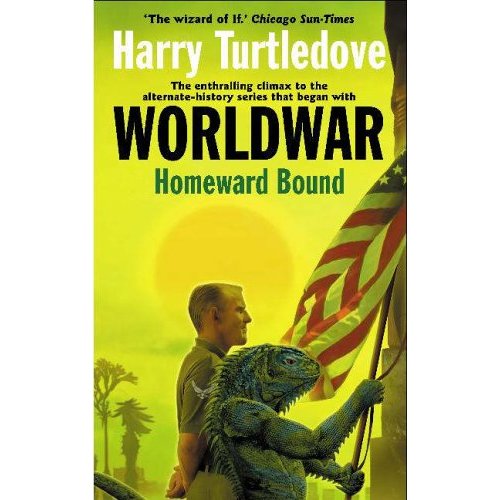 Just Finished Reading: Worldwar – Homeward Bound by Harry Turtledove.
This was the 8th book in the epic series starting with Worldwar – In the Balance which related the tale of an alien invasion of Earth back in 1942. Needless to say this series was Alternate History [grin].
This rather long, and to be honest fairly dull, 600 page volume was the climax of the story. In it the surviving unoccupied human countries are gradually surpassing the alien lizards in technology causing them to think the unthinkable. Is it best for the Empire to destroy the Earth now or risk a delay and allow humans to gain the upper hand? The question becomes all the more urgent when the USA manages to send its first interstellar ship successfully to the lizard Homeworld.
As I’ve probably said before, Harry Turtledove has several annoying habits not least of which is his constant repetition of ‘facts’ we already know from his previous works. This book is no exception to that and although the book does move the story on to a conclusion of sorts it does leave a few things hanging for a possible 9th book. This book was a bit of a struggle, not because it was difficult reading but because very little seemed to happen. We learnt something about Homeworld and a little about the history of the lizards but we already knew most of that. The story wandered & meandered gently on for a good 300 pages before anything substantial happened – and the ‘surprise’ ending was pretty much telegraphed well in advance. I guess the main reason I finished the book was that (apart from paying good money for it) I had read the other seven books in the series so felt obligated to finish the last one. Only recommended for die-hard Turtledove fans.
Saturday, October 28, 2006

Friday, October 27, 2006
 Tiny fossils reveal inner secrets
By Jonathan Fildes for BBC News
Friday, 13 October 2006
The exact moment when a 550 million year old cell began to divide has been captured in an exquisite 3-D image. The picture is one of a series taken by researchers examining ancient fossil embryos from Guizhou Province, China. The specimens, described in the journal Science, are the oldest known examples of fossil embryos, and shed light on the early evolution of complex life. Scientists used an advanced X-ray technique to peer inside the balls of cells to reveal the structures inside. "We have been able to tease apart every structure, geological or biological," said Professor Phil Donoghue of the University of Bristol in the UK and one of the team who worked on the 162 pristine specimens.
The tiny fossils are part of the Doushantuo Formation in South China, a limestone bed deposited between 635 and 551 million years ago that contains layers composed almost entirely of fossil embryos. The team behind the research believe the fossils are the developing offspring of extremely primitive sponge-like creatures.
To resolve the delicate internal structures, the scientists used a technique known as microfocus x-ray computed tomography (microCT). The method allowed the team to construct 3-D images of the tiny fossils. Computer software was then used to analyse individual cells. "We digitally extracted each cell from the embryos and then looked inside the cells," said Shuhai Xiao of Virginia Tech University in the US. Inside, the team found kidney-shaped structures which they believe could be nuclei or other subcellular components. "It is amazing that such delicate biological structures can be preserved in such an ancient deposit," said Professor Xiao. In some four-celled embryos, each cell had two of the kidney-shaped structures, suggesting they were caught in the process of splitting prior to cell division.
Although the bed is packed full of the tiny fossils, the team has been unable to find any adult specimens. Previous research has suggested that the embryos were the product of complex animals, the ancestors of modern organisms. If true, this would suggest that complex multi-cellular life got started much earlier than previously thought, prior to the "Cambrian Explosion" 542 million years ago. At this time, fossils record a dramatic change in animal diversity with many of today's modern groups suddenly making an appearance. Some researchers believe that the Cambrian Explosion marked the emergence of modern animal life. Although complex animals had started evolving before 542 million years ago their development accelerated at this point. Others maintain that complex animals lived long before this event and that the period just marks a time of exceptional fossil preservation. The Doushantuo formation is important because it gives a window into the time leading up to the Cambrian and the new analysis goes some way towards resolving the dispute.
Using the microCT technique to analyse late stage embryos, with up to 1,000 cells, the team was able to gain insights into the creature that produced them. Although the cells show some modern traits they crucially lack others. "Even in these late-stage embryos there is no evidence of the formation of a tissue layer," said Dr Donoghue. "You would expect to see that in modern embryos, even those of sponges." The team believes the cells probably came from extremely simple creatures. "They would have developed into sponge-like creatures, but more primitive," said Dr. Donoghue. If right, this means that the Cambrian Explosion theory for the origin of complex animal life would still stand "This work provides a constraint on when advanced groups evolved," Dr Donoghue said.
Thursday, October 26, 2006
Wednesday, October 25, 2006
From the Web.
A woman has a close male friend. This means that he is probably interested in her, which is why he hangs around so much. She sees him strictly as a friend. This always starts out with, you're a great guy, but I don't like you in that way. This is roughly the equivalent for the guy of going to a job interview and the company saying, You have a great resume, you have all the qualifications we are looking for, but we're not going to hire you. We will, however, use your resume as the basis for comparison for all other applicants. But, we're going to hire somebody who is far less qualified and is probably an alcoholic. And if he doesn't work out, we'll hire somebody else, but still not you. In fact, we will never hire you. But we will call you from time to time to complain about the person that we hired.
A woman has a close male friend. This means that he is probably interested in her, which is why he hangs around so much. She sees him strictly as a friend. This always starts out with, you're a great guy, but I don't like you in that way. This is roughly the equivalent for the guy of going to a job interview and the company saying, You have a great resume, you have all the qualifications we are looking for, but we're not going to hire you. We will, however, use your resume as the basis for comparison for all other applicants. But, we're going to hire somebody who is far less qualified and is probably an alcoholic. And if he doesn't work out, we'll hire somebody else, but still not you. In fact, we will never hire you. But we will call you from time to time to complain about the person that we hired.
Tuesday, October 24, 2006
Who Are the Real Terrorists?
By Bob Burnett for Huffington Post
August 24, 2006
President Bush's Monday press conference made two things clear: He's not about to withdraw troops from Iraq, and he's locked into a definition of "terrorist" so general that it's meaningless and, therefore, dangerous. It's time to reconsider: Who are the terrorists: Why are we fighting them? How can we defeat them?
Bush began his "war on terror" with a deliberately vague definition of America's new enemy: a "terrorist" was any group the Administration attached that label to. On 9/20/01 the President said, "Our war on terror begins with al Qaeda, but it does not end there. It will not end until every terrorist group of global reach has been found, stopped and defeated."
Bush's "war" initially centered on Al Qaeda. The U.S. and its allies invaded Afghanistan. In the September issue of The Atlantic Monthly James Fallows persuasively argues that Al Qaeda has, for the most part, been defeated. He suggests that it's time to declare "victory" in the war on terror, because the U.S. has diminished the effectiveness of Al Qaeda: "Their command structure is gone, their Afghan sanctuary is gone, their financial and communications networks have been hit hard." He notes there has been "a shift from a coherent Al-Qaeda Central to a global proliferation of 'self-starter' terrorist groups." Rather than stay focused on Al Qaeda, and their malignant offspring, Bush expanded the scope of his "war." In the 2002 State-of-the-Union address, he denounced Iraq and Syria as state "sponsors" of terrorism. Implied there could be terrorist states.
Subsequently, the Administration convinced Congress and much of the American public that his war on terror necessitated an invasion of Iraq. Bush conflated Al-Qaeda-trained Iraq-based terrorists, such as Abu Musab al-Zarqawi, members of Iraq's Baath party, any Iraqi who resisted the occupation, "insurgents", and, ultimately, Sunni Muslims. Bush confused those who fight the U.S. because we are occupying their country -- "resistance" fighters -- with those who are operatives of Al Qaeda and have pledged to destroy America. In his press conference, Bush referred to them all as "terrorists who are trying to stop the advance of democracy." Anyone who opposes the occupation is a "terrorist." Fallows' Atlantic Monthly article argues that the war in Iraq has greatly hampered Bush's war on terror: "The war in Iraq advanced the jihadist cause because it generates a steady supply of Islamic victims, or martyrs; because it seems to prove Osama bin Laden's contention that America lusts to occupy Islam's sacred sites, abuse Muslim people, and steal Muslim resources; and because it raises the tantalizing possibility that humble Muslim insurgents, with cheap, primitive weapons, can once more hobble and ultimately destroy a superpower..." Nonetheless, Bush stubbornly defends the occupation: "We leave before the mission is done, the terrorists will follow us here."
In his 2002 speech, Bush defined "Hamas, Hezbollah, Islamic Jihad, Jaish-i-Mohammed" as terrorist organizations. Of these, only "Jaish-i-Mohammed" has direct links to Al Qaeda. "Islamic Jihad" is an umbrella term used by groups in Egypt, Iran, and Syria among others. Hamas and Hezbollah are resistance groups in Palestine and Lebanon, respectively. Whether they deserve the label "terrorist" is debatable. In 1988, the U.S. deemed Hezbollah a terrorist organization. Nonetheless, the group has little in common with Al Qaeda. Professor Stephen Zunes argues that Hezbollah is a Lebanese Shiite socio-political organization. Where Al Qaeda is Sunni and stateless, Hezbollah is part of Lebanese society -- holding fourteen seats in Lebanon's National Assembly. Where Al Qaeda has repeatedly threatened the United States, Hezbollah has not. Where Al Qaeda has a long history of terrorist attacks, Hezbollah does not -- Zunes notes that the U.S. accuses Hezbollah of two bombings of Jewish targets in Argentina, attacks most independent experts do not attribute to Hezbollah. Nonetheless, in his news conference Bush referred to Hezbollah as "terrorists” and blamed them for the recent war in Lebanon.
Bush's muddled definition of "terrorist" has had four chilling consequences: It's shifted attention away the eradication of Al Qaeda. It's largely ignored the threat posed by a secondary wave of 'self-starter' terrorist groups; those spawned by the ideology of Al Qaeda. Bush's sloppy thinking produced the debacle in Iraq and led to a mindset where the Administration labels any Middle Eastern "resistance fighter" as a terrorist. Finally, the White House's sweeping, ideological driven definition of terrorist led the Administration to condemn Hamas and Hezbollah, lump them with Al Qaeda; an action that contributed to Israel's decision to invade Palestine and South Lebanon. American foreign policy needs a fresh start. Rather than continue the Bush approach -- define a terrorist group as anyone we don't like -- it makes more sense to be pragmatic. Let's begin with a more focused definition: A "terrorist" organization is Al Qaeda, or any group that adopts Al Qaeda' objectives and advocates attacks on the U.S. mainland or U.S. citizens. The first step towards real security is for America to be clear about who our enemies are.
By Bob Burnett for Huffington Post
August 24, 2006
President Bush's Monday press conference made two things clear: He's not about to withdraw troops from Iraq, and he's locked into a definition of "terrorist" so general that it's meaningless and, therefore, dangerous. It's time to reconsider: Who are the terrorists: Why are we fighting them? How can we defeat them?
Bush began his "war on terror" with a deliberately vague definition of America's new enemy: a "terrorist" was any group the Administration attached that label to. On 9/20/01 the President said, "Our war on terror begins with al Qaeda, but it does not end there. It will not end until every terrorist group of global reach has been found, stopped and defeated."
Bush's "war" initially centered on Al Qaeda. The U.S. and its allies invaded Afghanistan. In the September issue of The Atlantic Monthly James Fallows persuasively argues that Al Qaeda has, for the most part, been defeated. He suggests that it's time to declare "victory" in the war on terror, because the U.S. has diminished the effectiveness of Al Qaeda: "Their command structure is gone, their Afghan sanctuary is gone, their financial and communications networks have been hit hard." He notes there has been "a shift from a coherent Al-Qaeda Central to a global proliferation of 'self-starter' terrorist groups." Rather than stay focused on Al Qaeda, and their malignant offspring, Bush expanded the scope of his "war." In the 2002 State-of-the-Union address, he denounced Iraq and Syria as state "sponsors" of terrorism. Implied there could be terrorist states.
Subsequently, the Administration convinced Congress and much of the American public that his war on terror necessitated an invasion of Iraq. Bush conflated Al-Qaeda-trained Iraq-based terrorists, such as Abu Musab al-Zarqawi, members of Iraq's Baath party, any Iraqi who resisted the occupation, "insurgents", and, ultimately, Sunni Muslims. Bush confused those who fight the U.S. because we are occupying their country -- "resistance" fighters -- with those who are operatives of Al Qaeda and have pledged to destroy America. In his press conference, Bush referred to them all as "terrorists who are trying to stop the advance of democracy." Anyone who opposes the occupation is a "terrorist." Fallows' Atlantic Monthly article argues that the war in Iraq has greatly hampered Bush's war on terror: "The war in Iraq advanced the jihadist cause because it generates a steady supply of Islamic victims, or martyrs; because it seems to prove Osama bin Laden's contention that America lusts to occupy Islam's sacred sites, abuse Muslim people, and steal Muslim resources; and because it raises the tantalizing possibility that humble Muslim insurgents, with cheap, primitive weapons, can once more hobble and ultimately destroy a superpower..." Nonetheless, Bush stubbornly defends the occupation: "We leave before the mission is done, the terrorists will follow us here."
In his 2002 speech, Bush defined "Hamas, Hezbollah, Islamic Jihad, Jaish-i-Mohammed" as terrorist organizations. Of these, only "Jaish-i-Mohammed" has direct links to Al Qaeda. "Islamic Jihad" is an umbrella term used by groups in Egypt, Iran, and Syria among others. Hamas and Hezbollah are resistance groups in Palestine and Lebanon, respectively. Whether they deserve the label "terrorist" is debatable. In 1988, the U.S. deemed Hezbollah a terrorist organization. Nonetheless, the group has little in common with Al Qaeda. Professor Stephen Zunes argues that Hezbollah is a Lebanese Shiite socio-political organization. Where Al Qaeda is Sunni and stateless, Hezbollah is part of Lebanese society -- holding fourteen seats in Lebanon's National Assembly. Where Al Qaeda has repeatedly threatened the United States, Hezbollah has not. Where Al Qaeda has a long history of terrorist attacks, Hezbollah does not -- Zunes notes that the U.S. accuses Hezbollah of two bombings of Jewish targets in Argentina, attacks most independent experts do not attribute to Hezbollah. Nonetheless, in his news conference Bush referred to Hezbollah as "terrorists” and blamed them for the recent war in Lebanon.
Bush's muddled definition of "terrorist" has had four chilling consequences: It's shifted attention away the eradication of Al Qaeda. It's largely ignored the threat posed by a secondary wave of 'self-starter' terrorist groups; those spawned by the ideology of Al Qaeda. Bush's sloppy thinking produced the debacle in Iraq and led to a mindset where the Administration labels any Middle Eastern "resistance fighter" as a terrorist. Finally, the White House's sweeping, ideological driven definition of terrorist led the Administration to condemn Hamas and Hezbollah, lump them with Al Qaeda; an action that contributed to Israel's decision to invade Palestine and South Lebanon. American foreign policy needs a fresh start. Rather than continue the Bush approach -- define a terrorist group as anyone we don't like -- it makes more sense to be pragmatic. Let's begin with a more focused definition: A "terrorist" organization is Al Qaeda, or any group that adopts Al Qaeda' objectives and advocates attacks on the U.S. mainland or U.S. citizens. The first step towards real security is for America to be clear about who our enemies are.
Monday, October 23, 2006
 Police play down spy planes idea
From The BBC.
15 October 2006
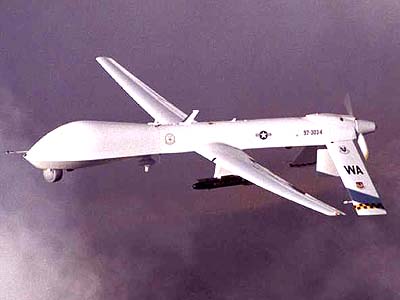
Police have played down reports that spy planes could be flown high above the streets of Merseyside as a way to fight anti-social behaviour. Merseyside Police's new anti-social behaviour (ASB) task force is exploring a number of technology-driven ideas. But while the use of surveillance drones is among them, they would be a "long way off", police said. The squad's aim is to use any criminal of civil law available to help curb anti-social behaviour. A spokesperson for Merseyside Police said: "The idea of the drone is a long way off, but it is about exploring all technological possibilities to support our war on crime and anti-social behaviour.
"What we have got here and now is a new task force using all legislation available to it, to stop the misery of anti-social behaviour, which is something that affects communities up and down the country." The force said its ASB taskforce, launched last week, was the first of its kind in the UK. The 137-strong squad features officers from all policing disciplines together with fire officers and lawyers. Powers include seizing uninsured cars, evicting criminal families and issuing Asbos (Anti-social behaviour orders). It plans to utilise the latest law enforcement technology, including automatic number plate recognition (ANPR), CCTV "head-cams" and metal-detecting gloves.
There will also be low-level surveillance and other methods of intelligence-gathering. Senior officers have described the new initiative as an "Al Capone" approach to so-called yob behaviour. Chris Case, group manager of Merseyside Fire Service, said drones were just one of the ideas being considered. "It is just one thing we are looking at. It has been used to great effect in the US," he said. "This 'Al Capone' approach is driving it. We will have many, many legal means to tackle this problem. We have a host of powers. It is a new alternative approach, where nothing is being ruled out. Anti-social behaviour is a problem all over the UK. I wouldn't say Merseyside is any better or worse than any other urban area."
[So now that police spy planes have been officially denied I guess its time to watch the skies and be afraid… very afraid.]
Police play down spy planes idea
From The BBC.
15 October 2006
Police have played down reports that spy planes could be flown high above the streets of Merseyside as a way to fight anti-social behaviour. Merseyside Police's new anti-social behaviour (ASB) task force is exploring a number of technology-driven ideas. But while the use of surveillance drones is among them, they would be a "long way off", police said. The squad's aim is to use any criminal of civil law available to help curb anti-social behaviour. A spokesperson for Merseyside Police said: "The idea of the drone is a long way off, but it is about exploring all technological possibilities to support our war on crime and anti-social behaviour.
"What we have got here and now is a new task force using all legislation available to it, to stop the misery of anti-social behaviour, which is something that affects communities up and down the country." The force said its ASB taskforce, launched last week, was the first of its kind in the UK. The 137-strong squad features officers from all policing disciplines together with fire officers and lawyers. Powers include seizing uninsured cars, evicting criminal families and issuing Asbos (Anti-social behaviour orders). It plans to utilise the latest law enforcement technology, including automatic number plate recognition (ANPR), CCTV "head-cams" and metal-detecting gloves.
There will also be low-level surveillance and other methods of intelligence-gathering. Senior officers have described the new initiative as an "Al Capone" approach to so-called yob behaviour. Chris Case, group manager of Merseyside Fire Service, said drones were just one of the ideas being considered. "It is just one thing we are looking at. It has been used to great effect in the US," he said. "This 'Al Capone' approach is driving it. We will have many, many legal means to tackle this problem. We have a host of powers. It is a new alternative approach, where nothing is being ruled out. Anti-social behaviour is a problem all over the UK. I wouldn't say Merseyside is any better or worse than any other urban area."
[So now that police spy planes have been officially denied I guess its time to watch the skies and be afraid… very afraid.]
Sunday, October 22, 2006
 Just Finished Reading: The Rise and Fall of the Third Chimpanzee (How our Animal heritage affects the way we live) by Jared Diamond
Though a little ‘old’ for a science book (even a pop science one) with a publication date of 1991 this was still both an interesting and informative introduction to Anthropology. Jared Diamond has a very easy writing style which enables him to get across the kind of information he needs to make his points.
We humans are the Third Chimpanzee of the books title and Diamond goes to great pains to show that we are, in many respects, just another animal, just another ape. But, as he rightly points out, we have many arguably unique features which separate us from the rest of the animal kingdom. Things like language, art, agriculture and genocide. Diamond certainly doesn’t shy aware from the less savoury aspects of being human, indeed he devotes the final part of his book discussing and trying to understand just why we are such a destructive species. I most certainly agree with him that we are largely our own worst enemy but also agree that we can, if we so choose, rise above our animal heritage and stop the damage we do to our planet and ourselves on a daily basis.
Anyone who has an interest in human nature and wants to know more about why we are how we are could do a lot worse than starting with this book. Though a bit dated it still provides lots of food for thought and opens avenues to be explored further in more modern texts. The conclusion should be viewed as more sobering than depressing. Knowing our darker side and our less than glowing history as a species well enough is the first step towards doing something about it. I look forward to reading his other works.
Saturday, October 21, 2006
Friday, October 20, 2006
Common Misconceptions About Atheists and Atheism
By David Gleeson for the American Chronicle
August 10, 2006
After watching Morgan Spurlock's "30 Days" episode on FX last night, about an atheist mother who agrees to live with a wealthy Christian family for a month, it became painfully obvious to me that most people have glaring misconceptions about what it means to be an atheist, and about atheism in general. In this article, I'd like to highlight some of the most common errors and offer a level-headed response to these misunderstandings.
Atheism is the belief that no gods exist.
This statement's ubiquity is exceeded only by its utter falseness; not only is it misleading, but it is the complete opposite of the truth. The word 'atheism' comes from the Greek prefix 'a', meaning without, and 'theist', meaning having a belief in a supernatural deity. Atheism, therefore, literally means "without theistic belief". Atheism does not positively assert anything; rather, it is a statement of withheld belief. Atheists, therefore, do not positively assert that gods do not exist. Atheists simply withhold belief in said gods because the evidence is not sufficient to warrant the belief. This is not to say that there isn't sufficient reason to believe that certain gods do not exist. There is. But to categorically deny the existence of all gods would require a leap of faith that is anathema to a true atheist. Atheism requires no such leap.
Atheism requires just as much faith as theism.
This misconception arises because of the misunderstanding of the term 'atheism', as described above. If atheism were indeed a positive assertion that no gods exist, then this
criticism would be valid. After all, it would take just as much faith to claim that no gods exist as it would to claim that one god or many gods exist. But atheism makes no such claim. Atheism, as noted above, is nothing but withheld belief. It does not take faith to have a non-belief. If I don't believe that Elvis is still alive, I am not practicing an anti-Elvis faith. If I withhold belief in Santa Claus, I am not a member of a Santa-less church. When an atheist says, "I don't believe in the Christian God", she is merely saying that the evidence for belief is insufficient. It is the same type of withheld belief that a Christian practices with regard to the beliefs of Muslims, Jews and other non-Christians.
Atheists' lives are meaningless and devoid of hope and purpose.
This is nothing but the believer projecting his own feelings onto the atheist about how his life might be different in the absence of God. It says nothing about the true feelings of atheists. Atheists' lives are not tied up in the remote possibility of an afterlife. My life is meaningful, simply, because it is meaningful to me and to those who love me. My life has purpose every time I strive toward a worthy goal. I do not need the promise of an afterlife to find meaning and purpose in this life. Indeed, my life is more precious and more meaningful simply because I know it is short and fleeting. Because I expect no eternal reward or damnation after death, I treat each day as a gift. Compare this to the thought processes of an Islamic fundamentalist, who is willing to give up his earthly life for the promise of eternal bliss in the arms of 72 sex-starved virgins. Whose life has more hope and meaning and purpose, I wonder?
Atheists have no morals because they reject belief in an eternal moral-giver (i.e. God).
When you think about it, this is a preposterous statement. Ethics and morals, after all, preceded Jesus by thousands of years. Jesus' Sermon on the Mount, while inspiring, was basically just a rehash of the same Golden Rule that had been around for three milliennia. But let's look at the issue a little more critically. If God is the source of all morals, then God, presumably, could change the rules at any time. Since no one is writing new Bibles or talking to God behind burning bushes, how are we to know what's right now, today? What's to stop God from deciding that moral behavior now includes the option of intentionally starving millions of innocent children, and then demonstrating this new morality by inflicting famine on the world's poorest nations? How would we ever know right from wrong under such circumstances? Doesn't this lead to the same sort of moral relativism that theists accuse atheists of practicing? If, on the other hand, moral laws are independent of God, then humans are free to discover those laws on their own. Either way, it seems God is unnecessary with regard to moral behavior. Atheists simply follow the moral agenda that has been refined by the evolution of advanced civilizations over the past few centuries. We've learned how to be nice to each other. It's not that hard, really.
Atheists must have had a bad childhood experience to cause them to give up on
religion and hate God.
Some atheists may have had such experiences, but I can assure you this is not the case in most situations. For me and for most atheists, the journey from belief to non-belief is simply a gradual process of discovery that eventually leads to God/gods becoming unnecessary. I don't need God to explain the origin or evolution of life on Earth; evolution provides a naturalistic and awe-inspiring explanation that's backed by mountains of evidence. I don't need God to comfort me against the fear of death and the unknown; I do not fear death. I don't need God to account for human selfishness or altruism; my understanding of human nature accomplishes that. In short, as my knowledge has increased, the gaps that God may have filled have become progressively smaller, to the point that God is no longer necessary. I am no more angry at "God" than Christians are angry at the gods of Mount Olympus. Christians simply have no investment in the belief in said gods; they lose nothing by rejecting them. The same is true for me and "God".
In summary, then, an atheist rejects belief in God or gods because the evidence does not compel such belief. This does not lead to a lonely and terrifying universe; in fact, it gives life more meaning and more purpose. Atheists aren't angry and resentful; they are thoughtful and caring and respectful of the inherent dignity in all of us. They deserve none of the vitriol that is constantly leveled at them.
Thursday, October 19, 2006

Wednesday, October 18, 2006
 Just Finished Reading: The Occult Tradition – From the Renaissance to the Present Day by David S Katz
Touching briefly on subjects as various as Gothic literature, Spiritualism and Secret Societies David Katz bolts through 500 years of Occult thought in just 200 pages. Needless to say the analysis of the various traditions within the Occult is rather fleeting. Katz does draw out some interesting threads though spending some time on the relationship between science, especially in subjects such as psychology and anthropology, and Occult thinking which are fairly surprising. Also surprising (at least to me) was the inclusion of Mormonism and present day Christian Fundamentalism within the Occult world view. This was a disappointing and in some ways a rather boring book. Katz did a reasonable job drawing the attention of the reader to quite a few of the Occult highlights over the last half millennium but his remit was far too large for such a brief book. At best this was a brief introduction to the Occult tradition sometimes consisting of lists of names, dates and books published. It would have been far better if the author had narrowed his scope a bit and attempted more analysis of why these people believed and acted as they did. That is what disappointed me most about this volume. Not a total waste of time and money but certainly not the best book I’ve read on the subject.
Tuesday, October 17, 2006
It’s all part of The Plan….. Right?
I’ve been thinking lately about Gods Plan and, rather inevitably, I have a few questions about it. But first, for the sake of argument I’m going to assume that God exists and that He does indeed have a Plan – otherwise this is going to be a very short post!
Anyway….. The Plan. The first thing that comes to mind is just what exactly is covered by The Plan? Is everything that happens part of it? Is every falling sparrow part of the overall Plan or are some things outside of the Planning process? For example is the fact that I’m a vegetarian part of the Divine Plan? Or that I’m particularly fond of the colour Blue? Or are such things just too trivial to be part of Gods Plan for us all? If some things are part of the plan and some things are not then how can we tell the difference?
Are we indeed all part of Gods Plan? Are some people more involved with the Plan than others? Are some people not part of the Great Plan at all? If so, then how do we (or they) tell the difference? If you feel that you’re part of Gods Plan does that mean you are? Does that feeling of being involved come from God or from yourself? Are people who don’t believe in God part of Gods Plan? Is it then part of Gods Plan that I’m an Atheist? If so, then a person’s belief (or lack of) is beyond criticism by believers in The Plan and any kind of religious discrimination or violence is against Gods design – unless of course such conflict is part of The Plan. But how would we tell the difference?
As an Atheist am I in opposition to Gods Plan? Is such a thing even possible? Using our God given Free Will can we choose not to be part of The Plan? Would that make any difference? Is it possible to oppose The Plan in such a way that it could be delayed or even derailed? Can an individual or group of people upset Gods planning to that degree? If Gods Plan is inevitable no matter what we do then what has happened to Free Will? Is it just the choice between accepting God or rejecting Him? Is that the limit of our freedom? That’s not exactly what I would call Free Will, never mind the consequences of the ‘choice – exercise you ‘Free’ Will in a way that God doesn’t want you to and you burn in Hell forever. Use your ‘Free’ Will to do exactly as God tells you to and you get to go to Heaven. That’s an interesting interpretation of the words Free and Choice.
Of course we’re not exactly clear just what Gods Plan actually is. After all He moves in ‘Mysterious Ways’ and all that. But whatever The Plan is its going to be worth it, Right? I mean look at all the death and suffering in the world so far. Presumably, as it’s all part of Gods Plan, the deaths of countless millions of (largely) innocent people must be leading to something truly amazing if they are to be justified, Right? I mean if someone came forward to the United Nations with a Plan to create an Earthly utopia that required the painful deaths of 10 million children to achieve it we’d call Him a lunatic or a monster wouldn’t we? So what kind of result is worth all of the wars, disasters and atrocities we’ve witnessed during our recorded history? After all they where all part of Gods Plan, Right?
So many questions. Is it any wonder I’m an Atheist?
I’ve been thinking lately about Gods Plan and, rather inevitably, I have a few questions about it. But first, for the sake of argument I’m going to assume that God exists and that He does indeed have a Plan – otherwise this is going to be a very short post!
Anyway….. The Plan. The first thing that comes to mind is just what exactly is covered by The Plan? Is everything that happens part of it? Is every falling sparrow part of the overall Plan or are some things outside of the Planning process? For example is the fact that I’m a vegetarian part of the Divine Plan? Or that I’m particularly fond of the colour Blue? Or are such things just too trivial to be part of Gods Plan for us all? If some things are part of the plan and some things are not then how can we tell the difference?
Are we indeed all part of Gods Plan? Are some people more involved with the Plan than others? Are some people not part of the Great Plan at all? If so, then how do we (or they) tell the difference? If you feel that you’re part of Gods Plan does that mean you are? Does that feeling of being involved come from God or from yourself? Are people who don’t believe in God part of Gods Plan? Is it then part of Gods Plan that I’m an Atheist? If so, then a person’s belief (or lack of) is beyond criticism by believers in The Plan and any kind of religious discrimination or violence is against Gods design – unless of course such conflict is part of The Plan. But how would we tell the difference?
As an Atheist am I in opposition to Gods Plan? Is such a thing even possible? Using our God given Free Will can we choose not to be part of The Plan? Would that make any difference? Is it possible to oppose The Plan in such a way that it could be delayed or even derailed? Can an individual or group of people upset Gods planning to that degree? If Gods Plan is inevitable no matter what we do then what has happened to Free Will? Is it just the choice between accepting God or rejecting Him? Is that the limit of our freedom? That’s not exactly what I would call Free Will, never mind the consequences of the ‘choice – exercise you ‘Free’ Will in a way that God doesn’t want you to and you burn in Hell forever. Use your ‘Free’ Will to do exactly as God tells you to and you get to go to Heaven. That’s an interesting interpretation of the words Free and Choice.
Of course we’re not exactly clear just what Gods Plan actually is. After all He moves in ‘Mysterious Ways’ and all that. But whatever The Plan is its going to be worth it, Right? I mean look at all the death and suffering in the world so far. Presumably, as it’s all part of Gods Plan, the deaths of countless millions of (largely) innocent people must be leading to something truly amazing if they are to be justified, Right? I mean if someone came forward to the United Nations with a Plan to create an Earthly utopia that required the painful deaths of 10 million children to achieve it we’d call Him a lunatic or a monster wouldn’t we? So what kind of result is worth all of the wars, disasters and atrocities we’ve witnessed during our recorded history? After all they where all part of Gods Plan, Right?
So many questions. Is it any wonder I’m an Atheist?
Monday, October 16, 2006
Air passengers 'could be tagged'
By Rebecca Morelle for BBC News
Electronically tagging passengers at airports could help the fight against terrorism, scientists have said. The prototype technology is to be tested at an airport in Hungary, and could, if successful, become a reality "in two years". The work is being carried out at a new research centre, based at University College London, set up to find technological solutions to crime. Other projects include scanners for explosives and dirty bomb radiation. Dr Paul Brennan, an electrical engineer, is leading the tagging project, known as Optag.
He said: "The basic idea is that airports could be fitted with a network of combined panoramic cameras and RFID (radio frequency ID) tag readers, which would monitor the movements of people around the various terminal buildings." The plan, he said, would be for each passenger to be issued with a tag at check-in. He said: "In our system, the location can be detected to an accuracy of 1m, and video and tag data could be merged to give a powerful surveillance capability."
The tags do not store any data, but emit a signal containing a unique ID which could be cross-referenced with passenger identification information. In the future, added Dr Brennan, this could incorporate biometric data. The project still needs to overcome some hurdles, such as finding a way of ensuring the tags cannot be switched between passengers or removed without notification. The issue of infringement of civil liberties will also be key. But potentially, said Dr Brennan, the tags could aid security by allowing airports to track the movement patterns of passengers deemed to be suspicious and prevent them from entering restricted areas.
It could also aid airports by helping evacuation in case of a fire, rapidly locating children, and finding passengers who are late to arrive at the gate. The "proof of concept" of the system is about to be tested at Debrecen airport in Hungary. If successful, claimed Dr Brennan, it could be available elsewhere within two years. The new centre will also be investigating a range of other airport security tools. Professor Robert Speller has been developing scanners to detect explosives and drugs. The devices could be used at airports or other ports of entry.
The scanners work by firing an x-ray at an item and then detecting how light particles called photons are scattered. Different materials, he said, produce unique patterns of photon scattering, and this can be used to identify whether an explosive or type of drug is present. The scanners, he said, could be incorporated into the machines being used by airports to scan bags. He is also developing a prototype "Compton camera". This portable device, he said, could be used if a suspected dirty bomb had been exploded. It is able to detect if any radiation is present, and if so, its precise location. He said it would help the emergency services identify dangerous areas, and would aid the possible clear-up operation. The UCL Centre for Security and Crime Science, which opens on Friday, works across many different areas in science and is investigating a number of security and crime issues. Professor Gloria Laycock, director of the centre, said: "Security is a major issue in today's society and can take many forms. "We've got rising crime across the developing world, and that has been linked to rising opportunities for crime. The most effective means of tackling this is by tackling those opportunities. Science and technology can help us to do this."
[Here we go again. Security ‘fears’ are being used as an excuse to spy on people going about their own business. Why don’t we just cut through the bullshit and permanently electronically tag or tattoo barcodes on everyone so they can be monitored 24/7 wherever they are? That seems to be the way we’re going so why not just cut to the chase and get it done? I’m sure we’d all feel SO much safer and I’m confident that all kinds of crimes would be eliminated over night. It could be an instant Utopia!]
By Rebecca Morelle for BBC News
Electronically tagging passengers at airports could help the fight against terrorism, scientists have said. The prototype technology is to be tested at an airport in Hungary, and could, if successful, become a reality "in two years". The work is being carried out at a new research centre, based at University College London, set up to find technological solutions to crime. Other projects include scanners for explosives and dirty bomb radiation. Dr Paul Brennan, an electrical engineer, is leading the tagging project, known as Optag.
He said: "The basic idea is that airports could be fitted with a network of combined panoramic cameras and RFID (radio frequency ID) tag readers, which would monitor the movements of people around the various terminal buildings." The plan, he said, would be for each passenger to be issued with a tag at check-in. He said: "In our system, the location can be detected to an accuracy of 1m, and video and tag data could be merged to give a powerful surveillance capability."
The tags do not store any data, but emit a signal containing a unique ID which could be cross-referenced with passenger identification information. In the future, added Dr Brennan, this could incorporate biometric data. The project still needs to overcome some hurdles, such as finding a way of ensuring the tags cannot be switched between passengers or removed without notification. The issue of infringement of civil liberties will also be key. But potentially, said Dr Brennan, the tags could aid security by allowing airports to track the movement patterns of passengers deemed to be suspicious and prevent them from entering restricted areas.
It could also aid airports by helping evacuation in case of a fire, rapidly locating children, and finding passengers who are late to arrive at the gate. The "proof of concept" of the system is about to be tested at Debrecen airport in Hungary. If successful, claimed Dr Brennan, it could be available elsewhere within two years. The new centre will also be investigating a range of other airport security tools. Professor Robert Speller has been developing scanners to detect explosives and drugs. The devices could be used at airports or other ports of entry.
The scanners work by firing an x-ray at an item and then detecting how light particles called photons are scattered. Different materials, he said, produce unique patterns of photon scattering, and this can be used to identify whether an explosive or type of drug is present. The scanners, he said, could be incorporated into the machines being used by airports to scan bags. He is also developing a prototype "Compton camera". This portable device, he said, could be used if a suspected dirty bomb had been exploded. It is able to detect if any radiation is present, and if so, its precise location. He said it would help the emergency services identify dangerous areas, and would aid the possible clear-up operation. The UCL Centre for Security and Crime Science, which opens on Friday, works across many different areas in science and is investigating a number of security and crime issues. Professor Gloria Laycock, director of the centre, said: "Security is a major issue in today's society and can take many forms. "We've got rising crime across the developing world, and that has been linked to rising opportunities for crime. The most effective means of tackling this is by tackling those opportunities. Science and technology can help us to do this."
[Here we go again. Security ‘fears’ are being used as an excuse to spy on people going about their own business. Why don’t we just cut through the bullshit and permanently electronically tag or tattoo barcodes on everyone so they can be monitored 24/7 wherever they are? That seems to be the way we’re going so why not just cut to the chase and get it done? I’m sure we’d all feel SO much safer and I’m confident that all kinds of crimes would be eliminated over night. It could be an instant Utopia!]
Sunday, October 15, 2006
 My Favourite Music: August and Everything After by the Counting Crows
I was introduced to the Counting Crows by a good friend of mine who was going through a very emotional split with his girlfriend. We both fell in love with the sound of the lead singer’s (Adam Duritz) voice and the bands musical style. I like most types of music but I particularly like songs that tell stories – and that’s certainly a strong point of the Crows. Its actually quite difficult to get across what music is like by writing about it, you really have to listen to it. If, however, you do want to try out this band then August (their first album) is a very good place to start. Unfortunately – in a way – we enjoyed it so much that their second album Recovering the Satellites was an initial disappointment which only grew on us slowly. The follow up This Desert Life was, we thought, a return to form. Disappointingly, after seeing them perform on TV both for MTV and VH1 the follow up CDs actually cut a great deal of the between song chat that makes such programs a joy to watch and listen to. I guess I’ll have to buy the DVDs.
Being such fans my friend and I longed to see them live. So far we’ve seen them during the 2000 Glastonbury Festival where they wowed us with a wonderful but far too short set and we saw them again at the Cardiff International Arena for over two hours of fantastic entertainment. If you like mellow, thoughtful, heartfelt and beautiful music then check out the Counting Crows.
Saturday, October 14, 2006
America Struggles With Its Own Evangelical Taliban
by Pierre Tristam for the Daytona Beach News-Journal
August 1, 2006
At this late stage of the Bush rapture, American evangelism is a lot like the Exxon Valdez: Massive, sloshing with oily energy and not a little drunk on its power as it steers through hazards of its own designs. The moment evangelicals began tearing down the church-state wall, the rubble became their shoals. The wreck will be ugly. It will take years to mend because, as one of their own, Minnesota's Rev. Gregory Boyd, recently put it: "Never in history have we had a Christian theocracy where it wasn't bloody and barbaric. That's why our Constitution wisely put in a separation of church and state." Meanwhile, too much damage is being done by policies keyed to the "Battle Hymn of the Republic" not to have lasting consequences abroad and at home.
The wreck's effects abroad are spreading. Remember William Boykin, the Army lieutenant-general who went around Christian congregations after Sept. 11, telling them how he knew that "my" God "was bigger than his" (one of Osama's lieutenants), "that my God was a real God, and his was an idol"? Instead of being relegated to sorting junk mail in a Pentagon basement, Boykin was promoted to undersecretary of defense for intelligence -- including the supervision of prison interrogations. It's "his" God against the jihadis now in Iraq and Afghanistan, and apparently "his" God against the Constitution or the Geneva Conventions.
The evangelical assault on secular values at home is no less dangerous than its Islamic variant. It's a difference of degrees, not substance. The difference is hard to see when evangelicals eagerly thump for blood-letting abroad or stage-manage it like Boykin and his crusading commander-in-chief do. John Hagee is a Texas evangelical and leader of that hybrid known as the Christian Zionist movement. He commands a huge following and the ear of politicians, Bush among them. Earlier this month Hagee led a rally of 3,500 evangelicals at a Washington hotel, where he called Israel's attacks on Lebanon a "miracle of God" and proof that Israel was doing God's work. Hagee was quoted in The Wall Street Journal as saying that for Israel to show restraint would violate "God's foreign policy statement" toward Jews. Bush sent Hagee a message of praise for "spreading the hope of God's love and the universal gift of freedom."
When he's not thumping for Israel, Hagee raises money for Republican causes and beats war drums in line with his clash-of-civilizations thesis. "This is a religious war that Islam cannot -- and must not -- win," he wrote in a recent book. He also sees the United States heading toward a nuclear confrontation with Iran, itself a fulfillment of a joyful promise: "The end of the world as we know it is rapidly approaching," he writes. "Rejoice and be exceedingly glad -- the best is yet to be." In other words, war is a good thing, rapturous and necessary and sealed with a kiss from God, as the world edges toward Armageddon. The Bush presidency is that evangelical view's self-fulfilling prophesy. Militants for Hezbollah, Hamas and the Taliban speak the very same language. Only the roles are reversed.
Gregory Boyd, author of those words in the first paragraph about every Christian theocracy's sorry history, is the sort of evangelical who wants to prevent a complete wreck. His profile appeared in the Sunday New York Times, yang to Hagee's Journal yin three days earlier. Boyd wants evangelicals out of politics, out of cheering for war and turning politics and patriotism into "idolatry." "America wasn't founded as a theocracy. America was founded by people trying to escape theocracies," he tells his Minnesota congregation. Boyd, writes The Times, "lambasted the 'hypocrisy and pettiness' of Christians who focus on 'sexual issues' like homosexuality, abortion or Janet Jackson's breast-revealing performance," as well as the claim the evangelicals alone know the right values. "All good, decent people want good and order and justice," he says. "Just don't slap the label 'Christian' on it."
Boyd and Hagee are the good cop and bad cop of American evangelism as it pulpits its way to 50 million congregants and beyond. The bad cop is winning right now. It's always easier to destroy than build. We should know. Boyd and Hagee have their twins all over the world of Islam, where theocratic thumping is the regressive rule. There, too, the likes of Hagee are winning. But that's not our battle. It's Islam's to resolve, if it can. Our battle is with our own domestic Taliban, if it doesn't sink us on those shoals first.
by Pierre Tristam for the Daytona Beach News-Journal
August 1, 2006
At this late stage of the Bush rapture, American evangelism is a lot like the Exxon Valdez: Massive, sloshing with oily energy and not a little drunk on its power as it steers through hazards of its own designs. The moment evangelicals began tearing down the church-state wall, the rubble became their shoals. The wreck will be ugly. It will take years to mend because, as one of their own, Minnesota's Rev. Gregory Boyd, recently put it: "Never in history have we had a Christian theocracy where it wasn't bloody and barbaric. That's why our Constitution wisely put in a separation of church and state." Meanwhile, too much damage is being done by policies keyed to the "Battle Hymn of the Republic" not to have lasting consequences abroad and at home.
The wreck's effects abroad are spreading. Remember William Boykin, the Army lieutenant-general who went around Christian congregations after Sept. 11, telling them how he knew that "my" God "was bigger than his" (one of Osama's lieutenants), "that my God was a real God, and his was an idol"? Instead of being relegated to sorting junk mail in a Pentagon basement, Boykin was promoted to undersecretary of defense for intelligence -- including the supervision of prison interrogations. It's "his" God against the jihadis now in Iraq and Afghanistan, and apparently "his" God against the Constitution or the Geneva Conventions.
The evangelical assault on secular values at home is no less dangerous than its Islamic variant. It's a difference of degrees, not substance. The difference is hard to see when evangelicals eagerly thump for blood-letting abroad or stage-manage it like Boykin and his crusading commander-in-chief do. John Hagee is a Texas evangelical and leader of that hybrid known as the Christian Zionist movement. He commands a huge following and the ear of politicians, Bush among them. Earlier this month Hagee led a rally of 3,500 evangelicals at a Washington hotel, where he called Israel's attacks on Lebanon a "miracle of God" and proof that Israel was doing God's work. Hagee was quoted in The Wall Street Journal as saying that for Israel to show restraint would violate "God's foreign policy statement" toward Jews. Bush sent Hagee a message of praise for "spreading the hope of God's love and the universal gift of freedom."
When he's not thumping for Israel, Hagee raises money for Republican causes and beats war drums in line with his clash-of-civilizations thesis. "This is a religious war that Islam cannot -- and must not -- win," he wrote in a recent book. He also sees the United States heading toward a nuclear confrontation with Iran, itself a fulfillment of a joyful promise: "The end of the world as we know it is rapidly approaching," he writes. "Rejoice and be exceedingly glad -- the best is yet to be." In other words, war is a good thing, rapturous and necessary and sealed with a kiss from God, as the world edges toward Armageddon. The Bush presidency is that evangelical view's self-fulfilling prophesy. Militants for Hezbollah, Hamas and the Taliban speak the very same language. Only the roles are reversed.
Gregory Boyd, author of those words in the first paragraph about every Christian theocracy's sorry history, is the sort of evangelical who wants to prevent a complete wreck. His profile appeared in the Sunday New York Times, yang to Hagee's Journal yin three days earlier. Boyd wants evangelicals out of politics, out of cheering for war and turning politics and patriotism into "idolatry." "America wasn't founded as a theocracy. America was founded by people trying to escape theocracies," he tells his Minnesota congregation. Boyd, writes The Times, "lambasted the 'hypocrisy and pettiness' of Christians who focus on 'sexual issues' like homosexuality, abortion or Janet Jackson's breast-revealing performance," as well as the claim the evangelicals alone know the right values. "All good, decent people want good and order and justice," he says. "Just don't slap the label 'Christian' on it."
Boyd and Hagee are the good cop and bad cop of American evangelism as it pulpits its way to 50 million congregants and beyond. The bad cop is winning right now. It's always easier to destroy than build. We should know. Boyd and Hagee have their twins all over the world of Islam, where theocratic thumping is the regressive rule. There, too, the likes of Hagee are winning. But that's not our battle. It's Islam's to resolve, if it can. Our battle is with our own domestic Taliban, if it doesn't sink us on those shoals first.
Subscribe to:
Posts (Atom)